Scientific discovery of Spiritual Laws given in Rational
Scientific Revelations
|
|

Series: |
Theistic Psychology:
| ||||||||||||||||||||||||||||||||||||||||||||||||||||||||||||||||||||||||||||
|
↑ Please read this Chart from bottom up (1, 2, 3) ↑ |
|
|
LEVELS OF MEANING OF |
MENTALITY LEVEL INDICATING |
|
3
The Writings of Swedenborg
(1745 AD |
(i) Relationship to God at a particular level. |
|
2
natural-sensuous
New
(50 AD |
(i)
Relationship to God at a personal
level. |
|
1
natural-corporeal
Old
(3000 BC |
(i) Relationship to God at a general level. |
You can see that Divine
Speech in Sacred Scripture has been given to the human race on this earth over
a period of thousands of years in Western culture comprising three periods or
phases of evolution. Prior to this history, Divine Speech was received in
earlier forms of Sacred Scripture whose character is described in the Writings.
These earlier forms of Sacred Scripture formed the consciousness and religions
of the Asiatic people. Subsequently, the East and the West cultures and religions
have developed separately, but at the beginning all cultures on this earth had
religions from the ancient Sacred Scripture given to the first human generations
born on this planet. These historical details are revealed in the Writings.
They are important to know because of the universal law that individual
biography recapitulates cultural history, or that the developmental steps of
our consciousness recapitulate the evolution of mentality in the race (see
Section xx).
In the table above, the first
phase is marked by the Hebrew Old Testament Sacred Scripture which was
written in a style and mentality called "natural-corporeal"
correspondences of Divine Speech. The meaning of Divine Speech in Sacred
Scripture was cast in a mentality that corresponded to the level and style of
thinking of the civilization of the Old Testament in the
The second phase is
marked by the Greek New Testament Sacred Scripture, which is written in a higher
mentality level called "natural-sensuous" correspondences of Divine
Speech. When you contrast the numbered entries in the table which describe that
mentality, you can see that Divine Speech in correspondences at the
natural-sensuous level, comes through and speaks to a more universal level of
the human mind, less sectarian and ethnic. From a general or distant relationship to God, humanity could now develop
a personal and close relationship.
God as a Divine Human has a relationship directly to the individual (phase 2 consciousness),
not just collectively to a nation or religion (phase 1 consciousness).
The third phase is
marked by the Writings Sacred Scripture which are written with the highest
level of natural correspondences called "natural-rational"
correspondences of divine Speech. At this level of thinking Divine Speech
describes the particulars of our
relationship to God in universal scientific ideas, such as we have in theistic
psychology based on the Writings Sacred Scripture.
Theistic psychology is based
on the systematic methodical activity of extracting layers of correspondences
in the Writings Sacred Scripture. This extraction process must follow the
procedures specified in the Writings regarding how to extract higher order correspondences
from all Sacred Scripture. Theistic psychology was made possible when the
Divine Child during the Incarnation Event created the interior-natural organ in
Himself, and consequently in every human being’s mind (see Section xx).
Considered in its literal
meaning, the Old and New Testament Sacred Scripture appears to be historical, ethnic,
and religious, and sometimes even sectarian and sexist. This literal content
has been used in history to wage cruel wars against other religions and ethnic
groups. Even within one religion that is based on the same historical Sacred
Scripture, there are sub-varieties of interpretations that have fueled passions
and aroused discrimination, disagreement, cruelty, and bitterness. All this
negativity and dogmatism associated with religion and Sacred Scripture
disappear totally when we go below the surface literal meaning to the inner
level of correspondences, as is illustrated and demonstrated in the Writings
Sacred Scripture.
It is understandable why
Divine Speech is of such a negative character by the time it comes down to the
lowest common denominator, which is the ethnic mind of a prophet who is a
member of a community somewhere and has a cultural or socialized mentality
reflecting his tribe and times. All portions of Sacred Scripture are
constructed of written sentences in some natural language like Hebrew (Old
Testament), Greek (New Testament), or Latin (the Writings). In each case the
literal-historical content reflects the age and culture. But the inner sense
that is extracted through correspondences has no cultural, historical, and
religious content. Its content is theistic psychology, a universal
scientific revelation of endless proportions, delivered through the modern
scientific mind of Emanuel Swedenborg (1688-1772).
It is very significant to
note that the modern scientific revelations in the Writings could not have been
delivered by Swedenborg in the same way as the revelations contained in the Old
Testament, and the New Testament. None of the authors of the Old and New
Testament books had any idea of the hidden inner correspondences of the
sentences they wrote down. Their thinking mentality was pre-modern. They could
not possibly understand the rational scientific descriptions of the human mind,
its anatomy, and relation to the spiritual world, heaven, and regeneration. For
instance, the people who wrote the New Testament were eyewitnesses to the physical
Incarnation of God as the Divine Human. They were able to relate to Him only at
the natural-sensuous level. They would not have been able to read and
understand the Writings, written 17 centuries later in natural-rational
correspondences of Divine Speech. They had only natural-sensuous concepts by
which to comprehend God and the Divine Human that walked among them.
For instance, they could not understand
why it was that the physical Divine Human had to undergo death and had to
vanish from their sensuous consciousness. They tried to hold Him back, not
being able to understand His explanations that He must return to a state of
spiritual existence in order that He might appear to them in a more eternal
manner. This new more real Presence is the Divine Human in their conscious
rational mind and is called the “Holy Spirit.” The co-Presence of God with us
is in our rational consciousness. The Divine Human, once He was present
physically on earth, could have remained within their sensuous consciousness,
as they urged Him to do. But He refused to do that for their sake and the sake
of all humanity. It took 17 more centuries of evolution before a modern
scientist like Swedenborg could be introduced into the spiritual world while
still on earth, so that he might give an empirical rational account of the
spiritual world and God. Nothing but an empirical and scientific account could
serve for the new modern science of theistic psychology.
From this discussion you can see how it is that the evolution of human consciousness is brought about by God through Divine Speech expressed in levels of correspondences matching the ability of people to understand God's management techniques. Human consciousness is therefore an expression of our relationship to God -- general, personal, and particular.
For more on this topic see Section xx and my other online book Moses, Paul, and Swedenborg: Three Steps in Rational Spirituality available online: www.soc.hawaii.edu/leonj/leonj/leonpsy/instructor/gloss/moses.html
See also AN INTRODUCTION TO THE PRESENCE OF CORRESPONDENCES WITHIN THE WORD by Rev. Dr. Reuben P. Bell available online at: http://highermeaning.org/Authors/RPB/CORRESPO.shtml
A common spiritual law governs all developmental mechanisms at the macro and micro levels of existence. One way to phrase this law is this: Biography recapitulates history and evolution (see Sections xx). In other words, the steps or sequential procedures we can observe at the macro level -- cultural history and biological evolution -- are the same number and the same categorical content as the sequential procedures we can observe in our own mental and spiritual development. Our consciousness level or mentality steps through the same sequence of cumulative change as can be noted for the evolution of civilizations and societies.
The stages of theistic psychology are the levels of our relationship to God. As we study theistic psychology our thinking steps through a sequence of concepts that are arranged in the same universal order as the geography of the spiritual world and the anatomy of the organic mind (see Section xx). The following chart illustrates various features of the three principal stages of theistic psychology.
|
↑ Read Chart from bottom up (1, 2, 3) ↑ |
||||
|
THEISTIC PSYCHOLOGY STAGES |
"MEDIATE" OR CONSCIOUS PRESENCE OF GOD |
CONSCIOUSNESS |
CORRESPONDENCES |
"NEW CHURCH" |
|
3 PHASE OF PARTICULAR |
internal |
Rational THIRD AND SECOND HEAVENS |
celestial-rational |
perception of the internal meaning of Sacred Scripture in oneself as the Divine Human |
|
2 PHASE OF SPECIFIC
|
external of internal co-presence |
Mystical FIRST HEAVEN |
spiritual-natural |
acknowledgement of an internal meaning to Sacred Scripture as the Divine Human |
|
1 PHASE OF GENERAL |
presence is |
Sensuous WORLD OF SPIRITS |
natural-rational |
acknowledgement of the literal meaning of Sacred Scripture as the Divine Human |
|
Note: In Theistic Psychology the phrase "Sacred Scripture" always refers to the threefold collection of revelations known as the Old Testament ("Hebrew Word"), the New Testament ("Greek Word"), and the Writings of Swedenborg ("Latin Word"). Everything being said about "Sacred Scripture" applies equally to each "Word" separately as well as to the three of them together (see Section xx). Nothing can be said about one of them that does not apply equally to the other two because they each are equally the Divine Speech when considered internally in their universal scientific meaning. |
||||
The chart above shows that the initial stage of theistic psychology (1) is equivalent to the general concepts characteristic of the Old Testament sentences. General concepts about God allow us to conceptualize Him as the infinite which is external to the self yet can communicate with every human being. In the Old Testament God communicated with people through a "voice from heaven" or a "burning bush" or through the apparition of an angel. The Divine was known through some natural event that was unusual or abnormal. This natural perspective on God was superseded by that in the New Testament which reveals a "God of Spirit" who communicates to us not by a "living voice" on the outside, but by a living voice on the inside. It is the voice of God in our conscience. It is silent on the outside physical world but thunderous on the inside mental plane.
The historical movement from the outside natural Old Testament God to the inside spiritual New Testament God is a developmental step that elevates human consciousness to a new level (see Section xx). This elevation of human consciousness is brought about by Divine Speech as it is communicated to people through the sentences of Sacred Scripture. The study of theistic psychology goes through this elevation mechanism as our thinking moves from general concepts derived from the Writings (level 1) to specific concepts (level 2).
At the initial stage of studying theistic psychology (1) we read the Writings of Swedenborg as Sacred Scripture and acknowledge God as the Divine Human who is plainly described in the literal sentences of the Writings of Swedenborg. We recognize that this Divine Human is the same God that that has been revealed in the Old and New Testaments under a more general form. The literal sentences of the Writings are written in natural-rational correspondences (see Section xx). This allows us to reconstruct Divine Speech to the level of the world of spirits, which is below the First Heaven (see Section xx). This is called a "general understanding" of Divine Speech and the principles we derive from this level are called "sensuous doctrine" in contrast to the "mystical" doctrine of the New Testament phase (2).
The chart shows that the second stage of understanding theistic psychology (2) is equivalent to the specific concepts of God characteristic of the New Testament sentences. Specific concepts about God allow us to conceptualize Him as the infinite which is co-present to every individual. When we read the Writings of Swedenborg at this second level of depth we are elevating our rationality from natural-rational correspondences (1) to spiritual-natural correspondences (2). Historically and by evolution of consciousness, this elevation was achieved by Divine Speech revelations in the Old Testament being supplemented by Divine Speech revelations in the New Testament. Individual development recapitulates history and evolution. When we study theistic psychology our rational spirituality progressively evolves and is elevated from level 1 to 2 to 3, as shown in the chart above.
The elevation of our consciousness comes about through the mechanism of concepts we appropriate as our own and with which and from which we think and form conclusions about reality. As we read the Writings we elevate our view from the general concepts of the literal sentences (level 1) to the specific concepts that are derived from the literal sentences. The derivation process is not spontaneous or subjective but must follow methodologies prescribed in the Writings as essential and obligatory (see Section xx). In other words, any spontaneous and subjective interpretation is not considered an elevation, whatsoever it is, however plausible, clever, or brilliant it may appear. This absolutist rule is necessary to exclude from theistic psychology concepts and ideas that are from human beings rather than from the Divine Human. In other words, by applying the required methodology for extraction, the new knowledge is a valid representative of Divine Speech. Only valid representatives have the power to elevate the consciousness.
The mystic doctrine at stage 2 is historically achieved with the New Testament sentences. This level of understanding Divine Speech is produced by the spiritual-natural correspondences with which we are thinking when reading the sentences in the Writings. When we do this our level of consciousness is called enlightened because we are thinking in association with the good spirits of the first heaven (see Section xx). They are in the interior of the natural. As you study theistic psychology you learn to read the Writings by transforming its literal meaning into its scientific meaning (see Section xx). You are involved in a mental progression from natural ideas about God (level 1) and spiritual ideas about God (level 2). The literal sentences of the Writings present a natural idea of the Divine Human (level 1). At this literalistic level we picture the Divine Human as outside of ourselves, specifically amidst the Spiritual Sun. This is how in fact the Divine Human can be seen, surrounded by the Sun, as Swedenborg was able to observe for the 27 years that he enjoyed dual consciousness (see Section xx).
The literal of Sacred Scripture, equally for the Hebrew, Greek, and Latin Word, is written in natural correspondences. The Old Testament is written in natural-corporeal correspondences, the New Testament is written in natural-sensuous correspondences, and the the Writings is written in natural-rational correspondences (see Section xx). Note that the letter of Sacred Scripture is always natural, even though its three portions are progressively higher within the natural mind, which is composed of these three organic portions (see Section xx). But the natural mind never touches the spiritual mind and is a discrete degree below it (see Section xx). The two minds communicate with each other only by functional correspondence, the lower mind (natural) reacting under the influence of the higher (spiritual).
Note that the literal meaning or message of all three portions of Sacred Scripture is concretized in natural correspondences. These correspondences are called "natural" because they are immersed in culture and language. All culture and language on earth is structured and ordered within the parameters of time, space, identity, number, quantity, historicity, materialism, and so on. For instance, when we think with natural correspondences about Divine Speech we get the message that Sacred Scripture is about religion and culture. We have different religions because religion exists only within the context of culture and society. With a diversity of cultures and races and mental dispositions, the human race on earth needs a diversity of religions. But religion and culture and the natural world (level 1 meanings) vanish from view when we transform the natural correspondences (level 1 ideas) into spiritual correspondences (level 2 ideas).
Now our consciousness is elevated. We see from a higher perspective what Divine Speech is talking about (level 2 ideas). Spiritual-natural correspondences (level 2 ideas) make the religious and historical elements disappear (level 1 ideas), and we can see God more specifically than before. All our concepts of God now become specific. For example, one often encounters the word "church" in the Writings. At level 1 in its literal sense "church" refers to the societal establishment of the Christian religion in Western history. But you can make this reference disappear when you read the sentence as "church = regenerating mind." If you think of the Divine Message as being about a religious body (level 1) you are forming natural ideas about God and heaven. But we know from the Writings that in all Sacred Scripture reference to the historical church is a representative way of talking about the regenerating mind of every individual. This is what Divine Speech is talking about when it filters down to the first heaven in people's mind (level 2).
Similarly, when the literal sentence says "Christian Church" or "Christians" we can substitute "regenerating mind" since "Church" in the Writings always refers to Christians, unless otherwise described (e.g., "the Ancient Church" or "the Jewish Church"). When we change Christian Church to regenerating mind we also are changing "the Lord" to "the Divine Human." This substitution is often seen in the Writings. Let us now consider a passage where we can make these substitutions. Quoting from the Writings:
A marriage of good and truth in a person is the church in him (CL 76)
That with Christians, the marriage of the Lord and the Church is profaned by polygamous marriages, is because there is a correspondence between that Divine marriage and the marriages of Christians (concerning which, see above, nos. 83-102); and if wife is added to wife, this correspondence is wholly destroyed, and with this destroyed, the consort is no longer a Christian. (CL 339)
The first passage (CL 76) establishes the methodology by which we can substitute "church" for "regenerating mind." Many other passages confirm this. The word "marriage" at level 1 is a natural idea, but in the spiritual idea (level 2) it means "conjunction," as may be confirmed in many passages in the Writings. In the second passage we make the substitution (underlined) as follows:
That with regenerating minds, the conjunction of the Divine Human and the regenerating mind is profaned by polygamous conjunction, is because there is a correspondence between that Divine conjunction and the conjunctions of regenerating minds; if wife is added to wife, this correspondence is wholly destroyed, and with this destroyed, the individual is no longer a regenerating mind. (CL 339)
To be "conjoined to the Divine Human" means that we are giving up thinking and willing from ourselves according to our own ideas and preferences. This is why it is described as "conjunction." When we agree to let the Divine Human form our thinking and willing, God and human beings are conjoined together, as if in a marriage. "Polygamous conjunctions" are pet ideas we keep around during regeneration that do not come from Sacred Scripture. These pet ideas destroy our ability to regenerate. We must give them up so that what is left are ideas exclusively from Sacred Scripture.
You can see that this Divine Message involves specific ideas about ourselves (level 2) rather than general ideas about history of churches (level 1). Consider the continuation of that passage within level 2 meanings and you'll have an explanation of why Sacred Scripture must be the exclusive source for our thinking and willing:
That with Christians, the marriage of good and truth is profaned by polygamous marriages is because marriages on earth are derived from this spiritual marriage, and the marriages of Christians differ from the marriages of other nations in this, that as good loves truth and truth good, and the two are a one, so is it with wife and husband. Wherefore, if a Christian should add wife to wife, he would rend asunder that spiritual marriage in himself, and consequently would profane the origin of his marriage and so would commit spiritual adultery. (CL 339:2)
In other words, the purpose of regeneration is conjunction with God, by which we become immortal angels in heaven. This goal cannot be accomplished when we mix knowledge and principles from Sacred Scripture with knowledge and principles from any other source. The method of regenerating the mind involves uniting our principles with our actions. Our principles must be derived from Sacred Scripture, in which case they are called "truth." Then, we must love these principles by living them, which means, willing them. This means acting in accordance with our principles. Many times we know the principles of truth but we fail to act accordingly. This is because we are still using our own ideas as principles ("polygamous marriages"). To commit "spiritual adultery" means to mix principles we have from Sacred Scripture and principles we have from another source.
God creates and manages all
the details of the dual universe through Divine Speech (historically known to
many as "the Word of God" or "Logos"). Divine Speech issues
or proceeds from the Infinite Rational Mind of the Divine Human. Swedenborg has
described the Spiritual Sun as a brilliant aura around the Divine Human so that
all whose consciousness is in the highest portion of their rational mind, can visually
or sensually see the Divine Human amidst the Spiritual Sun as an aura around Him.
In that state of mind called
our “third heaven,” we know that the visual and sensuous appearance of the
Divine Human outside of themselves at a seeming distance in the sky, is only an
appearance that represents the Omnipresence and the Co-Presence of the Divine
Human within themselves. They know that He is actually co-Present inside their
mind, not sensuously, but rationally in the good and truth that inflows from Him
and activates their will and their understanding. They know that the Spiritual
Sun seen outside of themselves is actually within themselves. They cannot see
the infinite, but the infinite can be within what is their finite and never the
other way round (see Section xx).
The sensuous consciousness
of God is distant, but the rational consciousness of God is close
up. Co-Presence with God is possible only in rational
consciousness of Him. This is why the Divine Human had to depart the physical
plane of reality. To remain would have condemned humanity to a distant
relationship when God was longing for a close relationship. He departed from a
distant sensuous consciousness for the sake of close up rational consciousness.
It is revealed in the
Writings Sacred Scripture that God created the universe in order to bestow
eternal conjugial happiness and wisdom to every human being. It was not
possible for us to be human, rational, and free by being created ready made
angels in the eternity of heaven. That's what God would have done had He wanted
a race of sensuous robots. While such a race could worship and obey God, it
would not be able to love God. But God wants love, not worship and
obedience for its own sake. God Himself is infinite love and truth, and the
nature of love, as revealed in the Writings, is "spiritual
conjunction."
In other words, God's love
is such that it desires to make every human being He creates, happy and
rational to eternity by having them experience His infinite love and truth as
if they are their own.
For instance, when we walk,
we feel like we are walking from our own power to exercise our will to move
towards a goal. And yet, we know from rational revelation that our will has no
power of its own but must be moved by God's Divine Speech which inflows into
our affective organ in the form of love or spiritual heat (see Section xx). It
is God's spiritual heat, or love, inflowing, that moves our legs while walking
toward a particular goal. And yet, if feels like it is our own will that moves
our legs towards the goal we have chosen.
Another example is given by
our ability to study and learn. It feels like we are putting up the effort to
read, analyze, comprehend, memorize, apply. And we are happy with ourselves
when we succeed. But in reality, it is God's moment by moment interventions
that puts one thought next to another, or supplies the reasoning procedure by
which we can make an appropriate conclusion.
These examples show how God wills
that what is actually His, to be as-if ours.
God's inflowing love and
truth, activating our will and intelligence, appear ours, yet are not actually
ours, but appear as-if they are ours (see Section xx). This is the actualizing
form that God's love takes.
Swedenborg was told by the
celestial angels that they actually perceive the inflowing love and truth from
the Divine Human. They also told him that if they should for a moment think
that their powers, intelligence, and wisdom are their own, rather than appear
as-if their own, they would instantly fall out of heaven. The heavenly state of
consciousness attributes every detail of one's thoughts and feelings to the
Divine Human. But it is otherwise for the unenlightened person informed by
sensuous consciousness rather than by rational ideas from Sacred Scripture.
When we are in this materialistic mentality of the sensuous, we attribute some
things to God and some things to ourselves. I have sometimes been told by
people that they hate the idea of this "as-of self" that I was
explaining to them. They react to the idea as something that removes their
motivation or incentive to do or think anything. People want the credit for
their effort and abilities. Of course, this is a practical attitude when we are
interacting with other people in society, but it is an insane idea spiritually
when we are considering our interactions with God who activates all our
activities.
Rational reception of Divine
Speech by each individual is the mechanism that God has created for human
beings so that they can be consciously co-Present with God. Co-presence with
God is called "conjunction" with Him. When we are in a state of
conjunction with God we are consciously aware of His interior presence in our
rational mind. We can talk to Him as if He were present face to face on the
outside, but He does not engage in sensuous or physical dialog by voice or
apparition. He makes His thoughts known to us instantly, so that we think it in
the form and meaning that is at our level of mentality. This is rational
consciousness of God and it affords us conscious co-Presence. In that state of
closeness to Him He is able to give us conjugial bliss in eternity.
It is most important to underscore
the fact that this co-Presence and communication with the Divine Human is not
sensuous but rational.
There are no voices or visions
like the prophets of old experienced in their sensuous consciousness. There is
no interlocutor who takes turns in a dialog, as we do with other people. There
is only rational perception and rational love. In other words, God arranges our
thoughts and feelings in a way that corresponds to His message. We experience His message as our own
thinking, feeling, and rational perception. It is only rationally that we
know that it is God who has rearranged our thoughts and feelings in any
particular situation. In terms of sensuous experience, it appears that it is
our own rearrangement or insight. It is easy to deny that it is God's. God
makes it easy for us to deny that it is He that arranges our thoughts and
feelings.
In the modern age of science,
God would not speak to us in living voice or appear to us visually because this
would paralyze our rational consciousness of Him and thus deny us His
co-Presence, rob us of conjugial bliss in eternity. God appearing at the United
Nations tomorrow and making a Divine Declaration in the world media, would
paralyze our ability to be co-Present with Him in our rational mind, which is
where our eternal heavens are. God created heaven in our rational mind so that
He can be co-Present with us to eternity, and by this conjunction to make us
happy and intelligent to eternity. It is through Divine Speech in Sacred
Scripture that God is present with us in our rational consciousness of Him.
This rational consciousness is built up in our mind by the correspondences of Divine
Speech in Sacred Scripture – and in no other way.
God’s co-Presence varies from
clear to obscure. "Clear" means that we are able to receive more interior
meanings of Divine Speech in higher order correspondences of Sacred Scripture. When
God is clearly co-Present in our
rational consciousness we are able to receive a more perfect happiness and
wisdom, than what we can receive when His co-Presence in our mind is somewhat
"obscure.” Our consciousness or level of mentality reflects the clarity of
His co-Presence within our rational understanding of His Sacred Scripture.
The following chart shows the
levels of descent of Divine Speech from the Rational Mind of the Divine Human
to human minds at various levels of mentality or consciousness and
enlightenment (from clear to obscure). This descent is sequential in successive
order, but it is simultaneous in existential order. The descent of Divine
Speech occurs simultaneously into every human mind but it is perceived
according to one’s clarity or obscurity of His co-Presence. The clarity of His
co-Presence depends on one main thing: The intensity or purity of our love of
His truth and good. This purity is measured by how much we are willing to
cooperate with Him in our endless regeneration process.
Hence it all comes down to
the bottom line of spiritual accounting – how much we are willing to let go of
our own desires and justifications, in exchange for His desires and
justifications, as explained to humanity through Divine Speech in Sacred
Scripture. Our consciousness would be elevated instantaneously to the highest
human potential of near omniscience (“third heaven”) if we were willing right
this moment to let go of one hundred percent of our desires and justifications.
But, assuming we can let go of all of them, would we be as happy as we can be?
When the answer is Yes, we are in that third heaven.
|
LEVELS OF |
SPIRITUAL |
MENTAL |
CORRESPONDENCES OR
CONSCIOUSNESS LEVELS |
CONTENT OR |
|
1 |
Spiritual Sun |
Soul |
Divine
Truth from |
Infinite
things make distinguishably one |
|
2 |
Celestial Heaven |
Affective |
Celestial-rational
|
What
is love, good, hierarchy of affections, intending and willing, regeneration |
|
3 |
Spiritual Heaven |
Cognitive |
Spiritual-rational
|
What
is truth, faith, rationality, theology, science, doctrine, understanding |
|
4 |
Natural Heaven |
Sensorimotor |
Spiritual-natural
|
What
is use, good works, morality, justice, virtue, aesthetics, competition |
|
5 |
World of Spirits |
Conscious |
Natural
|
(c)
Psychology -- Writings |
|
6 |
Hells |
Sensorimotor, Cognitive, and Affective Organs
Corrupted |
Falsified
|
What
is love, good, truth, faith, use, morality, justice, good works, aesthetics,
competition |
There are six levels of
descent indicated. In Itself (level 1) Divine Speech is incomprehensible and
inexpressible because it is infinite and our understanding cannot comprehend the
infinite. In the Rational Mind of the Divine Human infinite things make one
distinguishably. In other words the infinite individual items each remain
unique and mutually distinguished from all others. Divine Speech flows out of
the Divine Human's Mind into the created universe from within by means of correspondences arranged in exteriorizing
discrete degrees and operating in simultaneous order. Divine Speech as an
outflow or emanation from the Spiritual Sun, is the means by which the Divine
Human creates all things and maintains them in a rational and loving order.
The Divine Speech exits or
proceeds from the Spiritual Sun, which is an aura of spiritual heat (love) and
spiritual light (truth) that is continuously proceeding, united as one, into
the created universe. This proceeding is called Divine Influx and as it
descends it makes first contact with humanity through the soul of every created
individual (level 2). The soul is immortal. It is a mental organ constructed
out of the spiritual substances proceeding from the Spiritual Sun. The soul
functions as a receptor or filter. It is capable of receiving or capturing the
Divine Speech. Although the Divine
Speech as received by the soul is no longer infinite, it is still Divine.
In other words, the Divine can limit itself and “dwell” within the boundaries of
finite things created for the reception of the infinite. This self-delimited
Divine is called the Divine Proceeding or "Holy Spirit." It is what
forms, initiates, activates, and operates our consciousness – its rational
syntax and the human affections within it. The human begins in the inmost of
the rational, in the words of the Writings.
The Divine Proceeding which
is in our soul does not become amalgamated or one with the soul because the
infinite cannot become one with the finite. There is no “oneness” with God. There
is an absolute duality between God and human beings, or between that which is
uncreate (like love, life, truth, intelligence, light, heat, endeavor,
propensity) on the one hand, and on the other, that which is created (like
galaxies, atoms, plants, human minds, heaven, and hell). There is no possible
overlap between the uncreate and the created. But the created has the property of being able to contain the uncreate.
For instance, plant cells are capable of receiving life, light, heat, and
propensity, while rock molecules can only receive heat and motion. The form,
structure, and substance of each created object determines what uncreate
substances it is capable of receiving from the Divine Proceeding.
The human mind is created and
is born into the spiritual world and overlaps with it. All human minds
therefore overlap with each other, creating the objective spiritual world (see
Section xx). When we are born, our physical body is temporarily alive on earth
while our mental body ("spirit" or "mind") is permanently
alive in the spiritual world. The shape of the human mind is the shape of the
mental body, and this is the shape of the physical body. Therefore the
spiritual world must be in the shape of the human body and the human mind.
Swedenborg was able to confirm this by direct observation. He was given a
"bird's eye" view of the spiritual world, as if he were taken out of
it to look at it. He saw that it had a shape, and this was the form of the
human body. Nothing was missing. In fact, as he was traveling through the
spiritual world Swedenborg described his location with reference to the human
body. He would say that he was "in the province of the eye" or the
heart, or "in the region beneath the buttocks" (where some of the
worst hells are located). Quoting:
AC
818
There
is a dreadful hell beneath the buttocks, where they seem to stab one another
with knives, aiming the knives at one another's breasts like furies, but in the
act of striking the knife is continually taken away from them. They are those
who have held others in such hatred that they burned to kill them cruelly; and
from this they had derived a nature so direful. This hell was opened to me (but
only a little on account of their direful cruelties), so that I might see the
nature of deadly hatred. (AC 818)
Swedenborg called this shape
of humanity in eternity as "the Grand Man," which is also translated
as "the Grand Human." It has both male and female organs. Swedenborg
says that the Divine Human continuously wills to unify the entire created
immortal human race. This unification is reflected by the visual appearance of
the Grand Human. But this Grand Human contains only the portions of human minds
called heaven, which is why the Grand Human has a perfect human anatomical
shape. But the hells of the human mind are separated out and formed into
another unity which Swedenborg called a malformed or disfigured individual. (D.Love
6).
The 6 levels of the chart
above show the parallel forms of the spiritual world and the mental world, in
the columns marked "spiritual geography" and "mental
anatomy." The spiritual world is a vertically organized operational
sphere for supporting the activity of thoughts and feelings of the human race.
All our thoughts and feelings are operations in the anatomical organs of the
mind. Swedenborg was able to visit three layers of heaven and three equivalent
layers of hell. There is such a structural balance between the heavens and the
hells because hells are created by the corrupted reception of spiritual heat
(love) in the affective organ (“the will”), and spiritual light (truth) in the cognitive
organ (“the understanding.” Everyone receives the same Divine Proceeding into
their unique soul. From there, the Divine Proceeding descends by levels into
the discrete layers of the human mind, thus, of the spiritual world.
When Divine Speech descends
through the soul into our third heaven, it is first received into the highest
portion of the affective organ called celestial, which constitutes the third
heaven of every individual. This mental activation or operation of the affective
organ (or “will”) has a rational content which becomes conscious to us when we
have elevated our consciousness into the third heaven. In that mental state, we
are called "celestial angels." Swedenborg often talked to people who
already live in the eternity of their heavens.
Celestial angels think and
feel by means of celestial-rational correspondences of Divine Speech (level 2
in the chart above). The topics they think and talk about includes all the
things that have to do with love, affection, charity, willing, intending, and
regenerating. Swedenborg saw their Sacred Scripture, which he described as
having similar shaped letters to the Hebrew print of the Old Testament that he
was familiar with on earth. That Sacred Scripture is located in the mind of
every human being, in its uppermost layer of operation. If we are willing to
elevate our consciousness and mentality to that level, we can become conscious
of that celestial-rational Sacred Scripture.
Those who elevate their
conscious awareness to the second heaven (level 3) (also called “angelic
spirits”), think and feel from spiritual-rational correspondences of Divine
Speech in which their copy of Sacred Scripture is written. This level of
comprehending Divine Speech involves thinking about truth, faith, science,
knowledge, understanding. It is a cognitive world, while the third heaven is an
affective world. The cognitive mind is a receptor organ of spiritual light from
the Spiritual Sun descending through the soul and through the third heaven.
Swedenborg compared the thinking level of celestial-rational correspondences
(third heaven) with the thinking level of spiritual-rational correspondences
(second heaven). There was such a discrete difference that there was absolutely
no overlap in level of conscious meaning between the Sacred Scripture in these
two discrete locations in our mind.
The lowest form of thinking
in the third heaven was absolutely beyond the thinking and comprehension of the
highest thinking in the second heaven. But there was a relation of
correspondence between them. When a celestial angel (third heaven) was allowed
to communicate with a spiritual angel (second heaven) they did so through
correspondences. Every celestial-rational idea or operation has a corresponding
spiritual-rational idea or operation. Thus, while celestial angels are able to
perceive directly any truth they are interested in – thus being
near-omniscient, spiritual angels have to reason, reflect, debate, and be
instructed about it before gaining understanding and enlightenment.
There is a similar discrete
separation between the spiritual angels (second heaven) and the "natural
angels" of the first heaven, also called “good spirits.” When spiritual
angels think in spiritual-rational correspondences from their Sacred Scripture
(level 3), "angelic spirits" of the first heaven think in
corresponding ideas from their Sacred Scripture called spiritual-natural correspondences
(level 4). These interior-natural ideas involve things about the external
behavior rather than internal thoughts (second heaven) and feelings (third
heaven). They are involved in thinking about uses, functions, architecture,
competition, justice, and so on. Swedenborg describes the apparent lifestyle of
those who are in the three heavens of their eternal life, and it is fascinating
to see the differences, all of which relate to the level of correspondences in
which they understand their Sacred Scripture.
The chart above shows that
below the first heaven is located the "world of spirits" (level 5).
This is the mental "space" that separates our heaven and our hell.
This is the "great interspace" into which our mind is born at our
birth, and it is the mental space into which we are resuscitated at the death
of the physical body (see Section xx). The world of spirits is therefore the
same level as our normal conscious daily natural mind. This level of thinking
(level 5) is based on the level of natural correspondences in Sacred Scripture
as expressed, written down, and published in a natural language on earth.
Swedenborg observed that when people are resuscitated they awaken into the same
level of mentality and thinking that they had in their last period on earth.
For example, those who had materialistic beliefs and assumptions, would not at
first acknowledge that they were now spirits in the spiritual world of the
afterlife. They had to learn from new experience that their materialistic
beliefs were false. Those who were religious minded, upon awakening from
resuscitation, talk about heaven and angels.
Swedenborg calls this level
of thinking a natural level based on our "external memory" (level 5).
In other words, our sensorimotor experiences occasioned by contact with the
physical environment are permanently recorded in our memory. The organ of the
memory has an external natural portion and an interior spiritual portion. It
is our external memories from earth that form the style of life we have in the
spiritual world. Those who share compatible or similar memories can be
together as a community in heaven or hell since their intentionality will be
projecting a similar city or residence, a similar daily round of activities, a
similar civic and legal management system. Swedenborg reports that people even
name their cities in the world of spirits by similar names as they had on earth
--
The external natural mind is
our daily familiar conscious mind. It is formed entirely by sensory input from
the physical body and its abstraction into taxonomic explanatory systems. It is
revealed in the Writings that the natural mind has three sub-levels of discrete
operations in its outward external portion, and three levels of discrete
operations in its inward interior portion (see Section xx). In other words, the
natural mind is a microcosm of the entire spiritual world. The three vertical
layers of the external natural mind are called corporeal (level 5a), sensuous
(level 5b), and rational (level 5c). The natural-corporeal mind (level 5a) is
closely bound to the order and limits of the physical world as we know it
directly from our physical organs.
For example, our corporeal
mind (level 5a) can notice that the sun rises in the east every morning and
sets in the west. From this observation we may conclude that the earth is flat,
unmoving, while the sun is round and moving. The natural-sensuous mind (level
5b) is less closely bound to the physical appearances and is able to construct
mental abstractions of them in which it can comprehend new higher relations. The
sensuous mind can figure out that the earth must also be round and that the
appearance of flatness is only present for the immediate visual view around us.
The natural-sensuous mind (level 5b) forms abstractions by abandoning the
assumptions of natural-corporeal correspondences (level 5a) and thinking in
terms of natural-sensuous correspondences (level 5b).
Materialistic science and
secularized democratic societies are two great achievements of the natural-sensuous
mind. The level of civilized society has been progressively moving to a more
rational and spiritual mentality, as we can see when we compare the literal
sentences of the Old and New Testaments. The mentality of the Old Testament
peoples was such as we detect from the natural-corporeal correspondences in its
literal sentences. They thought of God as a stern omnipotent ruler who was
partial to certain people and seemed not to care about others, even to the
point of commanding cruel acts against them, including slavery and genocide.
This mentality went on for centuries, created and embedded in the
natural-corporeal correspondences of the Old Testament.
Remember that Divine Speech
descends from the highest portion of the human mind (level 2, third heaven) to
the lowest (level 5, world of spirits and earth). It is the same Divine Speech
throughout, but its appearance in correspondences becomes progressively less
celestial, less spiritual, less rational, less natural, until it ends up at the
lowest level of correspondences built for the human mind -- natural-corporeal
correspondences (level 5a). The mental span from level 2 (celestial-rational
correspondences) to level 5a (natural corporeal correspondences) is so enormous
that it goes from a heavenly society of rational peaceful people to a barbaric
society of semi-rational and cruel people.
The span of correspondences
that shape human consciousness and behavior is built in given that spiritual
geography = mental anatomy. Every individual must go through the developmental
steps indicated by the elevation from level 5a (natural-corporeal) to level 2
(celestial-rational). We start our mental life with natural-corporeal
correspondences (5a), move on through experience and instruction to
natural-sensuous correspondences (5b), then to natural-rational correspondences
(5c). The chart above shows that the Writings are written in natural-rational
correspondences (level 5c), the New Testament is written in natural-sensuous
correspondences (level 5b), and the Old Testament is written in
natural-corporeal correspondences (level 5a).
For instance, the same Ten
Commandments are presented in all three collections of Sacred Scripture. One of
the commandments is Thou Shalt Not Commit Adultery (see Section xx). In the
natural-corporeal meaning of the Old Testament it is clear that this refers to
an overt act of infidelity in marriage. The same commandment is expressed in
the mentality of natural-sensuous correspondences in the New Testament. Now it
is made clear to the comprehension that there is physical adultery and mental
adultery. Both are forbidden, so that if we now fantasize infidelity, and do
not disapprove of it in our fantasy, then we are breaking the commandment
against adultery. Further, in the Writings when this commandment is presented
in the language of natural-rational correspondences, we can comprehend that
there are three kinds of adultery: physical, mental, and spiritual. Spiritual
adultery is a natural-rational concept that does not appear at the two discrete
lower levels of correspondences in Sacred Scripture. As mentioned above,
spiritual adultery refers to "adulterating the Word," which means to
falsify Sacred Scripture for personal reasons such as gaining influence over
others or using Sacred Scripture to justify continuing to practice one's
wickedness. The adulteration of Sacred Scripture by falsifying its
correspondences produces hell in our mind (level 6), as is discussed below.
It is important to understand
the connection between the natural mind and regeneration. No issue is more
central to theistic psychology than this connection. The natural mind of the
human race has undergone a major evolutionary transformation when the
Incarnation Event occurred two thousand years ago (see Section xx). The purpose
of this event was to create new mental pathways for the human race on earth
which has descended to the level of sensuous consciousness of God (see Section
xx). Swedenborg observed what happens to the masses of people that enter the
world of spirits every day. Those who arrive with a sensuous consciousness of
God reject the spiritual instructions they receive regarding the Divine Human, heaven,
the doctrine of good and truth, charity and faith, love and wisdom. They reject
them because these spiritual ideas require a rational understanding of them.
Sensuous consciousness (5b) is the reliance on external appearances and their
symbolic abstractions, while rational consciousness (5c) is reliance on
interior framework and their correspondences.
Sensuous consciousness (level
5b) sees absolutely nothing above itself, which is why it interprets all
higher-order correspondences at the level of natural-sensuous correspondences.
This type of mentality is known as "materialism." Swedenborg observed
that hose who arrive in the world of spirits with a materialistic world view
are unwilling to accept the reality of God and heaven unless it be proven to
them by visual experience that God or heaven actually exist. In other words,
materialism demands a sensuous consciousness of the Divine before it will
acknowledge it. Since sensuous consciousness of the Divine is not given,
materialism fabricates novel interpretations of natural-rational and
spiritual-rational correspondences. Swedenborg reports that people with a
materialistic outlook, when they realize that they are in the spiritual world,
demand to be brought into heaven and into the presence of God.
Angels then show up who are
able to keep these people's spiritual mind closed while they are raised into
their heaven with their externals or natural mind. This is necessary for it is
impossible for their corrupted spiritual to be raised to their heaven. When
they reach the mental state of their heaven, they face a surrounding
environment that is devoid of all things -- no light, no sound, no people, no
movement, nothing happening. They are shocked when they are told this is heaven
and that it is filled with all sorts of beautiful gardens, palaces, and people.
But they see nothing, hear nothing, smell nothing. Soon they begin to
experience the emotion of panic and the sensation of suffocation. They quickly
throw themselves out of their state of heaven back down into their
natural-sensuous ideas and emotions. Their inability to have any experience in
heaven is because heaven is a rational consciousness of God.
It was crucial therefore for
God to continue the creation of the human race by providing new mental
pathways, new organic structures in the human mind by which materialism could
be defeated. This was accomplished by the Incarnation Event (see Section xx).
Since then every individual is born with these new mental pathways and organic
structures. The individuals who were already in their afterlife phase were
transformed physiologically and anatomically so that they can continue their
immortality in the "new heavens" of the human mind that the Divine
Human created through spiritual-rational and celestial-rational correspondences
(levels 3 and 2).
It is still possible for
people to ignore the new mental structures and arrive into the world of spirits
with a materialistic worldview. However, many people do not think deeply about
their materialism so that they go through life ignoring their materialism and
practicing decency and integrity for the sake of their idealism for good and
truth. When they arrive into the afterlife and are instructed in rational loves
and truths, they eagerly receive them, and love them. They ascend to their
heaven and live in eternal conjugial bliss.
When people's religious ideas
are based on sensuous consciousness of God they avoid the use of Sacred
Scripture for extracting higher-order meanings of God and heaven. They dislike
giving up their sensuous cravings for the sake of rational understanding, which
appears to them as "intellectualizing" God rather than
"experiencing" God or "being one with Him." Sensuous
consciousness of God turns into mysticism and opposes rational consciousness of
Divine Speech (see Section xx).
The Incarnation Event was
necessary for creating the new mental organ for regeneration. The natural mind
was reformed or transformed by that event so that it received a new interior
form it did not have before. This new portion is called the
"interior-natural mind" (see Section xx). The interior-natural organ
was created into a discrete degree higher than the natural-rational organ
(level 5c). If you look at the chart again you will see that immediately above
level 5c is located level 4, the first heaven, and above that, the second
heaven (level 3), and above that, the third heaven (level 2). These three
heavens are progressively higher by virtue of their correspondences from Sacred
Scripture. In other words, the newly created interior-natural organ was
capable of conscious operations that represented the discrete levels of the
three heavens.
This new ability marks the
highest and final phase of the creation of the human race. Now people are able
to read the natural-rational correspondences of the Writings and extract
higher-order correspondences that are spiritual-rational (level 3) and
celestial-rational (level 2). This is what makes theistic psychology possible.
With this new ability in our interior-natural mind we are able to understand
Divine Speech in its highest rationality and meaning (levels 3 and 2). We have
new powerful mental tools available for our regeneration efforts. The higher
the correspondences we can think with, the more effectively we can overcome our
inherited materialism. Individuals who have access to the concepts of theistic
psychology can understand the process of character reformation within
themselves. They can tap into a spiritual source of determination by which they
can face their inherited hellish inclinations, attachments, and involvements
and reject them for the sake of their heavenly opposites (see Section xx).
When people are unwilling to
acknowledge and to study the concepts of theistic psychology they are rejecting
rationality as revealed by our Creator. They are then drawn deeper into the web
of materialism and unreality. They retain their natural abilities to think
logically by segments, but they are unable to put the segments together into a
rational understanding of the whole. They have rejected the only source of
rationality and sanity -- the spiritual correspondences of Sacred Scripture.
They still receive the same influx as others but they systematically turn the
ideas into their opposites. They use their limited logic in local segments to
transform every statement of Divine Speech into its very opposite. The chart
shows this as thinking level 6. (See Note 8)
For additional descriptions of the three levels of rational mentality in spiritual development see my book titled Moses, Paul, and Swedenborg: www.soc.hawaii.edu/leonj/leonj/leonpsy/instructor/gloss/moses.html
For additional considerations of why Sacred Scripture must be our exclusive source of ideas about regeneration, see my book A Man of the Field: www.soc.hawaii.edu/leonj/nonduality.html
For additional discussion on extracting the scientific meaning from the Writings see Volume 2 of my book A Man of the Field: www.soc.hawaii.edu/leonj/nonduality.html
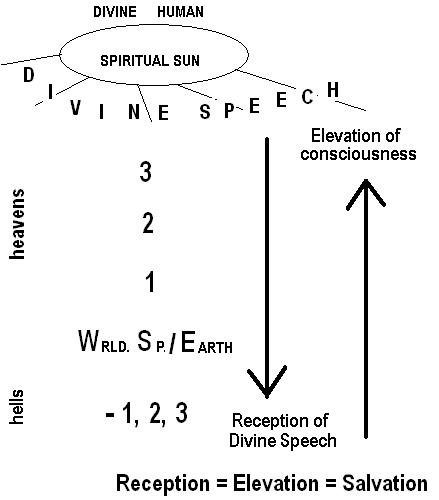 Note
from the accompanying diagram that Divine Speech proceeds from the Divine
Human's Rational Mind by means of the Spiritual Sun. This Proceeding from the
Spiritual Sun is uncreate and infinite, and as it proceeds downward relative to
the Spiritual Sun, or outward relative to the natural world. As the Divine
Proceeding or Speech exteriorizes and descends, it first reaches the human race
through the uppermost portion of the mind called "the Third Heaven." Swedenborg
received the opportunity to view the script in which Sacred Scripture was
written down in the Third Heaven of the human mind. People whose consciousness
are elevated to this level are called celestial angels and live their
immortality in conjugial bliss (see Section xx).
Note
from the accompanying diagram that Divine Speech proceeds from the Divine
Human's Rational Mind by means of the Spiritual Sun. This Proceeding from the
Spiritual Sun is uncreate and infinite, and as it proceeds downward relative to
the Spiritual Sun, or outward relative to the natural world. As the Divine
Proceeding or Speech exteriorizes and descends, it first reaches the human race
through the uppermost portion of the mind called "the Third Heaven." Swedenborg
received the opportunity to view the script in which Sacred Scripture was
written down in the Third Heaven of the human mind. People whose consciousness
are elevated to this level are called celestial angels and live their
immortality in conjugial bliss (see Section xx).
Swedenborg was also able to observe the Sacred Scripture which was read by the spiritual angels, which is the name given to those who dwell permanently in the Second Heaven of the human race. He confirmed the fact that the celestial Sacred Scripture (Third Heaven) corresponds perfectly to the spiritual Sacred Scripture (Second Heaven). The celestial angels saw the meaning of the sentences as discussing love and the hierarchy of human affections. The spiritual angels saw the meaning of the sentences as discussing truth and the varieties of human understanding. Clearly then, Divine Speech descends and exteriorizes by discrete degrees that do not overlap in meaning, but they do correspond to each other.
This conclusion was additionally confirmed when Swedenborg viewed the Sacred Scripture read by the angelic spirits, which is the name given to those who dwell permanently in the First Heaven of the human race. At each level, divine speech communicates itself in the form of Sacred Scripture written down in some language -- celestial-rational language, spiritual-rational language, or spiritual-natural language, for the three heavens respectively. These three types of human languages correspond to each other by discrete degrees (see Section xx). A fourth type of human language is called natural language, and it is what we speak and know here on earth. Sacred Scripture on earth is written and translated in many natural languages. It is always written in natural correspondences, which are a degree below the first three. By the time Divine Speech has descended and exteriorized to this ultimate level of human consciousness, the topic of Sacred Scripture appears to be historical, cultural, and religious. But using the method of correspondences revealed in the Writings, one can mentally or spiritually "climb back up" through the discrete degrees. At each higher level, the topic of Divine speech will change.
Note that the diagram shows earth and the world of spirits together. It is a level in the human mind located in the spiritual interspace that is created between the heavens and the hells, making it impossible for people's consciousness to go from one to the other, unless it is on earth, that is, still tied to a physical body. Earth and the world of spirits are together structurally or biologically since when we are born, our spiritual body or mind, is born into the world of spirits and remains there until we are resuscitated at the death of the physical body (see Section xx). Therefore, while we are tied to a physical body on earth, our mind is in the world of spirits. All the sensations and thoughts we have in the natural mind through the brain and sensory organs, are not in the brain, nor on earth, or anywhere else in the physical world. They are always from the beginning in the world of spirits where is our spiritual body which houses the mental organs or mind.
The diagram shows that below the world of spirits are the hells. There are three discrete hells, each formed by the inversion of correspondences in Sacred Scripture. Those who invert celestial-rational correspondences in their mind keep themselves in the worst hells (discrete level -3). Those who invert spiritual-rational correspondences in their mind keep themselves in the middle hells (discrete level -2). Those who invert spiritual-natural correspondences in their mind keep themselves in the least evil hells (discrete level -1).
Note the spiritual dynamics depicted in the above diagram with the two arrows. The descending arrow is the process that was just described, namely, the reception of Divine Speech at its various discrete levels of descent. The ascending arrow is the result of the reception and is called elevation of consciousness. In other words, the consciousness of the celestial angels (3) is elevated to ever higher levels within the celestial degree, the more they appropriate the ideas in their Sacred Scripture. Similarly with the spiritual angels (2) and the angelic spirits (1). Note however, that the no matter how elevated the consciousness grows for any particular individual, it remains at that same discrete degree.
The downward exteriorization of Divine Speech is the final and ultimate goal of creation. All else is derivative of this great use. Therefore, progressive excellence and perfection of this use is our highest and most human achievement. Our most human task here on earth is the elevation of our consciousness to the Divine Human. This elevation is achieved by the reception of the ideas in Sacred Scripture.
We can achieve elevation or enlightenment while we are in the natural mind attached to the physical body on earth. This amazing spiritual event is possible because the Divine Incarnation Event has created new mental pathways for this elevation (see Section xx). Specifically, the natural mind has three portions -- corporeal, sensuous, and rational. The new biological organism making elevation possible is the creation of a virtual heaven within our natural-rational mind (the highest portion of the natural mind). This new mental organ does not receive input from the physical world, as does the natural-rational mind. It receives input only from the spiritual and celestial mind, which are unconscious (see Section xx).
In other words, the new spiritual-natural organ can be activated by reacting to the correspondences in the three heavens. Through this built in feature, we are able to be aware and process higher order correspondences in a virtual form. This processing is what elevates our consciousness all the way to the Third Heaven of our mind, where we can understand what Divine Speech is saying about love and the hierarchy of human affections. Knowing this allows us to be angels on earth, that is, live a life of preparation for angelic life in the afterlife. This is also called becoming regenerated (see Section xx). Regeneration is also called salvation because only by character reformation can be prepare our mind for heavenly life. The mind that is unregenerate when awakening in the world of spirits, is unwilling to be elevated into the life of heaven. Swedenborg observed this phenomenon on many occasions.
Try memorizing the diagram given in this section. You can then use it in your mind to understand theistic psychology at a deeper and even more useful level. Also, try to relate it to the two charts in Section 3.7.2.1 and 3.7.2.2. The diagram and the two charts should be memorized together, enough so you are able to reproduce them from memory. This will add powerfully to your ability to understand theistic psychology at a deeper and more useful level.
Divine Speech in Sacred Scripture is expressed literally in the lowest common denominator of historical and cultural meaning. On earth it is expressed in natural correspondences in a natural language, and it can be translated in all languages without losing their capacity to include the hidden higher correspondences that are spiritual and celestial in meaning and rationality.
It is necessary that Sacred Scripture be written at this lowest level of representation because in that way Divine Speech can be understood rationally and accepted voluntarily by the receiving people. But in the Writings of Swedenborg, where Divine Speech is expressed with natural-rational correspondences, it is revealed that all Sacred Scripture is written in correspondences of Divine Speech. Also, a method is given specifying how we can systematically extract the higher correspondences or meanings that lay hidden within the literal sentences. Swedenborg was able to understand and write this method down so that everyone could have access to it. That's what theistic psychology is. It gives everyone access to the universal scientific meaning of Divine Speech.
Swedenborg compared the sentences of the Old and New Testaments which he found in the spiritual world, with those in his Bible on earth. He then wrote 12 volumes of a collection of books in Latin called Arcana Coelestia ("Heavenly Secrets"), in which he compares word by word, and phrase by phrase, major portions of the Old and New Testaments in the spiritual world with the natural version in the natural world. He did this systematically for the first two books of the Old Testament called Genesis and Exodus. Later he also did similar comparisons for the entire Book of Revelation in the New Testament, and many portions of other segments throughout the Old and New Testaments.
It turns out that while the Bible version on earth is about natural and historical events that took place on earth in relation to God, the version in the spiritual world is about theistic psychology -- the anatomy and growth of the human mind.
This scientific knowledge about the human mind is given to us by the Divine Human because such knowledge is of critical practical value to every human being regarding their regeneration, which is the lifelong process of character reformation (see Section xx). Every individual who will enter heaven in eternity must undergo character reformation on earth. Those who are unwilling to change their inherited hellish traits for new heavenly traits, are absolutely unwilling to do so after they arrive in the world of spirits. As a result, they are spontaneously drawn into the hells of their mind from which state they are unwilling to come out. Swedenborg has seen some who had been there for eons of ages, and still are unwilling to ascend to their higher rational consciousness where their heaven is. Hence it is that the topics of Divine Speech all have to do with the knowledge we need to regenerate, for there is no subject more vital about which God can talk to us at the conscious level of understanding and communication.
Swedenborg was the only person in history who was given this opportunity of objectively making a word by word comparison of the natural meaning of the Bible and its spiritual meaning. The people in the spiritual world who were reading Sacred Scripture could only understand the verses in their inner spiritual meaning. But when these people were still on earth, they could understand the verses only naturally. Swedenborg was the first person still on earth who could perceive both the natural meaning and at the same time the spiritual meaning of Sacred Scripture. And since he was a scientist he had to find the rational mechanisms and laws by which this amazing correspondence was taking place. He saw this spiritual-natural correspondence of Sacred Scripture as the key to understanding rationally how God manages the universe and how the human race evolves from lower to ever higher levels of rational and spiritual life.
For the past two hundred years the Writings of Swedenborg (published on earth between 1745-1771) have been read in the spiritual world as Sacred Scripture. Today, with the parallel development of theistic psychology on earth, people can begin to raise their consciousness and the level of their life, by studying and understanding the natural-rational correspondences of Divine Speech which are found only in the Writings of Swedenborg. This collection of works constitutes the third and final portion of the Judaeo-Christian tradition of Sacred Scripture (see Section xx). The Old Testament, the New Testament, and the Writings of Swedenborg are therefore known as the "Threefold Word" (see Section xx). Swedenborg has demonstrated that once the scientific meaning of the Threefold Word is extracted, nothing is left of the historical and natural references in their literal sentences. This is what makes theistic psychology a universal science for all times for the human race, both in this world and in our immortality.
Swedenborg has discussed this with the people who are in their highest heavens in eternity. They are called "spiritual and celestial angels" and they told Swedenborg that all their knowledge and intelligence comes from the spiritual-rational and celestial-rational correspondences in which their Sacred Scripture is written. Thus, while the literal meaning of the Judean-Christian tradition of Sacred Scripture is sectarian and cultural, its inner meaning is completely devoid of this content. Divine Speech must necessarily be given through a natural language, culture, and race, which is why the literal meaning sets races and nations apart and often against each other. As well, the literal meaning can be used as a powerful weapon of enslavement by which a a few professionals of religion dictate to many a religious or sectarian lifestyle that is their own invention since that is never what Divine Speech is talking about in its true correspondential sense.
Our spiritual development and eternal future does not depend on these invented religious lifestyles, prohibitions, and belief systems. Instead, our life in immortality is determined by what kind of character we bring with us from this earth. To achieve their character reformation successfully people need to be told what Divine Speech says about it, and this cannot be obtained from the literal sentences of Sacred Scripture. Hence all religious schools and all public educational systems on the planet should teach the content of Divine Speech as it is extracted from Sacred Scripture.
For the past 200 years, theistic psychologists have been extracting higher order correspondences from the literal sentences of Sacred Scripture and contributing to the growing field (see Readings). They did not call their work "theistic psychology" but from our perspective today, that's what it was. They have been engaged in the systematic effort of building a body of knowledge that is based exclusively on the Writings of Swedenborg. All work in theistic psychology requires the application of correspondences to the literal sentences.
Swedenborg created a kind of translation dictionary of correspondences so that you can look up a word, name, or number from the Old Testament and New Testament version on earth, and find out what it meant in the spiritual version. Since the spiritual version is a body of scientific knowledge called theistic psychology, you can see how crucial it was for Swedenborg to describe very precisely and exactly how we must use this method of extraction. This is why Swedenborg, a well known and qualified scientist, was given the unique and special ability of being conscious in the spiritual world while still alive on earth. What is remarkable is that he was able to prove beyond any doubt that the Old and New Testaments were written in the same language of correspondences since they are both Divine Speech expressed as Sacred Scripture.
It's extremely important to understand that the correspondences of Sacred Scripture described in the Writings are not a symbolic code that Swedenborg invented. Without his ability to observe both the natural and spiritual versions of Sacred Scripture, he would not have been able to describe the laws of correspondences that govern the functional interaction of the two worlds. This is not a symbolism for Sacred Scripture. Correspondences are the universal laws that govern the functional interaction of the levels of existence and creation. God governs all details of the universe through correspondences. It makes sense therefore that Sacred Scripture is written in these same laws since the natural language sentences of Sacred Scripture must be produced by a prior spiritual phenomenon. Also, the same Sacred Scripture appears at all the discrete levels of humanity, but at each level it has a different content. The differences of content across the discrete levels are specified exactly and precisely by correspondences (see Section xx).
Every correspondence in the language of Sacred Scripture has a positive and a negative meaning, so that in some passages it refers to the positive meaning and in others to the negative meaning. In the illustrations below, only one meaning is presented.
Beasts or Animals signify the things in our will or our loves, e.g., "bears" signifies the state of mind when the Word is read and not understood (Gen. 1:24); "dogs" signifies those of small value who are outsiders (e.g., Ex.. 11:7) "foxes" signifies those who rely on their own prudence (Ps. 63:10); "lamb" signifies the holiness of innocence (Gen. 21:28, Rev. 5:6);
Carriages signify goods from a rational origin (e.g., Rev. 18:13, Jdg. 18:21)
Husband signifies the rational mind (e.g., Gen. 3:16)
Egypt signifies the natural mind separated from the spiritual which is the pride of self-intelligence (Isa. 19:1)
Esau signifies natural good which was to be made Divine in the Incarnation Event (Gen. 25:25)
Hand signifies ability and power (Gen. 8:9)
Jacob signifies the lowest things of reason which are external knowledges (Gen. 25:26)
Jews signifies those who are in love to the Divine-Human, and in the truths of doctrine from Him (Zech. 8:23)
Mary, the Virgin signifies the universal church at that time, throughout the world (e.g., Mat. 1:16)
Numerals signify specific things; e.g., "1" signifies what is perfect (Gen. 11:6); "2" signifies conjunction of pairs which complete each other (Gen. 7:9); "7" signifies the celestial mind, fully regenerated (Gen. 2:2); "19" signifies the state of idolatrous worship (Gen. 11:25); "40" signifies the state of temptation (Gen. 7:4, Mt. 4:1); "99" signifies the state before the union of the Divine-Human's Human Essence with His Divine (Gen. 17:24); "250" signifies as much as is sufficient for use (Ex. 30:23); "144,000" signifies all who acknowledge the Divine-Human to be the God of heaven and earth (Rev. 7:4).
Rich signifies the spiritual goods from truth with which the Divine-Human was enriched at this stage of His inner life on earth (Gen. 13:2; Ex. 30:15)
Spider's web signifies deceitful falsities (Isa. 59:5)
Transgressions or Trespasses signify such evils as are done against the commandments (Num. 14:41)
Uncircumcised signifies one who is in self-love (Gen. 17:14)
Wife signifies selfhood in the external mind (Gen.2:24)
And so on. When these and other correspondences are applied to the text of Sacred Scripture, there emerges a new content which is the scientific description of human development and character reformation. In other words, the literal meaning of Sacred Scripture is given for the use of religion, while the derived correspondential meaning is given as scientific revelations about the human mind, life after death, the process of regeneration or character reformation, and so on.
Here are some examples of how Swedenborg derives the scientific meaning of the Old Testament by applying the laws of correspondences. You should remember as you read this that "church" in its scientific sense signifies the regenerating mind, and "religion" or "religious belief" signifies our knowledge of the literal sentences of Sacred Scripture. In other words this passage in its scientific sense discusses how Sacred Scripture is related to regeneration. Quoting from Arcana Coelestia:
From the mere letter of the Word of the Old Testament no one would ever discern the fact that this part of the Word contains deep secrets of heaven, and that everything within it both in general and in particular bears reference to the Divine-Human, to His heaven, to the church, to religious belief, and to all things connected therewith; for from the letter or sense of the letter all that anyone can see is that-to speak generally-everything therein has reference merely to the external rites and ordinances of the Jewish Church. Yet the truth is that everywhere in that Word there are internal things which never appear at all in the external things except a very few which the Divine-Human revealed and explained to the Apostles; such as that the sacrifices signify the Divine-Human; that the land of Canaan and Jerusalem signify heaven-on which account they are called the Heavenly Canaan and Jerusalem-and that Paradise has a similar signification. (AC 1)
The above passage says that no one has known before this that the Old Testament words and phrases actually refer to scientific concepts relating to the human mind and its regeneration for heavenly life. In the literal sense of the Old Testament "everything therein has reference merely to the external rites and ordinances of the Jewish Church." These topics do not seem universal or scientific, and they are not. But when you translate the words and phrases into their spiritual correspondences, the details about the rites and rituals of the Jewish Church vanish. What is left is a scientific concept or idea. These scientific concepts are arranged in a rational series or pattern, so that together they make up an exact map of the genes of human consciousness. This map describes the evolution of consciousness of the human race and how every individual must recapitulate in development all the steps or phases that the race went through. The map also indicates the final disposition of the human race in eternity and of every individual in immortality.
The passage above also says that the New Testament reveals a few selected instances of correspondences in the Old Testament. For instances New Testament scholars have known for centuries that the animal sacrifices God commanded in the Old Testament days were done in order to represent symbolically or ceremoniously the sacrifice of the Incarnated Son of God, or "Messiah" which was to take place hundreds of years later. The Old Testament people were not allowed to know of this explicitly because their mentality would have rejected this idea of the future. It is better for the people involved to keep spiritual ideas away from them if they are going to reject them. Hundreds of years later, the New Testament people were told that animal sacrifices in the Old Testament are not to be restarted, but recognized as having represented the future sacrifice of the Son of God, which was necessary to redeem the human race from the grips of hellish influences into which it has fallen by rejecting the guidance of God and conscience.
It wasn't until the 18th century that the human race was ready to receive and accept the revelations of the Writings of Swedenborg, in which all the correspondences are explicitly explained. Now it will take many more centuries and millennia for people to extract significant portions of theistic psychology from the Writings themselves. Swedenborg did not comment explicitly regarding the correspondences that are hidden in the Writings. For this reason, some scholars of the Writings do not accept the idea that they are also written in hidden correspondences, though they acknowledge them as Sacred Scripture. This does not seem justified since the Writings state that all Sacred Scripture on earth is written in natural correspondences of Divine Speech. Therefore if one acknowledges the Writings as Sacred Scripture one should also acknowledge that they too are written in correspondences. Theistic psychology is nothing but the spiritual-rational correspondences that we extract from the natural-rational correspondences in which the Writings are written (see Section xx).
Continuing with the next passage which discusses the scientific content of Genesis:
While the mind cleaves to the literal sense alone, no one can possibly see that such things are contained within it. Thus in these first chapters of Genesis, nothing is discoverable from the sense of the letter other than that the creation of the world is treated of, and the garden of Eden which is called Paradise, and Adam as the first created man. Who supposes anything else? But it will be sufficiently established in the following pages that these matters contain arcana which have never yet been revealed; and in fact that the first chapter of Genesis in the internal sense treats in general of the new creation of man, or of his regeneration, and specifically of the Most Ancient Church; and this in such a manner that there is not the least expression which does not represent, signify, and enfold within it these things. (AC 4)
The above passage reminds us that the Genesis creation story "treats of the new creation of man, or of his regeneration, and specifically of the Most Ancient Church." Remember that church signifies the regenerating mind. The "Most Ancient Church" signifies the first phase of the regenerating process. Historically, in its literal sense, the Writings discuss the Most Ancient Church as the celestial race on this earth prior to the Fall. The proof that such a race existed on this earth was given to Swedenborg when he was allowed to visit them in the heavens where they have been dwelling for thousands of years, since passing from life on earth to life in immortality (see Section xx). But in the scientific sense all reference to history on this earth vanishes, and instead what is signified is the regenerating mind. "Most Ancient" therefore signifies the initial or first phase of our regeneration. This beginning phase is also called "the new creation of man."
That this is really the case no one can possibly know except from the Divine-Human. It may therefore be stated in advance that of the Divine-Human's Divine mercy it has been granted me now for some years to be constantly and uninterruptedly in company with spirits and angels, hearing them speak and in turn speaking with them. In this way it has been given me to hear and see wonderful things in the other life which have never before come to the knowledge of any man, nor into his idea. I have been instructed in regard to the different kinds of spirits; the state of souls after death; hell, or the lamentable state of the unfaithful; heaven, or the blessed state of the faithful; and especially in regard to the doctrine of faith which is acknowledged in the universal heaven; on which subjects, of the Divine-Human's Divine mercy, more will be said in the following pages. (AC 5)
In the above passage Swedenborg once again refers to his dual citizenship as a Divine act of mercy or love for the human race. Through his special status he was able to observe both worlds simultaneously, a power or ability not granted to anyone before in human history. But now the time had come for God to advance the human race to its final and highest phase of consciousness. The human mind had been prepared by centuries of scientific developments. In the 18th century the modern human mind was fully matured and ready to hear the ultimate and final revelations about itself and its eternal future.
These final revelations had to be cast in a modern rational scientific language and Swedenborg had been prepared for scientific eminence prior to his new dual abilities that began at age 57. His mission, no longer impossible, was to give a rational scientific description and explanation of God, God's management techniques, the process of dying and the afterlife, heaven and hell, conjugial love in marriage, spiritual development, the geography of the spiritual world, the anatomy of the mind, the correspondential sense of Sacred Scripture, Divine Speech, spiritual language, earths in the universe and their inhabitants, evil spirits, influx, discrete degrees, and many more such facts and principles undiscoverable by any other means but revelation.
The following passage discusses the scientific sense of verse 2 in Genesis:
Verse 2. "And the earth was a void and emptiness, and darkness was upon the faces of the deep; and the Spirit of God was brooding upon the faces of the waters." Before his regeneration, man is called the "earth void and empty" and also the "ground" wherein nothing of good and truth has been sown; "void" denotes where there is nothing of good, and "empty" where there is nothing of truth. Hence comes "thick darkness" that is, stupidity, and an ignorance of all things belonging to faith in the Divine-Human, and consequently of all things belonging to spiritual and heavenly life. Such a man is thus described by the Divine-Human through Jeremiah:
My people is stupid, they have not known Me; they are foolish sons, and are not intelligent; they are wise to do evil, but to do good they have no knowledge. I beheld the earth, and lo a void and emptiness, and the heavens, and they had no light (Jer. 4:22-23). (AC 17)
In the above passage a contrast is made between "church," which signifies the regenerating mind, as discussed above, and the "earth that is void and empty," which signifies the unregenerate mind, or the mind before it has begun its regeneration. We begin our regeneration when we are willing to undergo "reformation" of our ideas and beliefs. Until that time, our ideas and beliefs are not patterned according to the ideas of Sacred Scripture. We grow up thinking and assuming that we are alone in our mental world. The mental effort we put up when we learn something feels like our own effort, and so we take credit for it. But when we are willing to undergo reformation of ideas, we focus on Sacred Scripture as the source of facts about ourselves. And Sacred Scripture says that God is omnipotent, which means we have no power of our own. Therefore the mental effort we put up while learning something is God's power operating in us, not our own power. We now begin a new way of thinking. We think of God's conscious cooperation and co-presence in our thinking process. Prior to this our mind was "void and empty" of spiritual truths," whence comes "darkness" and "stupidity" in spiritual matters and "of all things belonging to spiritual and heavenly life."
In the passage from Jeremiah, the Old Testament prophet, Divine Speech is being quoted in which God calls us "stupid," "foolish," and "not intelligent" when we are in the prior phase of "void and emptiness" regarding knowledge of God and spiritual truths. Materialism is an an instance of such a phase. non-theistic science and psychology today has completely denied God's existence and presence in all details of human behavior. It is therefore full of "darkness" and "foolishness." But theistic psychology enters a new phase of mental evolution. "Earth" in Sacred Scripture signifies the natural mind. Jeremiah quotes God saying that God "beheld the earth and lo a void and emptiness." In other words, the natural mind which is immersed in non-theistic materialism and the negative bias, "has not known Me," that is, has denied the existence of God. When this is done, the mind is plunged into irreality, delusion, and "spiritual insanity." The consequences of spiritual insanity are the plagues of civilization -- crime, poverty, war, prejudice, divorce, abuse of children and women, terrorism, and the rest of the ills of humankind with which we are all very familiar. These evil consequences are the result of spiritual insanity. Reversing this process is possible through regeneration and character reformation.
Another typical passage discusses verses 14-17 in the first chapter of Genesis in the Old Testament. The first eleven chapters of Genesis are a discussion of "those who are being created anew," which is a reference to our mental phase when we begin our regeneration. To be "created anew" means to be reformed in the old character we have prior to regeneration. The old character believes in self, while the new character believes in God.
AC 30. Verses 14-17.
"And God said, Let there be luminaries in the expanse of the heavens, to distinguish between the day and the night; and let them be for signs, and for seasons, and for days, and for years; and let them be for luminaries in the expanse of the heavens, to give light upon the earth; and it was so. And God made two great luminaries, the greater luminary to rule by day, and the lesser luminary to rule by night; and the stars. And God set them in the expanse of the heavens, to give light upon the earth."
What is meant by "great luminaries" cannot be clearly understood unless it is first known what is the essence of faith, and also what is its progress with those who are being created anew. The very essence and life of faith is the Divine-Human alone, for he who does not believe in the Divine-Human cannot have life, as He himself has declared in John:
He that believeth on the Son hath eternal life, but he that believeth not on the Son shall not see life, but the wrath of God shall abide upon him (John 3:36).
"The Son" refers to the Divine Human. To "believe on the Son" means to acknowledge the existence of the Divine Human as the Divine Psychologist who leads our thoughts and feelings towards regeneration and heaven. If we fail to acknowledge the Divine Human's co-presence in our mental operations we "shall not see life," that is, eternal life in the heavens of or mind. Instead, "the wrath of God shall abide upon him," which means that we shall be living in the hells of our mind instead the heavens. In Sacred Scripture "life" always refers to heavenly life in eternity, while "death" refers to life in hell to eternity. Those who are unwilling to acknowledge the Divine Human when they awaken in the world of spirits (see Section xx), are going down to their existence of "death" in hell. Those who are in the hells of their mind seem to feel that the "wrath of God abides with them." But in reality, God cannot feel or show wrath. And in fact, God supports the life of hell for those who insist on being there, making their condition less intolerable than they themselves would make it, if left to their own insanity.
[2] The progression of faith with those who are being created anew is as follows. At first they have no life, for it is only in the good and the true that there is life, and none in the evil and the false; afterwards they receive life from the Divine-Human by faith, first by faith of the memory, which is a faith of mere knowledge; next by faith in the understanding, which is an intellectual faith; lastly by faith in the heart, which is the faith of love, or saving faith. The first two kinds of faith are represented from verse 3 to verse 13 [in Genesis 1], by things inanimate, but faith vivified by love is represented from verse 20 to verse 25, by animate things. For this reason love, and faith thence derived, are now here first treated of, and are called "luminaries;" love being "the greater luminary which rules by day;" faith derived from love "the lesser luminary which rules by night;" and as these two luminaries ought to make a one, it is said of them, in the singular number, "Let there be luminaries," and not in the plural.
The above passage gives details about the "progression of faith" which in the scientific sense refers to the developmental steps of regeneration, as follows:
(I) The state prior to beginning our regeneration is a state of "no life" because our materialistic ideas and negative bias make no room for mental operations that lead to heaven, called "life." These mental operations involve "good and truth" which is called life itself. Only that mind which receives good and truth seems alive. The mind that turns the good and true into falsity and evil is not alive or heavenly since mental operations of falsity and evil are called dead or hellish. Only what is from heaven -- good and truth, is called "alive" in Sacred Scripture.
(II) When reformation starts we "receive life from the Divine Human." At first this new life is called a "faith of the memory, which is a faith of mere knowledge." We have acknowledged the existence of the Divine Human in our mental operations, but we have not yet applied this knowledge to our daily life. We are still operating largely as we did before, materialistically in all our motives, although we formally declare our knowledge of God and participate in religious worship. or, alternately, engage in the study of theistic psychology.
(III) Intellectual faith is the next stage, in which we not only know about God but try to justify God in our belief system. We now begin to think about the repercussions of accepting God as a philosophy or belief system. We find that we have to modify many aspects of our belief system to accommodate God's presence in them -- abortion, politics, science, history, business, education, marriage, parenting, entertainment.
(IV) Next is "faith of the heart," which refers to the mental state of loyalty to God's commandments of living. Now we feel that we must practice what we preach. This is the true beginning of regeneration. Until now we were busy with our intellectual "reformation," but now we are ready for our character "regeneration." Reformation is about our cognitive operations in the organ of the understanding, while regeneration is about our affective operations in the organ of the will.
xxxx
[3] Love and faith in the internal man are like heat and light in the external corporeal man, for which reason the former are represented by the latter. It is on this account that luminaries are said to be "set in the expanse of heaven" or in the internal man; a great luminary in its will, and a lesser one in its understanding; but they appear in the will and the understanding only as does the light of the sun in its recipient objects. It is the Divine-Human's mercy alone that affects the will with love, and the understanding with truth or faith. (AC 30)
And Lot was sitting in the gate of Sodom. That this signifies those who are in the good of charity, but in external worship, who here are "Lot," and who are among the evil, but separate from them-which is to "sit in the gate of Sodom"-can be seen from the representation of "Lot," and from the signification of "gate," and also from that of "Sodom." From the representation of "Lot:" Lot when with Abraham represented the Divine-Human's sensuous part, thus His external man (as shown in Volume 1, n. 1428, 1434, 1547). But here, when separated from Abraham, Lot no longer retains the representation of the Divine-Human, but the representation of those who are with the Divine-Human, namely, the external man of the church, that is, those who are in the good of charity, but in external worship.
[2] No, in this chapter Lot not only represents the external man of the church, or what is the same, the external church such as it is in the beginning, but also such as it is in its progress, and also in its end. It is the end of that church which is signified by "Moab" and the "son of Ammon," as of the Divine-Human's Divine mercy will appear from the series of the things that follow. It is a common thing in the Word for one person to represent a number of states that succeed each other, and which are described by the successive acts of his life.
[3] From the signification of a "gate:" a gate is that through which one enters into a city, and through which he goes out of the city; consequently, to "sit in the gate" does indeed here signify to be with the evil, but still to be separate from them; as is wont to be the case with the men of the church who are in the good of charity; these, although they are among the wicked, are still separate from them; not as to civic society, but as to spiritual life. (That "Sodom" signifies evil in general, or what is the same, the evil, especially within the church, was said above, n. 2322.) (AC 2324)
That a "horse" signifies the faculty of understanding is from no other source than the representatives in the other life. Often there, in the world of spirits, horses are seen, and this with great variety, and those also that sit on them; and whenever they are seen they signify the faculty of understanding. There are such representatives continually with spirits. It is from the representation of the horse, as being the understanding, that when horses are mentioned in the Word, the spirits and angels with man at once know that the understanding is what is treated of. It is also from this that when spirits from a certain distant world on being imbued with intelligence and wisdom are taken up from the world of spirits into heaven, there appear to them horses shining as with fire; which also I have seen when they were taken up.
[2] From this I could see what is signified by the chariot of fire and horses of fire seen by Elisha when Elijah went up by a whirlwind into heaven; as also what is signified by the exclamation of Elisha then: "My Father, my Father, the chariot of Israel and the horsemen thereof" (2 Kings 2:11, 12); and by Joash king of Israel saying the same to Elisha when he was dying: "My Father, my Father, the chariot of Israel and the horsemen thereof" (2 Kings 13:14). That by Elijah and Elisha was represented the Divine-Human as to the Word, will of the Divine-Human's Divine mercy be told elsewhere; the doctrine of love and charity from the Word being meant by the "chariot of fire," and the doctrine of faith therefrom by the "horses of fire." The doctrine of faith is the same as the understanding of the Word as to its interiors, or as to its internal sense.
[3] That chariots and horses are seen in the heavens with spirits and angels, is evident from the fact of their being seen by the prophets, as by Zechariah (chapter 1:8-10; 6:3-7), and by others, and also by Elisha's servant, as thus described in the book of Kings:
Jehovah opened the eyes of Elisha's boy, and he saw; and behold the mountain was full of horses and chariots of fire round about Elisha (2 Kings 6:17).
Moreover, where the abode of the intelligent and wise is, in the world of spirits, chariots and horses appear continually; for the reason as said that by chariots and horses are represented the things of wisdom and of intelligence. Resuscitated persons after death, who are entering into the other life, see represented to them a young man sitting upon a horse, and then alighting from the horse; and by this is signified that they are to be instructed in the knowledge of good and truth before they can come into heaven (see volume 1, n. 187-188).
[4] That chariots and horses signified these things, was well known in the Ancient Church, as also is evident from the book of Job, which is a book of that Church, where are these words:
God hath made her to forget wisdom, and hath not imparted to her intelligence; what time she lifteth up herself on high she cometh the horse and his rider (Job 39:17-19).
From the Ancient Church the signification of the horse, as being the faculty of understanding, was extended to the wise round about, even into Greece. From this it came to pass that when they described the sun (by which was signified love, n. 2441, 2495), they placed in it the god of their wisdom and intelligence, and gave him a chariot and four horses of fire; and that when they described the god of the sea, because by the sea were signified knowledges in general (n. 28, 2120), they gave horses also to him; and that when they described the rise of knowledges from the understanding, they represented a flying horse which with his hoof broke open a fountain, where dwelt the virgins that were the sciences; and by the Trojan horse nothing else was signified than a contrivance of their understanding for destroying city walls.
Even at this day the intellect is often described, according to the custom received from those ancient people, under the figure of a flying horse, or Pegasus; and learning is described as a fountain; but scarcely anyone knows that a horse, in the mystic sense, signifies the understanding, and a fountain truth; still less that these significatives were handed down to the Gentiles from the Ancient Church. (AC 2762)
From all this it is now manifest whence come the representatives and significatives in the Word, namely, from the representatives that exist in the other life. From this source they came to the men of the Most Ancient Church, who were celestial, and were in company with spirits and angels while living on earth. From them the representatives passed to their posterity, and at length to those who merely knew that they had such a signification; but because the representatives came from the most ancient times, and were in their Divine worship, they were venerated and held sacred.
[2] Besides representatives, there are also correspondences which suggest and also signify something altogether different in the spiritual world from what they do in the natural world; as the heart, the affection of good; the eyes, the understanding; the ears, obedience; the hands, power; besides innumerable other correspondences. These are not represented in this way in the world of spirits; but they correspond, as what is natural to what is spiritual.
Hence it is that every word, even to the smallest iota of all, in the Word, involves spiritual and heavenly things; and that the Word is in this manner inspired, so that when it is read by man, spirits and angels immediately perceive it spiritually according to the representations and correspondences. But this knowledge, which was so much cultivated and esteemed by the ancients after the flood, and by means of which they were able to think with spirits and angels, is at this day altogether obliterated, so much so that scarcely anyone is willing to believe that it exists; and they who believe in it merely call it a kind of mystical thing, of no use; and this for the reason that man has become altogether worldly and corporeal; to such a degree that when what is spiritual and heavenly is mentioned, he feels a repugnance, and sometimes a loathing, or even nausea. What then will he do in the other life, which lasts forever, and where there is nothing worldly and corporeal, but only what is spiritual and heavenly, which makes the life in heaven? (AC 2763)
Only a few passages are reproduced here to show the systematic and consistent quality of Swedenborg's application of correspondences to verses of Sacred Scripture and the resulting scientific information about human minds and the world. It is easy to see the objectivity and accuracy with which the Writings demonstrate that the literal meaning of the Old and New Testament verses is historical and deals with natural things in this world, while unbeknownst to the reader, there is a hidden underlying scientific sense that describes the anatomy and function of the mind and its relation to eternal life in heaven or hell. Again it's worth noting methodologically that Swedenborg demonstrates that this underlying scientific information runs across all the books of the Old and New Testaments, and they are strung out in a rational series that can be uncovered by research similar to what Swedenborg demonstrates in relation to the Old and New Testaments.
The same method of correspondences will be applied in future research to the Writings themselves since they constitute the third and final portion of "the Word of God" or Sacred Scripture. While this Sacred Scripture was given to the Western peoples of the Middle East, Europe, and America, this is only so in their literal meaning. When you extract their correspondential meaning it becomes obvious that this Sacred Scripture was given to the entire humanity, both in this world and in heaven. For an initial attempt in exploring the correspondential meaning of the Writings, see my book A Man of the Field, Volume Two, available on the Web at: www.soc.hawaii.edu/leonj/volume2-nonduality.html
Consider how amazing this discovery is. The books of the Old and New Testaments were written independently by dozens of prophets across two thousand years or more. Most of these prophets did not possess copies of most of the books, and yet unbeknownst to them, they wrote verses that were hiding an internal correspondential meaning consisting of an integrated series of scientific revelations about the anatomy and function of the mind, about human nature and character reformation, about how God manages the universe, and about how the entire race is in unconscious communication with each other in both this world and the spiritual world. None of the authors through whom these Sacred Scriptures were delivered could have even understood this inner scientific series of rational concepts belonging to theistic psychology. Even if it had been revealed to them, it would have meant nothing because only the modern scientific mind today is prepared enough in rational structure to understand theistic psychology.
This hidden integrated series is like the DNA code we have in every cell. Now imagine if the elements that make up the sequence of the DNA code were separated from each other and scattered in the ocean. How can we get the sequence back? Imagine 100 submarines marked 1 to 100 went out to all the oceans and brought back a sample of the water. Would the 100 samples allow you to reconstruct the DNA code? The chances of that happening is a far bigger number than the suspected age of the universe in nanoseconds! Therefore it cannot happen. And yet, suppose it did? The 100 samples brought back by the 100 submarines did fit perfectly in the right sequence when you placed them in the order of the number on each submarine. Suppose this did happen.
How would you explain it?
In the negative bias mode, one can only say again and again, "But that's impossible," as materialistic thinking hits itself upon anti-gravity that threatens to destroy its world. In the positive bias mode, a rational explanation is given by Divine revelation, namely, that God has arranged that the scattered pieces of the DNA code be gathered together in precisely the100 samples picked up by the submarines.
In the same way, as explained in the Divine revelations of the Writings, God managed that only those historical details are recorded in Sacred Scripture which arrange themselves in a perfect rational series in their inner correspondential meaning. You can see that this would have been impossible for the authors themselves to do this who were unknown to each other and did not know anything about correspondences. Furthermore, the names given to people and places had to be managed by God centuries in advance of the events, so that the historical events in those places could represent in correspondences the scientific meaning to be delivered to humanity at a later time--through the Writings in the18th century and beyond.
In addition, the visions of the prophets were also such as to represent the hidden correspondential meaning, and the visions of all the prophets over some centuries fit together in one uninterrupted rational series of theistic psychology, from the Genesis to Revelation, thus the Old and New Testaments. God arranged all this so that the human race would come into the possession of "heavenly secrets," understand them rationally as theistic psychology, and make use of the knowledge to help people regenerate their character for a heavenly life. Untold benefits to humankind are still to be extracted from this infinite scientific series that is enclosed in the finite verses of Sacred Scripture. It is a source of scientific knowledge that can never be exhausted from now to eternity. This is because Divine Speech contains infinite things within itself. Divine Speech is the same as Divine Truth and this is infinite in God. There is no limit to how many different truths and concepts one can extract from Sacred Scripture.
This is also why there is not going to be any new revelations after the Writings of Swedenborg. There is no need for new revelations when what has already been given is an infinite source for all the future to come. This also simplifies things so that if anyone should claim that they have new revelations from God, we can know in advance that this is impossible. This is why some theistic psychologists call the Writings "the Last Testament" and "the Final Testament." The Writings present the rationale as to why there cannot be a new revelation from God. Hence God has revealed that there are not going to be new Divine revelations after this. This may sound ridiculous to the negative bias perspective, but it makes rational sense in the positive bias.
Here is a sequence of passages from Swedenborg's Arcana Coelestia (=Heavenly Secrets) on correspondences and representatives -- their origin, their function, their power, and their meaning. This newly revealed scientific knowledge about cause-effect relations in behavior and the environment forms a central part of theistic psychology.
AC 2987.
2987. CONCERNING REPRESENTATIONS AND CORRESPONDENCES.
Few know what representations and correspondences are, nor can anyone know this unless he knows that there is a spiritual world, and this distinct from the natural world; for there exists a correspondence between spiritual things and natural things, and the things that come forth from spiritual things in natural ones are representations. They are called correspondences because they correspond, and representations because they represent.
AC 2988.
2988. That some idea may be formed of representations and correspondences, it is only necessary to reflect on the things of the mind, that is, of the thought and will. These things so beam forth from the face that they are manifest in its expression; especially is this the case with the affections, the more interior of which are seen from and in the eyes. When the things of the face act as a one with those of the mind, they are said to correspond, and are correspondences; and the very expressions of the face represent, and are representations. The case is similar with all that is expressed by the gestures of the body, and with all the acts produced by the muscles; for it is well known that all these take place according to what the man is thinking and willing. The gestures and actions themselves, which are of the body, represent the things of the mind, and are representations; and in that they are in agreement, they are correspondences.
AC 2989.
2989. It may also be known that such forms do not exist in the mind as are exhibited in the expression, but that they are merely affections which are thus effigied; also that such acts do not exist in the mind as are exhibited by the acts of the body, but that it is thoughts which are thus figured. The things which are of the mind are spiritual, but those of the body are natural. From this it is evident that there exists a correspondence between spiritual things and natural things, and that there is a representation of spiritual things in natural things; or what is the same, when the things of the internal man are effigied in the external man, then the things that appear in the external man are representative of the internal man; and the things that agree are correspondences.
AC 2990.
2990. It is also known, or may be known, that there is a spiritual world, and also a natural world. In the universal sense the spiritual world is where spirits and angels dwell; and the natural world is where men dwell. In particular, there is a spiritual world and a natural world with every man: his internal man being to him a spiritual world, and his external man being to him a natural world. The things that flow in from the spiritual world and are presented in the natural world, are in general representations; and insofar as they agree they are correspondences.
AC 2991.
2991. That natural things represent spiritual things, and that they correspond, may also be known from the fact that what is natural cannot possibly come forth except from a cause prior to itself. Its cause is from what is spiritual; and there is nothing natural which does not thence derive its cause. Natural forms are effects; nor can they appear as causes, still less as causes of causes, or beginnings; but they receive their forms according to the use in the place where they are; and yet the forms of the effects represent the things which are of the causes; and indeed these latter things represent those which are of the beginnings. Thus all natural things represent those which are of the spiritual things to which they correspond; and in fact the spiritual things also represent those which are of the celestial things from which they are.
AC 2992.
2992. It has been given me to know from much experience that in the natural world and its three kingdoms there is nothing whatever that does not represent something in the spiritual world, or that has not something there to which it corresponds. Besides many other experiences, this was made evident also from the following. On several occasions when I was speaking of the viscera of the body, and was tracing their connection from those which are of the head to those which are of the chest, and so on to those which are of the abdomen, the angels that were above me led my thoughts through the spiritual things to which those viscera correspond, and this so that there was not the least error. They thought not at all of the viscera of the body of which I was thinking, but only of the spiritual things to which these correspond. Such is the intelligence of angels that from spiritual things they know all things in the body in general and particular, even the most secret things, such as can never come to man's knowledge; nay, they know everything there is in the universal world, without a mistake; and this because from spiritual things are the causes, and the beginnings of causes.
AC 2993.
2993. The case is similar with the things in the vegetable kingdom; for nothing whatever exists there that does not represent something in the spiritual world, and correspond thereto; as has been frequently given me to know by a like interaction with angels. The causes also have been told me, namely, that the causes of all natural things are from spiritual things, and the beginnings of these causes are from celestial things; or what is the same, all things in the natural world derive their cause from truth which is the spiritual, and their beginning from good which is the celestial; and natural things proceed thence according to all the differences of truth and of good in the Lord's kingdom; thus from the Lord Himself, from whom is all good and truth. These things must needs appear strange, especially to those who will not or cannot ascend in thought beyond nature, and who do not know what the spiritual is, and therefore do not acknowledge it.
AC 2994.
2994. So long as he lives in the body, man can feel and perceive but little of this; for the celestial and spiritual things with him fall into the natural things in his external man, and he there loses the sensation and perception of them. Moreover the representatives and correspondences in his external man are such that they do not appear like the things in the internal man to which they correspond, and which they represent; therefore neither can they come to his knowledge until he has put off those external things. When this happens, blessed is the man who is in correspondence, that is, whose external man corresponds to his internal man.
AC 2995.
2995. As the men of the Most Ancient Church (concerning whom see n. 1114-1125) in every thing of nature saw something spiritual and celestial, insomuch that natural things served them merely as objects for thought about spiritual and celestial things, they were for this reason able to speak with angels, and to be with them in the Lord's kingdom in the heavens at the same time that they were in His kingdom on earth, that is, in the church. Thus with them natural things were conjoined with spiritual things, and wholly corresponded. But it was otherwise after those times, when evil and falsity began to reign; that is, when after the golden age there commenced the iron age; for then as there was no longer any correspondence, heaven was closed; insomuch that men were scarcely willing to know that there was anything spiritual; and at last even that there is a heaven and a hell, and a life after death.
AC 2996.
2996. In this world it is a great secret, although in the other life nothing is better known to every spirit, that all things in the human body have a correspondence to those in heaven; insomuch that there is not the smallest particle in the body, to which something spiritual and celestial does not correspond; or what is the same, to which heavenly societies do not correspond, for these exist according to all the genera and species of spiritual and celestial things; and this in such an order that together they represent one man, even as to all his parts, in general and in particular, both the interior and the exterior. Hence it is that the universal heaven is also called the Grand Man; and hence it is that it has been so often said that one society belongs to one province of the body, another to another, and so on. The reason is that the Lord is the Only Man, and heaven represents Him; and the Divine good and truth that are from Him are what make heaven; and because the angels are therein, they are said to be in the Lord. But they who are in hell are outside this Grand Man, and correspond to things unclean, and also to bodily corruptions.
AC 2997.
2997. This may also in some degree be known from the fact that the spiritual or internal man (which is man's spirit and is called his soul) has in like manner a correspondence to his natural or external man; and that this correspondence is of such a nature that the things of the internal man are spiritual and celestial, while the things of the external man are natural and corporeal; as may appear from what was said above (n. 2988, 2989) about the expressions of the face and the acts of the body. Moreover as to his internal man, man is a little heaven, because created after the Lord's image.
AC 2998.
2998. That such correspondences exist has become so familiar to me in the course of years that hardly anything can be more so; though the fact itself is such that man does not know of its existence, nor believes that he has any connection with the spiritual world; when yet all his connection is from this correspondence; and without this connection neither himself nor any part of him could subsist a moment; for all his subsistence is from it. It has also been given me to know what angelic societies belong to each province of the body, and also of what quality they are; as for instance what societies and of what quality belong to the province of the heart; what and of what quality to the province of the lungs; what and of what quality to the province of the liver; and also what and of what quality belong to the different sensories, as to the eye, to the ears, to the tongue, and the rest; concerning which, of the Lord's Divine mercy we shall speak singly.
AC 2999.
2999. Moreover nothing is possible in the created world that has not a correspondence to the things in the spiritual world, and therefore that does not in its own manner represent something in the Lord's kingdom. From this comes the existence and subsistence of all things. If man knew how these things are circumstanced, he would never as is his wont attribute all things to nature.
AC 3000.
3000. Hence it is that all things in the universe both in general and in particular represent the Lord's kingdom; insomuch that the universe with all its constellations, atmospheres, and three kingdoms, is nothing else than a kind of theater representative of the Lord's glory which is in the heavens. In the animal kingdom not only man, but also each particular animal, even the least and lowest, is representative; as for instance the little creatures that creep on the ground and feed on plants; these, when their time for wedding is at hand, become chrysalises, and presently, being supplied with wings they soar from the ground into the atmosphere, their heaven, and there enjoy their delight and their freedom, sporting together and feeding on the spoils of the flowers, laying their eggs and thus providing for a posterity; and being then in their state of heaven, they are also in their beauty. Everyone can see that these things are representative of the Lord's kingdom.
AC 3001.
3001. That there is one only life, that of the Lord, which flows in and causes man to live, whether he be good or evil, is evident from what has been said and shown above, in the explication of the Word (n. 1954, 2021, 2536, 2658, 2706, 2886-2889). To that life correspond the recipient things which are vivified by that Divine influx, and this in such a manner that they appear to themselves to live from themselves. This correspondence is that of life with the recipients of life. Such as are the recipients, so they live; those men who are in love and charity are in correspondence, for they are in agreement, and the life is received by them adequately; but those who are in things contrary to love and charity are not in correspondence, because the life itself is not received adequately; hence they have an appearance of life in accordance with their quality.
This may be illustrated by many things; as by the organs of motion and of sense in the body, into which the life flows through the soul; according to the qualities of these, such are their actions and sensations. The same may be illustrated also by the objects into which light flows from the sun; the light producing colorings according to the quality of the recipient forms. But in the spiritual world all the modifications that come into existence from the influx of life are spiritual, whence come such differences of intelligence and wisdom.
AC 3002.
3002. From this also we can see how all natural forms, both animate and inanimate, are representative of spiritual and celestial things in the Lord's kingdom; that is, that in nature all things, in both general and particular, are representative in accordance with the measure and quality of their correspondence.
AC 3213.
3213. CONTINUATION CONCERNING REPRESENTATIONS AND CORRESPONDENCES.
In the world of spirits there come forth innumerable and almost continual representatives, which are forms of actual things spiritual and celestial, not unlike those which are in the world. Whence these come it has been granted to me to know by daily interaction with spirits and angels. They inflow from heaven, and from the ideas and speech of the angels there; for the ideas of angels and their derivative speech, when they come down to spirits, are exhibited representatively in various ways. From these representations upright and well-disposed spirits are enabled to know what the angels are saying among themselves, for inwardly within the representatives there is something angelic, which, in consequence of its power to excite affection, is perceived even as to its quality. Angelic ideas and speech cannot be exhibited before spirits in any other way; for as compared with the idea of a spirit an angelic idea contains things illimitable; and unless it were formed and exhibited representatively, and thus visibly by images, a spirit would scarcely understand anything of its contents, which are for the most part unutterable. But when the ideas are represented by forms, then insofar as the more general things are concerned they become comprehensible to spirits. And wonderful to say there is not even the smallest thing in that which is represented which does not express something spiritual and celestial that is in the idea of the angelic society from which the representative flows down.
AC 3214.
3214. Representatives of things spiritual and celestial sometimes come forth in a long series, continued for an hour or two, in such an order successively as is marvelous. There are societies in which these representatives take place; and it has been given me to be with them for many months. But these representations are of such a nature that it would take many pages to relate and describe a single one of them in its order. They are very delightful, for something new and unexpected continually follows in succession, and this until what is represented is being fully perfected; and when all things have been perfectly represented, it is possible to contemplate everything in one view; and then it is at the same time given to take note of what is signified by each detail. Moreover good spirits are in this way initiated into spiritual and celestial ideas.
AC 3215.
3215. The representatives that come forth before spirits are of an incredible variety; yet they are for the most part similar to things which exist on the earth, in its three kingdoms. (For the better understanding of their nature, see what has been related above concerning them, n. 1521, 1532, 1619-1625, 1807, 1808, 1971, 1974, 1977, 1980, 1981, 2299, 2601, 2758.)
AC 3216.
3216. In order that it may be still better known how the case is with representatives in the other life, that is, with those things which appear in the world of spirits, take some further examples. When the angels are speaking about the doctrinal things of charity and faith, then sometimes in a lower sphere, where there is a corresponding society of spirits, there appears the form or pattern of a city or cities, with palaces therein exhibiting such skill in architecture as is amazing, so that you would say that the very art itself was there in its native home; not to mention houses of varied aspect; and wonderful to say in all these objects both in general and in particular there is not the smallest point, or visible atom, that does not represent something of the angelic idea and speech: so that it is evident what innumerable things are contained in these; and also what is signified by the cities seen by the prophets in the Word; and likewise what by the holy city or New Jerusalem; and what by the cities in the prophetic Word; namely, the doctrinal things of charity and faith (n. 402, 2449).
AC 3217.
3217. When the angels are discoursing of that which relates to the understanding, then in the world of spirits, beneath the angels, or in the corresponding societies, there appear horses; and these of a size, form, color, attitude, and varied equipment, in accordance with the ideas which the angels have concerning the understanding. There is also a place at some depth a little to the right, which is called the abode of the intelligent, where horses continually appear, and this by reason of those present being in thought about what is of the understanding; and when angels whose discourse is about this subject flow into their thoughts, there is a representation of horses. This shows what was signified by the horses seen by the prophets, and also by the horses mentioned elsewhere in the Word; namely, the things of the understanding (n. 2760-2762).
AC 3218.
3218. When the angels are in affections, and are at the same time discoursing about them, then in the lower sphere among spirits such things fall into representative species of animals. When the discourse is about good affections, there are presented beautiful, tame, and useful animals, such as were used in sacrifice in the representative Divine worship in the Jewish Church-as lambs, sheep, kids, she-goats, rams, he-goats, calves, bullocks, oxen; and then whatever appears upon the animal presents some image of their thought, which it is given to upright and well-disposed spirits to perceive. This shows what was signified by the animals that were employed in the rites of the Jewish Church; and what by the same when mentioned in the Word; namely, affections (n. 1823, 2179, 2180). But the discourse of the angels about evil affections is represented by beasts that are repulsive, fierce, and useless, such as tigers, bears, wolves, scorpions, serpents, mice, and the like; and these affections are also signified by the same beasts in the Word.
AC 3219.
3219. When the angels are conversing about knowledges, and ideas, and influx, there then appear in the world of spirits as it were birds, formed in accordance with the subject of their discourse. Hence it is that in the Word "birds" signify rational things, or those which are of thought (see n. 40, 745, 776, 991). There were once presented to my view birds, one dark and unsightly, but two noble and beautiful; and when I saw them, there then fell upon me some spirits with such violence as to strike a tremor into my nerves and bones. I imagined that then, as several times before, evil spirits were assaulting me, with intent to destroy me; but this was not the case; for when the tremor ceased, together with the emotion of the spirits who fell upon me, I spoke with them, asking what was the matter.
[2] They said that they had fallen down from a certain angelic society in which there was discourse concerning thoughts and influx; and that they had held the opinion that things relating to thought flow in from without, that is, through the external senses, according to the appearance; whereas the heavenly society in which they were, held the opinion that they inflow from within; and as they (the speakers) were in falsity, they fell down-not that they were cast down, for the angels cast no one down from them, but being in falsity they fell down of themselves; and they said that this was the cause.
[3] By this it was given to know that discourse in heaven concerning thoughts and influx is represented by birds; and that of those who are in falsity by dark and unsightly birds; but that of those who are in the truth, by birds noble and beautiful. I was at the same time instructed that all things of thought inflow from within, and not from without, although it appears so; and I was told that it is contrary to order for the posterior to flow into the prior, or the grosser into the purer; thus for the body to inflow into the soul.
AC 3220.
3220. When the angels are discoursing about things of intelligence and wisdom, and about perceptions and knowledges, the influx from them into the corresponding societies of spirits falls into representations of such things as are in the vegetable kingdom; as into representations of paradises, of vine-yards, of forests, of meadows with flowers, and into many lovely forms that surpass all human imagination. Hence it is that things which are of wisdom and intelligence are described in the Word by paradises, vineyards, forests, meadows; and that where these are mentioned, such things are signified.
AC 3221.
3221. The discourses of the angels are sometimes represented by clouds, and by their forms, colors, movements, and changes; things affirmative of truth by bright and ascending clouds; things negative by dark and descending clouds; things affirmative of falsity by dusky and black clouds; consent and dissent by the various gatherings together and partings asunder of the clouds, and these latter as in a sky like that of the heavens in the night.
AC 3222.
3222. Moreover loves and their affections are represented by flames, and this with inexpressible variation; whereas truths are represented by lights, and by innumerable modifications of light. This shows whence it is that by "flames" in the Word are signified the goods which are of love; and by "lights" the truths which are of faith.
AC 3223.
3223. There are two lights whereby man is enlightened-the light of the world, and the light of heaven. The light of the world is from the sun; the light of heaven is from the Lord. The light of the world is for the natural or external man, thus for those things which are in him, and although the things which are therein do not appear to be of this light, they nevertheless are so; for nothing can be comprehended by the natural man except by such things as come forth and appear in the solar world, thus except they have somewhat of form from the light and shade therein. All ideas of time and ideas of space, which are of so much account in the natural man that he cannot think without them, are also of the light of the world. But the light of heaven is for the spiritual or internal man. Man's interior mind, in which are his intellectual ideas that are called immaterial, is in this light. Man is unaware of this, although he calls his intellect sight, and ascribes light to it; the reason is that so long as he is in worldly and corporeal things he has a perception only of such things as are of the light of the world, but not of such things as are of the light of heaven; the light of heaven is from the Lord alone, and the universal heaven is in this light.
[2] This light (namely, that of heaven) is immensely more perfect than the light of the world; the things which in the light of the world make one ray, in the light of heaven make myriads; within the light of heaven there are intelligence and wisdom. This light is that which flows into the light of the world which is in the external or natural man, and causes him to perceive sensuously the objects of actual things; and unless this light flowed in, man could not have any perception, for the things which are of the light of the world derive from it their life. Between these lights, or between the things which are in the light of heaven and those in the light of the world, there exists a correspondence when the external or natural man makes one with the internal or spiritual man, that is, when the former is subservient to the latter; and the things which then come forth in the light of the world are representative of such things as come forth in the light of heaven.
AC 3224.
3224. It is surprising that man does not as yet know that his intellectual mind is in a certain light that is altogether different from the light of the world; but such is the condition that to those who are in the light of the world the light of heaven is as it were darkness, and to those who are in the light of heaven the light of the world is as it were darkness. This arises principally from the loves, which are the heats of the light. They who are in the loves of self and of the world, thus only in the heat of the light of the world, are affected solely by evils and falsities, and these are the things which extinguish truths, which are of the light of heaven. But they who are in love to the Lord and in love toward the neighbor, thus in spiritual heat, which is of the light of heaven, are affected with goods and truths, which extinguish falsities; but still with these persons there exists a correspondence.
[2] Spirits who are only in the things which are of the light of the world, and are thence in falsities derived from evils, have indeed light from heaven in the other life, but such a light as is fatuous, or as that which issues from a lighted coal or firebrand; but on the approach of the light of heaven this light is at once extinguished, and becomes thick darkness. They who are in this light are in phantasies, and the things which they see in phantasies they believe to be truths, nor to them is anything else truth. Their phantasies are also closely bound to filthy and obscene objects, with which they are most especially delighted; thus they think like persons who are insane and delirious. In regard to falsities, they do not reason whether these be so or not, but they instantly affirm them; whereas in regard to goods and truths they carry on a continual ratiocination, which terminates in what is negative.
[3] For truths and goods, which are from the light of heaven, flow into the interior mind, which with them is closed; wherefore the light flows in around and outside of this mind, and becomes such that it is modified solely by the falsities which appear to them as truths. Truths and goods cannot be acknowledged, except with those whose interior mind is open, into which the light from the Lord may inflow; and so far as this mind is open, truths and goods are acknowledged. This mind is open only with those who are in innocence, in love to the Lord, and in charity toward their neighbor; but not with those who are in the truths of faith, unless they are at the same time in the good of life.
AC 3225.
3225. From all this then it is evident what correspondence is and whence it is, also what representation is and whence; namely, that there is correspondence between those things which are of the light of heaven and those which are of the light of the world, that is, between those things which are of the internal or spiritual man and those which are of the external or natural man; and that there is representation in regard to whatever comes forth in the things which are of the light of the world (that is, in regard to whatever comes forth in the external or natural man), relatively to those which are of the light of heaven, that is, which are from the internal or spiritual man.
AC 3226.
3226. Among the eminent faculties which man possesses, although he is ignorant of it, and which he carries with him into the other life when he passes thither after his liberation from the body, is that he perceives what is signified by the representatives which appear in the other life; also that he is able by the sense of his mind to express fully in a moment of time what he could not express during hours in the body; and this by ideas from those things which are of the light of heaven, assisted and given as it were wings by suitable appearances representative of the subject of discourse, which are such as cannot be described; and whereas man after death comes into these faculties, and in the other life has no need to be instructed respecting them, it is evident that he is in them (that is, that they are in him) during his life in the body, although he does not know it.
[2] The reason of this is that there is a continual influx with man through heaven from the Lord. This influx is an influx of spiritual and celestial things, which fall into his natural things and are there presented representatively. In heaven among the angels nothing else is thought of than the celestial and spiritual things of the Lord's kingdom; but in the world, with man, scarcely anything else is thought of than the corporeal and natural things which belong to the kingdom in which he is, and to the necessaries of life. And since the spiritual and celestial things of heaven which flow in are presented representatively with man in his natural things, they therefore remain implanted, and when a man puts off the body and leaves the world behind, he is in them.
AC 3227.
3227. The subject of Representations and Correspondences is continued at the end of the next chapter.
AC 3337.
3337. CONTINUATION CONCERNING CORRESPONDENCES AND REPRESENTATIONS.
What correspondences are, and what representations, may appear from what has been said and shown above, namely, that there are correspondences between the things which are of the light of heaven and those which are of the light of the world; and that the things which take place in those which are of the light of the world are representations (n. 3225). But what the light of heaven is and what is its quality cannot be very well known to man, because he is in the things that are of the light of the world; and insofar as he is in these, the things that are in the light of heaven appear to him as darkness, and as nothing. It is these two lights which-life flowing in-produce all the intelligence of man. The imagination of man consists solely of the forms and appearances of such things as have been received by bodily vision wonderfully varied, and so to speak modified; but his interior imagination, or thought, consists solely of the forms and appearances of such things as have been drawn in through the mind's vision still more wonderfully varied, and so to speak modified. The things which come forth from this source are in themselves inanimate, but become animate through the influx of life from the Lord.
AC 3338.
3338. Besides these lights there are also heats, which likewise are from two fountains-the heat of heaven coming from its sun, which is the Lord; and the heat of the world from its sun, which is the luminary visible to our eyes. The heat of heaven manifests itself to the internal man under the form of spiritual loves and affections; but the heat of the world manifests itself to the external man under the form of natural loves and affections. The former heat produces the life of the internal man, but the latter that of the external man; for without love and affection man cannot live at all. Between these two heats also there are correspondences. These heats become loves and affections through the influx of the Lord's life; and hence they appear to man as if they were not heats, although they are; for unless as to both the internal and the external man, man derived heat from this source he would fall down dead in a moment. These facts must be evident to everybody from the circumstance that in proportion as man is inflamed with love, he grows warm; and in proportion as love recedes, he grows torpid. It is this heat from which the will of man lives, and it is the light above spoken of from which comes his understanding.
AC 3339.
3339. In the other life these lights, and also these heats, appear to the life. The angels live in the light of heaven, and also in the heat above described; from the light they have intelligence, and from the heat they have the affection of good. For in their origin the lights which appear before their external sight are from the Lord's Divine wisdom; and the heats which are also perceived by them are from His Divine love; and therefore the more the spirits and angels are in the intelligence of truth and the affection of good, the nearer they are to the Lord.
AC 3340.
3340. To this light there is an opposite darkness, and to this heat there is an opposite cold; in these live the infernals. Their darkness is from the falsities in which they are, and their cold is from the evils; and the more remote they are from truths, the greater is their darkness; and the more remote they are from good, the greater is their cold. When it is permitted to look into the hells where such infernals are, there appears a dark cloud in which they have their abode; and when any exhalation flows out thence, there are perceived insanities that exhale from falsities, and hatreds that exhale from evils. A light is indeed sometimes granted them, but it is a deceptive one; and this is extinguished with them, and becomes darkness, the moment they look at the light of truth. Heat also is sometimes granted them, but it is like that of an unclean bath; and this is changed into cold with them as soon as they observe anything of good. A certain person was let into that dark cloud where the infernals are, in order that he might know how the case is with those who are there; he being protected by the Lord by means of angels. Speaking from thence with me he said that there was there so great a rage of insanity against good and truth, and especially against the Lord, that he was amazed that it could possibly be resisted; for the infernals breathed nothing but hatred, revenge, and slaughter, with such violence that they desired to destroy all in the universe; so that unless this rage was continually repelled by the Lord, the whole human race would perish.
AC 3341.
3341. Inasmuch as the representations in the other life cannot take place except by means of differences of light and shade, be it known that all light, consequently all intelligence and wisdom, are from the Lord; and that all shade, consequently all insanity and folly, are from that which is their own in man, spirit, and angel; from these two origins flow forth and are derived all the variegations which are of light and shade in the other life.
AC 3342.
3342. All the speech of spirits and of angels is also effected by means of representatives; for by wonderful variations of light and shade they vividly present before the internal and at the same time before the external sight of him with whom they speak, all they are thinking about, and insinuate it by suitable changes of the state of the affections. The representations that come forth in such speech are not like those before described, but are quick and instantaneous, being simultaneous with the ideas that belong to their speech. They are like something that is described in a long series, while at the same time it is exhibited in an image before the eyes, for, wonderful to say, all spiritual things themselves whatever can be representatively exhibited by forms of imagery that are incomprehensible to man, within which are things of the perception of truth, and still more interiorly those of the perception of good. Such things are also in man (for man is a spirit clothed with a body); as is evident from the fact that all speech perceived by the ear, on ascending toward the interiors, passes into forms [ideas]* not unlike those of sight, and from these into intellectual forms or ideas, and thus becomes a perception of the sense of the expressions. Whoever rightly reflects upon these things may know from them that there is in himself a spirit which is his internal man, and also that after the separation of the body he will possess such a speech, because he is in the very same during his life in the world, although it does not appear to him that he is in it, by reason of the obscurity and darkness which earthly, bodily, and worldly things induce.
* Here Swedenborg uses the term idea in its original Greek sense of form. Compare Doctrine of Faith n. 34 with True Christian Religion n. 2; and see also the note to n. 1013:4 of the present work, and n. 3216.
AC 3343.
3343. The speech of the angels of the interior heaven is still more beautifully and pleasantly representative; but the ideas which are representatively formed are not expressible by words, and if they should be expressed by any, they would surpass not only apprehension, but also belief. Spiritual things, which are of truth, are expressed by modifications of heavenly light, in which are affections, which are wonderfully varied in innumerable ways; and celestial things, which are of good, are expressed by variations of heavenly flame or heat; so that they move all the affections. Into this interior speech also man comes after the separation of the body, but only the man who during his life in this world is in spiritual good, that is, in the good of faith, or what is the same, in charity toward the neighbor; for he has this speech within himself, though he is unaware of it.
AC 3344.
3344. But the speech of the angels of the still more interior or third heaven, although also representative, is yet such as to be inconceivable by any idea, and consequently is indescribable. Even this perfect form of speech [idea] is also within man, but in the man who is in celestial love, that is, in love to the Lord; and after the separation of the body he comes into it as if born into it, although as before said nothing of it could be comprehended by him under any idea during his life in the body. In short, by means of representatives adjoined to ideas, speech becomes as it were alive; least of all with man, because he is in the speech of words; but more so with the angels of the first heaven; still more so with the angels of the second heaven; and most of all with the angels of the third heaven, because these are most nearly in the Lord's life. In itself whatever is from the Lord is alive.
AC 3345.
3345. From what has been said it is evident that there are kinds of speech successively more interior, but yet of such a nature that the one comes forth from the other in order, and also that the one is within the other in order. The nature of man's speech is known, and also his thought from which the speech flows, the analytics of which are of such a nature that they can never be explored. The speech of good spirits, that is, of the angels of the first heaven, together with the thought from which it flows, is more interior, and contains within it things still more wonderful and unexplorable. The speech of the angels of the second heaven together with the thought from which again this flows, is still more interior, containing within it things still more perfect and unutterable. But the speech of the angels of the third heaven together with the thought from which again this flows, is inmost, containing within it things absolutely unutterable. And although all these kinds of speech are of such a nature that they appear different from one another, nevertheless there is but one speech, because the one forms the other, and the one is within the other; moreover that which comes forth in the exterior is representative of the interior.
A man who does not think beyond worldly and bodily things cannot believe this, and therefore supposes that the interior things with him are nothing, although in fact they are everything; and the exterior things, that is, the worldly and corporeal things that he makes everything, are relatively scarcely anything.
AC 3346.
3346. In order that I might know these things, and know them with certainty, of the Lord's Divine mercy it has been granted me for several years to speak almost constantly with spirits and angels; and with spirits (that is, with the angels of the first heaven)* in their own speech; also at times with the angels of the second heaven in their speech; but the speech of the angels of the third heaven has only appeared to me as a radiation of light, in which there was perception from the flame of good within it.
* The "Heaven of Good Spirits" is a term used by Swedenborg for the First Heaven. The expression is found (or is indicated) in the early volumes of the Arcana Coelestia, as for instance in n. 459, 684, 925, 978, 1642, 1752. The reader should remember in this connection that the Arcana Coelestia was written and published before the Last Judgment of 1757.
AC 3347.
3347. I have heard angels speaking concerning human minds, and concerning their thought and the derivative speech. They compared them to the external form of man, which comes forth and subsists from the innumerable forms that are within-as from the brains, the medulla, the lungs, the heart, liver, pancreas, spleen, stomach, and intestines, besides many other organs, as those of generation in both sexes from the innumerable muscles encompassing these organs; and lastly from the integuments; and from all these being woven together from vessels and fibers, and indeed from vessels and fibers within vessels and fibers, from which come the ducts and lesser forms; thus that the body is composed of things innumerable; all of which nevertheless conspire, each in its own way, to the composition of the external form, in which nothing appears of the things that are within. To this external form they compared human minds, and their thoughts and the derivative speech. But angelic minds they compared to those things which are within, which are relatively illimitable, and also incomprehensible. They also compared the faculty of thinking to the faculty that belongs to the viscera of acting according to the form of the fibers, saying that the faculty is not of the fibers, but of the life in the fibers; just as the faculty of thinking is not of the mind, but of life from the Lord flowing into it. When such comparisons are made by angels they are at the same time exhibited by means of representatives, whereby the interior forms above spoken of are presented visibly and intellectually, in respect to their smallest incomprehensible parts, and this in a moment; but comparisons made by means of spiritual and celestial things, such as take place among the celestial angels, immeasurably surpass in the beauty of wisdom those made by means of natural things.
AC 3348.
3348. Spirits from another earth were with me for a considerable time; and I described to them the wisdom of our globe, and told them that among the sciences pursued by the learned is that of analytics, with which they busy themselves in exploring what is of the mind and its thoughts, calling it metaphysics and logic. But I said that men have advanced little beyond terms, and certain shifting rules; and that they argue concerning these terms-as what form is; what substance; what the mind; and what the soul; and that by means of these general shifting rules they vehemently dispute about truths. I then perceived from these spirits that when men inhere in such things as terms, and think concerning these matters by artificial rules, they take away all sense and understanding of a subject.
[2] They said that such things are merely little black clouds interposed before the intellectual sight; and that they drag down the understanding into the dust. They added that with them it is not so, but that they have clearer ideas of things in consequence of being unacquainted with such analytics. I was also permitted to see how wise they are. They represented the human mind in a marvelous manner as a heavenly form; and its affections as spheres of activity in agreement with it; and this so skillfully that they were commended by the angels. They represented also in what manner the Lord bends those affections which in themselves are not delightful, into such as are delightful.
[3] Learned men of our earth were present, and could not in the least comprehend these things, although in the life of the body they had discoursed much on such subjects in a philosophical way; and when the spirits just referred to in turn perceived their thoughts, in that they inhered in mere terms, and were inclined to dispute on every point as to whether it is so, they called such things feculent froth.
AC 3349.
3349. From what has been said thus far it may be seen what correspondences are, and what representatives; but in addition to what has been said and shown at the end of the preceding chapters (n. 2987-3003, and n. 3213-3227), see also what is said of them elsewhere; namely, That all things in the sense of the letter of the Word are representative and significative of what is in the internal sense (n. 1404, 1408, 1409, 2763): That the Word through Moses and the prophets was written by means of representatives and significatives, and that in order to possess an internal sense by which there might be communication of heaven and earth it could not be written in any other style (n. 2899): That the Lord Himself for this reason spoke by representatives, as well as for the reason that He spoke from the Divine Itself (n. 2900): What has been the source of the representatives and significatives in the Word and in rituals (n. 2179): That representatives originated from the significatives of the Ancient Church, and these from the things perceived by the Most Ancient Church (n. 920, 1409, 2896,2897): That the most ancient people had their representatives from dreams also (n. 1977): That Enoch denotes those who collected the perceptive matters of the most ancient people (n. 2896): That continually in heaven there are representatives of the Lord and His kingdom (n. 1619): That the heavens are full of representatives (n. 1521, 1532): That the ideas of the angels are changed in the world of spirits into various representatives (n. 1971, 1980, 1981): Representatives by means of which children are introduced into intelligence (n. 2299): That the representatives in nature are from the Lord's influx (n. 1632, 1881): That in universal nature there are representatives of the Lord's kingdom (n. 2758): That in the external man there are things which correspond to what is internal, and things which do not correspond (n. 1563, 1568).
AC 3350.
3350. In order to show more plainly the nature of representatives, I may adduce one additional instance. I heard a host of angels of the interior heaven who together or in consort were forming a representative. The spirits about me could not perceive it, except from a certain influx of interior affection. It was a choir, in which many angels together thought the same thing, and spoke the same thing. By representations they formed a golden crown gemmed with diamonds around the Lord's head; which was effected all at once by means of a rapid series of representations, such as are those of thought and speech spoken of above (n. 3342-3344); and wonderful to say, although there were a host they nevertheless all thought and spoke as a one, thus they all represented as a one; and this because no one was desirous to do anything from himself, still less to preside over the rest and lead the choir; for whoever does this is of himself instantly dissociated. But they suffered themselves to be led mutually by each other, thus all individually and collectively by the Lord. All the good who come into the other life are brought into such harmonious agreements.
[2] Afterwards there were heard many choirs, which exhibited various things representatively, and although there were many choirs, and many in each choir, still they acted as a one; for from the form of various things there resulted a one, in which was heavenly beauty. Thus the universal heaven, which consists of myriads of myriads, can act as a one by being in mutual love; for thereby they suffer themselves to be led by the Lord; and wonderful to say the greater their numbers, that is, the greater the number of the myriads who constitute heaven, so much the more distinctly and perfectly are things done in general and in particular; and the more also in proportion as the angels are of a more interior heaven; for all perfection increases toward the interiors.
AC 3351.
3351. They who formed the choirs on this occasion belonged to the province of the lungs, thus to the Lord's spiritual kingdom, for they inflowed gently into the respiration; but the choirs were distinct, some pertaining to the voluntary respiration, and some to the involuntary.
AC 3352.
3352. A continuation concerning correspondences and representatives, especially those in the Word, will be found at the close of the following chapter.
AC 3472.
3472. CONTINUATION CONCERNING CORRESPONDENCES AND REPRESENTATIONS, ESPECIALLY THOSE IN THE WORD.
That the things in the literal sense of the Word are each and all representative of the spiritual and celestial things of the Lord's kingdom in the heavens, and in the supreme sense are representative of the Lord Himself, may be seen from what has been thus far shown, and from what of the Lord's Divine mercy is still to be shown. But as man has removed himself so far from heaven, and has immersed himself in lowest nature, and even in what is earthly, it is altogether repugnant to him to hear that the Word contains deeper things than he apprehends from the letter; and this is still more the case when it is said that it contains things incomprehensible, which are adapted solely to the wisdom of angels; and this is even still more so when it is said that it contains Divine things themselves, which infinitely transcend the understanding of angels. The Christian world does indeed acknowledge that the Word is Divine, yet that it is Divine in this manner it denies at heart, if not with the lips; nor is this to be wondered at, inasmuch as the earthly thought in which man is at this day does not apprehend things of a sublime character; and is not willing to apprehend them.
AC 3473.
3473. That the Word in the letter stores up such things within it, is often presented to the sight of the spirits or souls who come into the other life; and it has sometimes been granted me to be present when this was done, as may be seen from the experiences adduced in the first part of this work concerning the Holy Scripture or Word, as containing things Divine which are manifest to good spirits and angels (n. 1767-1776, and 1869-1879); from which experiences I may for the sake of confirmation again relate what now follows.
AC 3474.
3474. A certain spirit came to me not long after his departure from the body, as I was able to infer from the fact that he did not yet know that he was in the other life, but supposed that he was living in the world. It was perceived that he had been devoted to studies, concerning which I spoke with him. But he was suddenly taken up on high; and, surprised at this, I imagined that he was of those who have aspired to high things, for such are wont to be carried up on high; or else that he had placed heaven on high, for such likewise are often taken up on high, in order that they may know from experience that heaven is not in what is high, but in what is internal. But I soon perceived that he was carried up to the angelic spirits who are in front a little to the right at the first entrance into heaven. He then spoke with me from thence, saying that he saw things more sublime than human minds could possibly apprehend.
While this was taking place I was reading the first chapter of Deuteronomy, concerning the Jewish people, in that men were sent to explore the land of Canaan and what was in it. While I was reading this, he said that he perceived nothing of the sense of the letter, but the things in the correspondential sense; and that these were wonders that he could not describe. This was in the first entrance to the heaven of angelic spirits. What wonders then would be perceived in that heaven itself! And what in the angelic heaven!
[2] Certain spirits who were with me, and who before had not believed that the Word of the Lord is of such a nature, then began to repent of their unbelief; and in this state they said that they believed because they heard that spirit say that he heard, saw, and perceived it to be so. But other spirits still persisted in their unbelief, and said that it was not so, but that these things were fancies; and therefore they too were suddenly taken up, and spoke with me from thence; and they confessed that it was anything but fancy, because they really perceived it to be so, and this by a perception more exquisite than can ever be given to any sense during the life of the body.
[3] Soon others also were taken up into the same heaven, and among them one whom I had known in the life of his body, who testified to the same effect, saying also, among other things, that he was too much amazed to be able to describe the glory of the Word in its internal sense. Then, speaking from a kind of pity, he said that it was strange that men know nothing at all of such things.
[4] On two occasions after this I saw others taken up into the second heaven among the angelic spirits, and they spoke with me thence while I was reading the third chapter of Deuteronomy from beginning to end. They said that they were only in the interior sense of the Word, at the same time asserting that there was not even a point in which there was not something spiritual that coheres most beautifully with all the rest and further that the names signify actual things. Thus they too were confirmed, for they had not believed before that each and all things in the Word have been inspired by the Lord; and this they desired to confirm before other, by an oath, but it was not permitted.
AC 3475.
3475. That in the heavens there come forth continual representatives such as are in the Word, has already been several times stated and shown. These representatives are of such a nature that spirits and angels see them in a much clearer light than that of this world at noonday; and they are also of such a nature that when seen in their external form the spirits and angels perceive what they signify in their internal form; and therein things still more interior. For there are three heavens: in the first heaven these representatives appear in an external form, with a perception of what they signify in the internal form; in the second heaven they appear such as they are in their internal form, with a perception of what they are in a more interior form; in the third heaven they appear in this more interior form, which is their inmost form.
The representatives that appear in the first heaven are the generals of those things which appear in the second; and these are the generals of those which appear in the third; thus within those which appear in the first heaven are those which appear in the second; and within these are those which appear in the third. And as they are thus presented according to degrees, it may be seen how perfect and full of wisdom, and at the same time how happy, are the representatives in the inmost heaven; and that they are utterly unspeakable; for myriads of myriads of them present only one single particular of the general representative. In both general and particular these representatives involve such things as are of the Lord's kingdom; and these such as are of the Lord Himself. They who are in the first heaven, in their representatives see such things as come forth in the interior sphere of that kingdom; and within these such things as come forth in the sphere still more interior; and thus see representatives of the Lord, but remotely. They who are in the second heaven, in their representatives see such things as come forth in the inmost sphere of that kingdom, and within these see representatives of the Lord more nearly. But they who are in the third heaven see the Lord Himself.
AC 3476.
3476. From all this men may know how the case is with the Word; for the Word has been given by the Lord to man and also to the angels in order that by it they may be with Him; for the Word is the medium that unites earth with heaven, and through heaven with the Lord. Its literal sense is that which unites man with the first heaven; and as within the literal there is an internal sense which treats of the Lord's kingdom, and within this a supreme sense which treats of the Lord; and as these senses are in order one within another, it is evident what is the nature of the union with the Lord that is effected by means of the Word.
AC 3477.
3477. It has been said that there are continual representatives in the heavens, and indeed such as involve the deepest arcana of wisdom. Those which are manifest to man from the literal sense of the Word are relatively as few as are the waters of a small pool as compared with those of the ocean. The nature of representatives in the heavens may be seen from what has been occasionally related above from things seen, and likewise from the following. There were represented before certain spirits, as I myself saw, a broad way and a narrow way such as are described in the Word; a broad way which led to hell, and a narrow way which led to heaven. The broad way was planted with trees, flowers, and the like that in outward form appeared beautiful and delightful, but unseen snakes and serpents of various kinds were hidden there. The narrow way did not seem to be so much adorned with trees and flowers, but appeared sad and dark; and yet there were in it angel infants most beautifully adorned, in delightful paradises and flower-gardens, which the spirits did not see. They were then asked which way they wished to go. They said, The broad way; when suddenly their eyes were opened, and in the broad way they saw the serpents, but in the narrow way the angels. They were then again asked which way they wished to go, whereupon they remained silent; and so far as their sight was opened, they said that they wished to go the narrow way; and so far as their sight was closed, that they wished to go the broad way.
AC 3478.
3478. There was also represented before certain spirits the tabernacle with the ark; for they who during their abode in the world have been greatly delighted with the Word, have such things actually presented to view. Such was the case with the tabernacle, together with all its appurtenances, its courts, its curtains round about, its veils within, the golden altar, or altar of incense, the table with the loaves upon it, the lampstand, the mercy-seat with the cherubim. At the same time it was given to the well-disposed spirits to perceive what each thing signified: that the three heavens were represented by the tabernacle, and the Lord Himself by the Testimony in the ark on which was the mercy-seat; and in proportion as their sight was opened, they saw therein things more and more heavenly and Divine, of which they had no knowledge in the life of the body; and wonderful to say there was not the smallest thing there that was not representative, even to the hooks and rings.
[2] For instance, the bread that was on the table-in this as in a representative and symbol they perceived that food by which angels live, thus celestial and spiritual love together with their joys and felicities; and in these loves and joys they perceived the Lord Himself, as the bread or manna from heaven; besides many particulars from the form, position, and number of the loaves; and from the gold encompassing the table, and from the lampstand, by which these things when illuminated exhibited still further representations of things unspeakable; and the same with everything else; from all which it might also appear that the rituals or representatives of the Jewish Church contained within them all the arcana of the Christian Church; and likewise that they to whom the representatives and significatives of the Word of the Old Testament are opened may know and perceive the arcana of the Lord's Church on earth while they live in the world; and the arcana of arcana which are in the Lord's kingdom in the heavens when they come into the other life.
AC 3479.
3479. The Jews who lived before the coming of the Lord, as well as those who lived afterwards, had no other opinion concerning the rituals of their church than that Divine worship consisted solely in external things, and cared naught for what these represented and signified. For they did not know, and were not willing to know, that there was anything internal in worship and in the Word, thus that there was any life after death, nor consequently that there was any heaven, for they were altogether sensuous and corporeal; and inasmuch as they were in externals separate from things internal, relatively to these externals their worship was merely idolatrous, and therefore they were very prone to worship any gods whatsoever, provided only they were persuaded that such gods could cause them to prosper.
[2] But as that nation was of such a nature that they could be in a holy external, and thus could have holy rituals by which the heavenly things of the Lord's kingdom were represented, and could have a holy veneration for Abraham, Isaac, and Jacob, and also for Moses and Aaron, and afterwards for David; by all of whom the Lord was represented; and especially could have a holy reverence for the Word, in which each and all things are representative and significative of Divine things, therefore in that nation a representative church was instituted. If however that nation had known internal things so far as to acknowledge them, they would have profaned them, and thereby when in a holy external would have been at the same time in a profane internal, so that there could have been through them no communication of representatives with heaven; and for this reason interior things were not disclosed to them, not even that the Lord was within, in order that He might save their souls.
[3] Inasmuch as the tribe of Judah was of this character more than the other tribes, and at this day just as in former times regard as holy the rituals which can be observed outside Jerusalem, and as they have a holy veneration for their fathers, especially as they regard the Word of the Old Testament as holy, and inasmuch as it was foreseen that Christians would almost reject this Word, and would likewise defile its internal things with things profane, therefore that nation has been preserved until this time, according to the words of the Lord in Matt. 24:34. It would have been otherwise if Christians, being acquainted with internal things, had also lived as internal men; in this case that nation, like other nations, would before many generations have been cut off.
[4] But the case with that nation is that their holy external or holy of worship cannot at all affect their internals, because these are unclean from the base love of self and from the unclean love of the world; and also from the idolatry of worshiping external things separate from internal; and thus because they have not anything of heaven in them, neither can they carry anything of heaven with them into the other life, except a few who live in mutual love, and thus do not despise others in comparison with themselves.
AC 3480.
3480. It was also shown how the unclean things with that nation did not prevent the interiors of the Word, or its spiritual and celestial things, from being nevertheless presented in heaven; for the unclean things were removed so as not to be perceived, and evils were turned to good, so that the mere external holiness served as a plane, and thus the internal things of the Word were presented before the angels, without the interposition of any hindrances. From this it was made manifest how that people, interiorly idolatrous, could represent things holy, and even the Lord Himself; and thus how the Lord could dwell in the midst of their uncleanness (Lev. 16:16); consequently how there could be something like a church there; for a church merely representative is a semblance of a church, and not a church.
[2] With Christians this cannot be the case, because they are acquainted with the interior things of worship, but do not believe them; thus they cannot be in a holy external separate from its internal. Moreover with those who are in the life of faith, communication is effected by the goods pertaining to them, evils and falsities being in the meantime removed; and it is a remarkable fact that all things of the Word, when being read by them, lie open to the angels, and this even though they who read do not attend to its meaning (as has been shown me by much experience); for the internal in them, which is not so perceptible, serves as a plane.
AC 3481.
3481. I have very frequently spoken with the Jews in the other life. They appear in front, in the lower earth, beneath the plane of the left foot. I once spoke to them concerning the Word, the land of Canaan, and the Lord: concerning the Word, that there are in it deepest arcana which are not manifest to men; and this they affirmed; then, that all the arcana which are therein treat of the Messiah and His kingdom which also they were willing to allow: but when I said that Messiah in the Hebrew tongue is the same as Christ in the Greek, they were not willing to hear. Again, when I said that the Messiah is most holy, and that Jehovah is in Him, and that no other is meant by the Holy One of Israel and by the God of Jacob; and that because He is most holy, none can be in His kingdom but those who are holy, not in external form but internal, thus who are not in the unclean love of the world, and in the exaltation of themselves against other nations, and in hatred among themselves, this they could not hear.
[2] Afterwards when I told them that according to the prophecies the Messiah's kingdom must be eternal, and that they who are with Him will also inherit the earth forever; and that if His kingdom were of this world, and they were to be introduced into the land of Canaan, it would only be for the few years which are of a man's life; besides that all those who died after they were driven out of the land of Canaan would not enjoy such blessedness and that from this they might know that by the land of Canaan is represented and signified the heavenly kingdom; and especially as they now know that they are in the other life, and are to live forever, so that it is manifest that the Messiah has His kingdom there; and that if it were given them to speak with angels they might know that the universal angelic heaven is His kingdom; and moreover that by the new earth, the New Jerusalem, and the new temple in Ezekiel, nothing can be signified but such a kingdom of the Messiah-to these things they could make no reply, except merely that they who were to be introduced into the land of Canaan by the Messiah, and were to die after so few years and leave the blessedness which they were to enjoy there, would weep bitterly.
AC 3482.
3482. Although the language used in the Word to man appears simple, and in some passages unpolished, it is the angelic language itself, but in its lowest form; for when the angelic speech, which is spiritual, falls into human words, it cannot fall into any other speech than such as this; every single thing therein being representative, and every single word being significative. As the ancients had interaction with spirits and angels, they had no other speech than this, which was full of representatives, and in every expression of which there was a correspondential sense. The books of the ancients were also written in this way; for it was the study of their wisdom so to speak and so to write. From this also it is evident how far man afterwards removed himself from heaven. At this day he does not even know that there is in the Word anything else than that which appears in the letter; not even that there is a correspondential sense within; and whatever is said beyond the literal sense is called mystical, and is rejected merely on this account. Hence also it is that communication with heaven is at this day intercepted, insomuch that few believe there is any heaven, and wonderful to say, among the learned and erudite much fewer than among the simple.
AC 3483.
3483. Whatever is seen anywhere in the universe is representative of the Lord's kingdom, insomuch that there is not anything in the atmospheric and starry universe, or in the earth and its three kingdoms, which is not in its own manner representative. All things in nature, in both general and particular, are ultimate images, inasmuch as from the Divine are celestial things which are of good, from celestial things spiritual things which are of truth, and from both celestial and spiritual things are natural things. From this it is evident how gross, nay, how earthly and also inverted is that human intelligence which ascribes everything to nature separate or exempt from an influx prior to itself, or from an efficient cause. Moreover they who so think and speak seem to themselves to be wiser than others; that is, in attributing all things to nature, when yet on the contrary angelic intelligence consists in ascribing nothing to nature, but all and everything to the Divine of the Lord, thus to life, and not to anything dead. The learned know that subsistence is a perpetual coming forth; but still it is contrary to the affection of falsity and thence to a reputation for learning to say that nature continually subsists, as it originally came into existence, from the Divine of the Lord. Inasmuch therefore as each and all things subsist, that is, continually come forth, from the Divine, and as each and all things thence derived must needs be representative of those things whereby they came into existence, it follows that the visible universe is nothing else than a theater representative of the Lord's kingdom; and that this kingdom is a theater representative of the Lord Himself.
AC 3484.
3484. From very much experience I have been instructed that there is but one only life, which is that of the Lord, and which flows in and causes man to live, nay, causes both the good and the evil to live. To this life correspond forms which are substances, and which by continual Divine influx are so vivified that they appear to themselves to live from themselves. This correspondence is that of the organs with their life; but such as are the recipient organs, such is the life which they live. Those men who are in love and charity are in correspondence, for the life itself is received by them fitly; but they who are in what is contrary to love and charity are not in correspondence, because the life itself is not received fitly; hence such a life comes forth as is in accordance with their quality. This may be illustrated by natural forms into which the light of the sun flows; such as are the recipient forms, such are the modifications of light in connection with them. In the spiritual world the modifications are spiritual; and therefore in that world such as are the recipient forms, such is their intelligence and such their wisdom. Hence good spirits and angels appear as the very forms of charity, while wicked spirits and infernals appear as forms of hatred.
AC 3485.
3485. The representations that come forth in the other life are appearances, but living ones, because they are from the light of life. The light of life is the Divine wisdom, which is from the Lord alone. Hence all things that come forth from this light are real; and are not like those things that come forth from the light of the world. Wherefore they who are in the other life have sometimes said that the things they see there are real things, and the things which man sees are in comparison not real; because the former things live, and thus immediately affect their life, while the latter things do not live, thus do not immediately affect the life, except insofar and in such a manner as the things in their minds which are of this world's light conjoin themselves fitly and correspondently with the things of the light of heaven. From all this it is now evident what representations are, and what correspondences.
3.8 Divine Speech in Sacred Scripture as the Source of Scientific Revelations
There is nothing in the scientific code of correspondences that is contradictory to religion. There is no difficulty in understanding that Sacred Scripture is Divine Speech that is written for the entire human race, not only for a particular ethnic group at a specific time in history. The literal meaning of Sacred Scripture is always historical, cultural, and religious in context and content, but the extracted scientific meaning that is hidden within, is universal, applies to all human beings, and is independent of time, culture, religion, or race (see Section xx).
Swedenborg's daily explorations of the spiritual world for 27 years, led him to examine experimentally the functional interaction between the written version of Sacred Scripture on earth and its version in the spiritual world. It may be surprising at first to hear that there are books in the afterlife world called the spiritual world, which consists of heaven and hell, and the interspace between them called the world of spirits, where all of us are resuscitated a few hours after the death of the physical body (see Section xx). But because this may be surprising, it doesn't lessen the actuality of that fact which Swedenborg confirmed by visiting libraries and interviewing authors engaged in writing. Of course we must recall that the world of our afterlife in immortality is a mental world that exists in rational ether created by the outflow of rational substances from the Spiritual Sun (see Section xx).
At first we might think that the mental world of our immortality must be like a fantasy or dream so that it's not actually real. But the more you study theistic psychology and understand it scientifically, the more you can see why the mental world of rational ether in the spiritual world is far more real and eternal than the temporary existence of physical objects and planets. Our consciousness while still tied to this earth, is weighted down with materialistic ideas built up from our sensorimotor earthly environment. Within this "corporeal" frame of thinking that we use in everyday life, the rational ether of our mind doesn't sound as concrete and real as a skyscraper, diamond ring, warm bath, or a banana. But when you think about it more rationally and objectively you realize that the warm bath or the banana is not what we think of real but the sensations we experience through them. A skyscraper seems very real because it's solid and many people can live in it. But in fact a building or house is real to us because people have actual experiences in them -- walking around, storing their belongings, keeping other people out, etc. What makes things real to us is the mental experience we have through them. These physical objects are real because without them, we would not have those mental experiences. But it is the mental experiences that provide us with the actual reality. The objects themselves are temporary and disappear in the course of time. However the mental experiences are forever. They are part of our immortality in the afterlife.
You can see therefore that recreating books that are on earth is not something unusual or difficult in the spiritual world where our conscious awareness awakens shortly after death in the physical world. In our memory are permanently recorded every single sensorimotor experience we have had through the physical body and objects on earth. Nothing is lost, not the slightest detail, even to the little details to which we never paid conscious attention. Through our perfect and total memory we can recreate anything from earth. In addition however, the laws of the rational ether in the spiritual world are such that spiritual objects are instantly created around you in response to what you are feeling and thinking. These objects and surroundings look as real as intense experience can make them. We are familiar with the intense experience we have when we awaken from a vivid dream. Everything looked so real. The characters in the dream looked real. The kisses and embraces we received felt intense and real. The chocolate we ate tasted incredibly good. This is possible because dreams are actual operations of the mind that are similar to the operations of our mind during thinking and feeling.
From this you can see to some extent that the rational ether world of our afterlife is far more intense and real than any physical object can give us in terms of experience.
Now think about books again. Every book written on earth must have a spiritual or mental source in the thinking process of the author. The author's mind or mental operations are not located in the brain or the planet. Only chemical and electrical operations can occur on the planet or in the brain. The mental operations that correspond or parallel the brain operations are located in the spiritual world where the mind was born and will remain there to eternity. This makes sense since the spiritual world is made of rational ether in which thoughts and feelings can exist. Rational ether cannot support electrical or chemical operations, and vice versa, electrical and chemical objects cannot contain mental operations, sensations, or feelings. The thinking operations that produced the book were never in the physical world, like the printed book. When you hold a book in your hand you are holding a physical object, and when you are looking at the printed words, you are still looking at something physical in time and space. But when you are reading the physical printed words with your physical eyes, a parallel operations takes place in your mind, namely, comprehending the meaning of the words and sentences. Where is this meaning?
It is a mental operation of our consciousness. This is a spiritual operation involving spiritual neurons and organs. These spiritual substances and operations cannot occur in time and space. The thoughts we have while reading the physical words are not physical operations but mental or spiritual. Two different operations are therefore going on simultaneously -- one in the physical brain, which involves physically seeing printed words; the other operation in the mind, which involves rationally comprehending the meaning of words. The printed words are natural; their meaning is spiritual. This is true of everything around us. Every single natural operation always occurs in parallel correspondence to a spiritual operation. This is the basic premise of scientific dualism. This is what Swedenborg was able to verify by direct observation on a daily basis for almost three decades. In order that he might fulfill his Divinely appointed mission, conscious awareness in his spiritual mind was activated while he was still conscious in his physical body on earth. Everyone gets to become conscious in their spiritual mind, like Swedenborg, but only when our physical senses die and we can no longer receive incoming physical stimuli from this world. Swedenborg's double consciousness allowed him to write his scientific reports about the spiritual world.
Since early childhood, Swedenborg had a special interest in the Bible. As an adult he was unique among well known scientists of his day in that he alone wrote scientific books from the perspective of "theistic" science. He combined his scientific genius and his love of the Bible into a new modern science that integrated the natural world and the spiritual world. Everything he wrote about the spiritual world prior to age 57 was speculative or inferential. But when he suddenly found himself conscious in both worlds he wrote only about what he was able to observe directly. As a testimony to his genius we can note that he correctly hypothesized and anticipated several key properties of the spiritual world -- that there are two worlds; that the spiritual world is outside time-space-matter; that there is a heaven and a hell; that the spiritual world is created by the Spiritual Sun just as the physical world of planets and space is created by means of the natural sun or stars. He was also able to perceive that the Bible was written in a symbolic style and that one could discover its spiritual meaning by the knowledge of correspondences. Once introduced into conscious awareness of the spiritual world, Swedenborg was able to prove by observations and experiments that these symbolic meanings or correspondences are not subjective and arbitrary but scientific and universal.
Swedenborg discovered that God did not merely create the dual universe. He also maintains and manages it, and in fact, recreates the universe moment by moment. In other words, since only God is alive and has power, nothing created can be alive or have power from itself. Plants, animals, and people are not alive from themselves. They are organic receptacles or organs that are capable of receiving life from God, and are capable of acting as-if from themselves, though they are not. God makes it appear that animate things have life of their own and power themselves as-if from themselves. But in reality they are dead in themselves and are only capable of receiving life. This life and power to move and do, must flow in continually from God since the objects are only receptors. It's similar to your TV -- it is a receptor of electronic signals that light up the screen in particular patterns showing you an image. That image continually changes in accordance with the inflow of electronic signals. If you press the Off button or if there is an electrical outage, the image vanishes. Similarly, if God stops the inflow of His life and power at any moment, the receptor organs and objects can no longer be alive.
The universe must therefore be recreated by God instant by instant, and must be managed to move in this or that direction at any moment. God cannot "remove" Himself and let "natural laws" run things. There are no natural laws that can act from themselves. All natural laws are God's Will acting on things in a rational and particular way. God's Will expresses itself through natural and spiritual laws that must be powered by God instant by instant. Swedenborg was led by God to discover and publish the rational methods God uses to recreate the universe moment by moment and to manage it according to God's purposes. One of the basic methods is called the laws of correspondences.
One of the main tasks for theistic psychology is to give a rational and scientific account of the laws of correspondences by which God manages the universe and our mind.
Substantive dualism makes it easier to understand scientifically how God manages the universe. This is accomplished through various spheres or layers that God produces from His infinite store of power and knowledge. The outpouring of God's power and intelligence from His infinite Being creates the Spiritual Sun in the midst of which the Divine Human can be seen by those who live in the highest heavens of their mind (see Section xx). From the Spiritual Sun there streams forth a constant flow of of spiritual heat and spiritual light. Spiritual heat is nothing else than what we can call Divine Love, and spiritual light is nothing else than what we call Divine Truth. Divine Love and Divine Truth are the basic spiritual substances that stream out into the universe, creating spheres that are further and further from the original quality to the Spiritual Sun. Divine Love and Truth stream into the minds of every human being and the mental organs of reception are created such that the will, or affective organ, receives the spiritual heat (or love), while the understanding, or cognitive organ, receives the spiritual light (or consciousness of meaning and rationality).
Similarly the outgoing spiritual heat and light stream into animals, plants, and inanimate objects, forming their structures and giving them their quality or properties. In other words, physical objects have two portions in existence. Their outward form is made of matter-time-space, but their inward form is made of spiritual heat and light, that is, love and truth. Clearly, the natural concrete and temporary physical world is based on something much more substantial and permanent. This may take a while for you to get used to. People often think that physical objects are more real than mental ideas. But you can see from scientific dualism that the opposite is true. Physical concrete things are temporary and ephemeral, while mental things are permanent and immortal. The natural is based on the spiritual. The physical is based on the mental. The two are kept in connection with each other by means of the laws of correspondences. These laws are the rational methods and procedures that God uses to create things and maintain them in operation. Swedenborg shows that the most ancient peoples on earth knew well the laws of correspondences, but that at the end of their civilization, the knowledge was lost. This prepared the way for the rise of materialistic thinking in the human race. Now, since the revelations of Swedenborg, the human race on earth is once more becoming conscious of these laws.
Apart from the extensive content analyses of portions of Sacred Scripture, Swedenborg also presents reports of his travels through the spiritual world and his observations there, some of which were systematic, in the form and style of scientific experiments. Here is a typical example. Some sentences are underlined to help in the analysis I give following the passage.
The fourth experience.
I once saw a long way off some walks between avenues of trees, and young men gathered together there in large groups; each of these was a meeting where people were discussing matters relating to wisdom. This took place in the spiritual world. I approached, and on coming near saw one whom the others reverenced as their leader, because he surpassed the rest in wisdom.On seeing me he said: 'I was surprised when I watched you on your way here and saw you at one time becoming visible to me, at another dropping out of sight; now I saw you, now you vanished. You must surely not be in the same state of life as the people in our country.'
I replied to this with a smile: 'I am no actor, or Vertumnus, but I am by turns sometimes in light and sometimes in shade to your eyes. So here I am both a stranger and native.'
At this the wise man gazed at me and said: 'What you say is unusual and strange. Tell me who you are.'
'I am,' I said, 'in the world where you once were and which you have now left, what is called the natural world. I am also in the world where you now are, what is called the spiritual world. Consequently I am in the natural state and at the same time in the spiritual state, the natural state when with people on earth, the spiritual state when with you. When I am in the natural state, I am invisible to you; when in the spiritual state, I am visible. I have been granted by the Divine-Human the ability to be like this. You as an enlightened man are well aware that a person who belongs to the natural world cannot see one who belongs to the spiritual world, and vice versa. Therefore when I plunge my spirit into the body, you do not see me, but when I release it from the body, you do. This is the result of the distinction between the spiritual and the natural.'
When he heard me mention the distinction between the spiritual and the natural, he said: 'What distinction is that? Is it not like that between what is purer and less pure? So what is the spiritual but a purer kind of the natural?'
'It is not that sort of distinction,' I replied, 'The natural can never become refined enough to approach the spiritual, so that it becomes spiritual. It is the sort of distinction there is between prior and posterior, which have no finite relationship. For the prior is in the posterior, as the cause is in its effect; and the posterior derives from the prior, as the effect derives from its cause. That is why one is not visible to the Other.'
To this the wise man said: 'I have pondered this distinction, but up to now in vain. I only wish I could grasp it.' 'You will,' I said, 'not only grasp the distinction between the spiritual and the natural, you will actually see it.' Then I went on: 'You are in the spiritual state among your people here, but in the natural state with me. For you talk with your people in the spiritual language, which is shared by every spirit and angel, but you talk with me in my native language. Every spirit or angel who talks with a man speaks his own language, French with a Frenchman, Greek with a Greek, Arabic with an Arab, and so on.
'So in order to be aware of the distinction between the spiritual and the natural as they appear linguistically, do this: go inside to your people, say something there, and memorize the words; then come back keeping them in mind, and pronounce them in my presence.'
He did so and came back to me with those words on his tongue, and uttered them; they were words completely strange and foreign, not to be found in any language of the natural world. Repeating the experiment several times showed clearly that all in the spiritual world have a spiritual language, which has nothing in common with any natural language. Everyone comes of his own accord into possession of that language after his death. I once also discovered by experience that the actual sound of the spiritual language is so different from that of a natural language, that even a loud spiritual sound is inaudible to a natural person, and so is a natural sound to a spiritual person.
Later I asked him and the by-standers to go inside to their own people, and write a sentence on a piece of paper, and then to bring the paper out and read it to me. They did so, and came back with the paper in their hands, but when they went to read it, they could not, since the script was merely composed of some letters of the alphabet with curly lines over them, each one of which conveyed as its meaning a particular matter. Since each letter of the alphabet there conveys a meaning, it is obvious why the Divine-Human is called 'alpha and omega'. When they again and again went in, wrote and came back, they learned that the script entailed and comprehended countless things which no natural script can ever express. They were told that this is because the thoughts of the spiritual man are incomprehensible and inexpressible to the natural man, and they cannot be transferred to another script and another language.
Then, since the by-standers were unwilling to grasp that spiritual thought is so far beyond natural thought, that it is relatively inexpressible, I said to them: 'Carry out an experiment. Go inside to your spiritual community, think of an idea, keep it in mind, and come back and expound it in my presence.'
They went inside, thought and, keeping the thought in mind, came out; and when they went to expound what they had thought, they were unable to do so. For they could not find any idea of natural thought capable of matching an idea of purely spiritual thought, so they could not find any words to express it, for the ideas of thought become words in speech. Thereupon they went back inside, came back, and convinced themselves that spiritual ideas were far above natural ones, inexpressible, unutterable and incomprehensible to the natural man. Because the spiritual ideas excelled the natural ones so much, they said that spiritual ideas or thoughts, compared to natural ones, were ideas of ideas, and thoughts of thoughts, and could therefore express qualities of qualities and affections of affections. It followed that spiritual thoughts were the beginnings and origins of natural thoughts. This also showed that spiritual wisdom is the wisdom of wisdom, and so incapable of expression by anyone, however wise, in the natural world.
Then they were told from the higher heaven that there is a still more inward or higher wisdom, called celestial, which stands in the same relationship to spiritual wisdom as this does to natural wisdom. These forms of wisdom flow in regularly, depending upon which heaven is concerned, from the Divine-Human's Divine wisdom, which is infinite.
At this point the man conversing with me said: 'I see this, because I have perceived that a single natural idea is a container for many spiritual ideas; and also that a single spiritual idea is a container for many celestial ideas. This leads too to this conclusion, that what is divided becomes not more and more simple, but more and more complex, because it approaches closer and closer to the infinite, in which everything is at infinity.'
At the conclusion of this conversation I said to the by-standers: 'You see from these three experimental proofs the nature of the distinction between the spiritual and the natural. Likewise, why the natural man is invisible to the spiritual, and the spiritual man to the natural, although either of them has a complete human form. Because of this form it seems to each as if one could see the other. But it is the interiors, which are mental, which constitute that form, and the mind of spirits and angels is composed of spiritual elements, whereas the mind of men, so long as they live in the world, is composed of natural elements.'
After this a voice was heard from the higher heaven saying to one of the by-standers, 'Come up here.' He went up, and on his return he said that the angels had not previously known the differences between the spiritual and the natural, because they had never before been given the opportunity of making the comparison with a person who was simultaneously in both worlds; and these differences can only become known by making a comparison and examining the relationship.
Before we parted we had another conversation on this subject, and I said that these distinctions arise solely, 'because you in the spiritual world are substantial, not material, and substantial things are the starting points of material things. What is matter but a gathering together of substances? So you are at the level of beginnings and therefore singulars, we, however, are at the level of derivatives and compounds. You are at the level of particulars, we, however, at that of general ideas. Just as general ideas cannot enter into particulars, so natural things, which are material, cannot enter into spiritual things, which are substantial. It is just as a ship's rope cannot enter or be pulled though the eye of a sewing needle, or just as a nerve cannot be introduced into one of the fibers which compose it. This then is the reason why the natural man cannot think the thoughts of the spiritual man, and therefore neither can he express them. So Paul calls what he heard from the third heaven "beyond description."
'A further point is that thinking spiritually means thinking without using time and space; thinking naturally involves time and space. For every idea of natural thought, but not of spiritual thought, has something of time and space clinging to it. This is because the spiritual world is not in space and time, as is the natural world, though it has the appearance of both of them. Thoughts and perceptions also differ in this respect. For this reason you can think of God's essence and omnipresence from eternity, that is, of God before the creation of the world, because you think about God's essence with no idea of time, and about His omnipresence with no idea of space. Thus you grasp ideas which are far beyond the natural ideas of men.'
I went on to relate how I had once thought about God's essence and omnipresence from eternity, that is, about God before the creation of the world, and because I could not yet banish space and time from the ideas I thought about, I became worried, since the idea of nature entered my mind in place of God. But I was told: 'Banish the ideas of space and time and you will see.' Then I was granted the power to banish them, and I did see. From that time on I have been able to think about God from eternity, without thinking of nature from eternity, because God is non-temporally in all time and non-spatially in all space, but nature is temporally in all time and spatially in all space. Nature with its time and space must inevitably have a beginning, but not so God, who is not in time and space. Therefore nature is from God, not from eternity, but exists in time together with its properties of time and space. (TCR 280)
The style of the Writings is very rich. Just from this one passage many facts about the spiritual world can be obtained, especially with the help of other passages dealing with the same topics. Here is a list of such facts that are contained in this passage. I have underlined the sentences above containing each of the facts.
Quoting from the Writings Sacred Scripture:
TCR 187. The third experience
Once when I was meditating on the dragon, the beast and the false prophet described in Revelation, an angelic spirit appeared to me and asked: 'What are you meditating about?' 'The false prophet,' I told him. Then he said: 'I will take you to a place where those live who are meant by the false prophet.' He told me that the same people are meant in chapter 13 of Revelation by the beast from the land, which had two horns like a lamb's, and spoke like a dragon.
I followed him, and came upon a crowd surrounding some leading ecclesiastics, who taught that nothing but faith in Christ's merit confers salvation on people, and that deeds are good but do not contribute to their salvation. None the less, they said, these should be taught in accordance with the Word, so that laymen, particularly the simple, should be kept more rigorously subject to the dictates of magistrates, and thus be impelled, as if by religion and thus inwardly, to exercise ethical charity.
[2] Then one of them saw me and said: 'Would you like to see our shrine, which contains a statue representing our faith?'
I went along and looked; and there was a magnificent shrine, and inside it a statue of a woman wearing a scarlet dress, holding a gold coin in her right hand and a pearl necklace in her left. But both the statue and the shrine were imaginary, for the spirits in hell can by their imagination produce magnificent representations, by closing the interiors of the mind, and opening only its exteriors. When I realised that all this was mere conjuring, I prayed to the Lord, and the interiors of my mind were suddenly opened. Then in place of that magnificent shrine I saw a ruinous building with cracks in the walls from ceiling to floor; and in place of the woman I saw hanging in that building an image with a head like a dragon's, a body like a leopard's, feet like a bear's and a mouth like a lion's, exactly as the beast from the sea is described in Revelation 13:2. Instead of the floor there was a marsh teeming with frogs. I was told that beneath the marsh there was a great squared stone, beneath which lay the Word, deeply hidden away.
[3] On seeing this I asked the conjurer: 'Is this your shrine?' He said it was. But then suddenly his interior sight was opened, which made him see what I saw. At this sight he shouted very loudly: 'What is this? Where has it come from?' I told him that it was the result of light from heaven, which reveals the true nature of every form, and consequently the true nature of his faith separated from spiritual charity.
Immediately the east wind sprang up and blew away the shrine with its statue. It also dried up the marsh, thus laying bare the stone beneath which the Word lay. After this a warm wind, as in springtime, blew from heaven, and then in the same place was to be seen a tent, of simple external construction. The angels with me said: 'This is what Abraham's tent was like, when the three angels came to him and told him that Isaac was to be born. This may appear to view as simple, but it becomes more and more magnificent as light flows in from heaven.'
They were allowed to open the heaven where the spiritual angels are, who possess wisdom, and the light which poured in from there made that tent look like a temple such as that in Jerusalem. When I looked inside, I saw the stone base under which the Word was stored inlaid all around with precious stones. A sort of radiance was projected from these on to the walls, which were decorated with carved cherubs; and these the radiance beautifully picked out in various colours.
[4] When I admired this, the angels said: 'Now you will see something even more wonderful.' They were allowed to open the third heaven, where the celestial angels are who possess love. Then the flame-coloured light flooding in made that whole temple vanish, and in its place was to be seen the Lord alone, standing upon the stone base which was the Word, in appearance as He was seen by John (Rev. chapter 1). But because a feeling of holiness then filled the interiors of the angels' minds, causing them to long to fall on their faces, the path of light from the third heaven was suddenly blocked by the Lord, and the path for light from the second heaven was opened up, thus restoring the previous appearance of the temple, and also of the tent, but this was inside the temple. These sights provided an illustration of what is meant by the verse in Revelation:
Here is the tabernacle of God with men, and He will dwell with them. Rev, 21:3.
and also this:
I saw no temple in the New Jerusalem, for the Lord God almighty and the Lamb are its temple. Rev. 21:22.
(TCR 187)
3.10 Observational Facts About the Spiritual World
" I once saw a long way off some walks between avenues of trees, and young men gathered together there in large groups." Also: "I watched you on your way here and saw you at one time becoming visible to me, at another dropping out of sight; now I saw you, now you vanished"
This is observational evidence that the visible features in the spiritual world appear phenomenally similar to what we can see on earth.
"a meeting where people were discussing matters relating to wisdom. Also: "I approached, and on coming near saw one whom the others reverenced as their leader, because he surpassed the rest in wisdom."
This indicates that when people pass on into the spiritual world their social life is somewhat similar to the social life they had on earth.
"I am in the natural state and at the same time in the spiritual state, the natural state when with people on earth, the spiritual state when with you"
This describes Swedenborg's dual citizenship, being simultaneously conscious in both worlds.
"a person who belongs to the natural world cannot see one who belongs to the spiritual world, and vice versa." Also: "The natural can never become refined enough to approach the spiritual, so that it becomes spiritual. It is the sort of distinction there is between prior and posterior, which have no finite relationship."
This shows that the natural and spiritual worlds are not continuous with each other. As explained in other passages, their relation is that of correspondence, like causes (spiritual) and their effects (natural).
"You will,' I said, 'not only grasp the distinction between the spiritual and the natural, you will actually see it.'"
This indicates that the distinction between natural and spiritual can be demonstrated rationally. It's a factual issue.
"you talk with your people in the spiritual language, which is shared by every spirit and angel, but you talk with me in my native language. Every spirit or angel who talks with a man speaks his own language, French with a Frenchman, Greek with a Greek, Arabic with an Arab, and so on."
This shows that people in the afterlife speak a language, that this language is innate to everyone, and that it is different from the native languages they spoke on earth.
"in order to be aware of the distinction between the spiritual and the natural as they appear linguistically, do this: go inside to your people, say something there, and memorize the words; then come back keeping them in mind, and pronounce them in my presence.'" Also: "Repeating the experiment several times showed clearly that all in the spiritual world have a spiritual language, which has nothing in common with any natural language"
This proves that experimental set ups are possible in the spiritual world. In this case the results showed that spiritual language cannot be translated into natural language in the same sense as one can translate from one natural language into another.
"the script was merely composed of some letters of the alphabet with curly lines over them, each one of which conveyed as its meaning a particular matter" Also: "they learned that the script entailed and comprehended countless things which no natural script can ever express"
This is an observational report of what script looks like in spiritual language.
"I said to them: 'Carry out an experiment. Go inside to your spiritual community, think of an idea, keep it in mind, and come back and expound it in my presence.'" Also: "they could not find any idea of natural thought capable of matching an idea of purely spiritual thought, so they could not find any words to express it, for the ideas of thought become words in speech."
This is another experiment in the same series. The results prove that the thoughts we have as "spirits" (i.e., when we are in the spiritual world), is so much more complex than our thoughts on earth, that they cannot be paraphrased into each other.
"Then they were told from the higher heaven that there is a still more inward or higher wisdom, called celestial, which stands in the same relationship to spiritual wisdom as this does to natural wisdom."
This gives the information that the spiritual world is organized in levels of height or "excellence" so that the "celestial level" of thinking is as far above the spiritual level, as the spiritual level is above the natural. This theme of "degrees" in the universe is discussed extensively in several books of the Writings.
"This leads too to this conclusion, that what is divided becomes not more and more simple, but more and more complex, because it approaches closer and closer to the infinite, in which everything is at infinity.'"
This formulates a new scientific principle, namely, that the smaller the object we examine the more complex it gets, until we reach the simplest of all, and this contains an infinity of complexity. Applying this to sub-atomic particles whose life is measured in nanoseconds, we can predict that the smaller the particle and the shorter its life, the more complex its structure and function. This theme is repeated elsewhere in the Writings. An additional principle is revealed here, namely that the infinite is within the finite, not the other way round, which is what most people think today. This theme is explored further in other passages.
"although either of them has a complete human form."
This states what Swedenborg was able to observe daily in the spiritual world where the people appear to each other not only full bodied, but with senses far sharper and intense, and with a mental power that far surpasses what we do here on earth. All the physiological and biochemical functions in the "spiritual body" are replicas of these same processes in the "physical body." And in fact, Swedenborg proves that the spiritual physiology and biochemistry is prior to the physical, in exactly the same sense as cause is prior to its effect.
"After this a voice was heard from the higher heaven saying to one of the by-standers, 'Come up here.' "
This indicates that the spiritual world is organized into higher and lower levels of the mind, and that those who operate from a higher consciousness level can look down and be aware of what's going on at lower levels. Also, that the consciousness of those at the lower level can be raised to the higher levels, at least temporarily.
"because they had never before been given the opportunity of making the comparison with a person who was simultaneously in both worlds"
From this we can see that Swedenborg's dual citizenship was a unique event for both this world and the spiritual world. Also, that Swedenborg's reports and dual presence was a source of new knowledge for both worlds. (e.g., "and these differences can only become known by making a comparison and examining the relationship.")
"substantial things are the starting points of material things. What is matter but a gathering together of substances"
Here and in in many other passages, the building blocks of matter are identified as spiritual substances. Matter, space, time, and energy are the external effects produced by internal causes which are substantive, not material. The source of all substances is the Spiritual Sun which everyone can see when being resuscitated in the world of spirits, a process which lasts a few hours after the physical body is dead.
"you are at the level of beginnings and therefore singulars, we, however, are at the level of derivatives and compounds"
This idea is discussed throughout the Writings, namely, that substances are "singulars" which are also called simple, while matter, which is compounded, is derived from the simple substances. In other words, compounds are derivatives of simple substances, and the more the simple substances are compounded, the less perfect they become. The most perfect of all are the simplest substances called spiritual heat and spiritual light streaming forth from the Spiritual Sun. Spiritual heat is called love and spiritual light is called truth. Love and truth are the simplest of all substances, hence the most perfect, as they each contain infinite things. That is, infinite compounds can be derived from them. Divine love and Divine truth are therefore the source of all substances and all derivatives as matter--quite an amazing idea!
"the spiritual world is not in space and time, as is the natural world, though it has the appearance of both of them"
This idea is dealt with throughout the Writings. The spiritual world is not in time and space, just as the mental world, or the world of imagination or of dreams, is evidently not in time and space. Nevertheless, the dream world appears like the world of time and space. Why? Because there is no other content in our mind but what has been built up from our experience with the physical world of time and space. Therefore it is that the spiritual world also appears as if it were in time and space, though it is also evident that these appearances in the spiritual world are not fixed they are in the physical world. The scenery in the spiritual world changes instantly with changes in the mental states of those who are there.
"you think about God's essence with no idea of time, and about His omnipresence with no idea of space. Thus you grasp ideas which are far beyond the natural ideas of men.' "
This idea is central to the understanding of the spiritual world and is described and elaborated in great detail in many places in the Writings. When we think only from our natural mind, we cannot rationally explain how God can be "omnipresent" or "infinite" when He describes Himself as the Divine-Human, that is, a Person with all the parts of a person, including Self, Rationality, Goals, Feelings, Body Parts, etc. How can a Divine Person be omnipresent? The answer is that God is the Divine-Human in whom infinite things make one. God cannot be present everywhere physically--this would be rationally impossible. But God can be in all space apart from space ("God is non-temporally in all time and non-spatially in all space, but nature is temporally in all time and spatially in all space").
See also Section 1.9
3.10.1 God, the Divine-Human
Quoting another passage (DLW 285), with my commentary added, giving the scientific sense of the topics:
THE LORD FROM ETERNITY, THAT IS, JEHOVAH, COULD NOT HAVE CREATED THE UNIVERSE AND ALL THINGS THEREOF UNLESS HE WERE A MAN.
This sub-title in the original Latin uses two references to God. The first, "the Lord from Eternity" refers to the perception we have of God in our highest state of mind or consciousness, in which we are able to receive a direct sensuous perception of the Divine-Human in the Spiritual Sun. Swedenborg confirmed that the people who operate mentally at their highest human potential, called "angelic" or "celestial," have a direct view of the Spiritual Sun, and this constantly, as long as they remain in that celestial state of mind. This means becoming consciously aware of the operations going in our celestial mind. This state cannot be reached while we are still attached to the physical body on earth, but is reached by many in the afterlife.
The second reference to God, "Jehovah," refers to the concept we have of God in the state of mind just below the celestial, called the spiritual mind or our spiritual heaven. In this state we have a rational understanding of God that is spiritual, which means that our direct sensuous perception of the Divine-Human is much weaker and we rely instead on a rational consciousness or conceptual framework ("doctrine") that requires study and reflection. In this state we need to study and reflect and confirm the scientific revelations in Sacred Scripture, before we have a clear image of the Divine-Human, and therefore, before we have an unconditional acceptance of and dependence on God. Consciousness of the Divine-Human is present in both the spiritual and the celestial states of mind, but it is much higher and clearer in the celestial state.
The sub-title above makes the assertion that God, in both our spiritual and celestial states of mind, is seen as a Divine-Human. This is the meaning of the phrase "the Lord from eternity," namely, the Divine-Human from Eternity, since "the Lord" is the Divine-Human. There is therefore a distinction to be made between "the Divine Human from Eternity" and the "the Divine Human born in time and glorified" (see Section xx). The latter if the fulfillment of the former. The Divine Human from Eternity became fulfilled when it became one with the Divine Human born in time ( = the process of glorification). But the unition was not between the Divine Human from Eternity and the mere human born in time. This would be be impossible since the uncreate and the create cannot be of one substance, thus cannot form a one. It was necessary therefore that the mere human born in time remain on earth and disintegrate, as do all natural bodies. As the mere human was disintegrating it was being replaced cell by cell with uncreate substances belonging to the Divine Human from eternity. By the time the mere human was crucified on the cross and died, the glorified Human was occupying its place. The Divine Human Body that resurrected from the grave and ascended to the Spiritual Sun, was not the physical body of the mere human, which was "expelled" molecule by molecule, and replaced with the uncreate substances. The new Divine Resurrected Body had absolutely no physical or natural components from earth.
The phrase "Divine-Human" appears contradictory from a natural-rational perspective which sees the two as a duality--either Divine or human, but not both. According to this view, we are human beings but God is the Divine Being. But when we adopt a spiritual-rational perspective, we can see that the duality is not between "Divine" and "Human" but between "Divine-Human" and "mere human."
The reason we are called "human beings" is because we are created in the "image" of God, that is, in the image of the "Human" part of the "Divine-Human." Animals are not created in the image of God, hence not in the image of the Human of the the Divine-Human. "Image of God" refers to "human" with a lower case "h", while the original of which it is an image, is "Divine-Human"-- "H" in the upper case. The duality is therefore between "human" and "Human" and not between "Divine" and "Human" which makes a one as the "Divine-Human."
The word "Human" refers to the Divine Rational mind, while "human" refers to our rational mind.
We are human only to the extent that we are rational.
The equation human=rational is a new scientific revelation from the Writings of Swedenborg.
Before this it was known that humans can think rationally, but it was not known that the human part of us begins with the rational mind. In other words human beings are created with two organs of the mind. The lower portion is animal but the upper portion is human. We share with animals our sensuous and corporeal mind. Above this portion is our rational mind, an organ not possessed by animals. The rational organ is what makes us human. There are people who immerse their consciousness in the corporeal mind by refusing to receive communication or influence from the rational. They become human-beasts or monsters, unable to have moral thoughts or judgment, and devoid of all empathy for anyone. They have a sad lot in the afterlife because of other human-beasts they are forced to live with.
Clearly then, we did not originate from animal species except in terms of our physical body and corporeal-sensuous mind. Our rational mind could not originate from animals since they were created without one. It is revealed that animals originate from human affections, rather than the other way. Every animal species corresponds to a specific operation in the human affective organ. In general terms we can say that heavenly affections, feelings, loves, and motives give rise by correspondence to animal species that are gentle and useful to human beings, like the domesticated animals or like the harmless and beautiful insects and birds. Hellish affections and motives give rise by correspondence to animal species that are ferocious and dangerous to human beings, such as wild beasts that attack human beings, or those that are poisonous, or destroy crops and houses.
The sub-title above also asserts that it is not the "Divine" of the Divine-Human that created the universe but the "Human" of the Divine-Human.
In other words, God the Divine-Human, has two attributes we can recognize, one corresponding to the Divine, the other corresponds to the Human. The Divine attribute is also called "Father" while the Human attribute is called "the Son." The Divine and the Human in God are one, but in creation, they are two. This separation is part of the process of creation that establishes an absolute duality between "God" and "created things." God is infinite, while created things are finite. The infinite has no beginning, while the finite has. "The Divine-Human from Eternity" refers to this feature of God by which the infinite has no beginning (="from eternity").
Since the Divine and the Human are one in God ('the Divine-Human"), they are both infinite and they both have no beginning. In other words, the "Human" part of the Divine-Human has no beginning and is infinite. Sometimes people erroneously think that the "Human" part of God started at the Incarnation, 2000 years ago. But in the Writings it is now revealed that God is not merely Divine, but has always been the Divine-Human ( = the Lord from Eternity"). And furthermore, it is the "Human" part of the Divine-Human that Incarnated and is called "the Word became flesh" in the New Testament. When the Incarnation work was completed after the Resurrection and Ascension, as recorded in Sacred Scripture, the "Human" and the "Divine" of the Divine-Human became one again. They had been partially separated during the 33 years of the Incarnation event in order to allow the partially separated "Human" to descend into natural consciousness such as we have on earth. In this partially lowered state of mind ("exinanition"), God was able to recreate new heavens and hells in every human mind. From then on a new evolutionary phase of consciousness began for the human race. This involved the new ability of rational consciousness of God through scientific revelations in Divine Speech (see Section xx).
How is it possible for infinite God to be present in the finite created universe as well as outside it? Does God divide Himself into parts so that He could be present in things or in people's minds?
No. It is not logical to say that God can divide Himself because then He would no longer be One and infinite, simultaneously. Therefore, God is present everywhere equally in His entirety. He is present in His entirety in every human mind. He is present in His entirety in every blade of grass or molecule. God is Omnipresent in His entirety. This can only be possible if God not present in time and space but apart from time and space, as will be explained (see also Section xx).
As revealed in the Writings, God is present outside creation as "the Divine Human from Eternity," or "Human Divine," and God is present in creation as the "Divine-Human born in time."
The "Human Divine" before creation (="The Divine-Human from Eternity") is not perceptible nor understandable by finite human minds. Therefore, in order for God to relate to finite human beings in creation, in a conscious way from our perspective, God (="the Father") had to create a Form of Himself in creation as "the Son of God." In other words, the unchanging and unchangeable Human Divine before creation (="the Father"), had to create a Divine-Human in creation, as part of creating human beings and the universe. This is called the Incarnation Event in human history (="the birth of the Son of God"). God had to make a direct visual and verbal appearance in the conscious sensuous awareness of human beings in the natural world. The fact that this event happened thousands of years ago in history, doesn't change its status as an actual real event that happened on this earth. The sensuous consciousness of God through history is as valid and functional as if it had happened a generation ago, or even in our own generation. Because it is an actual historical event time does not diminish its actuality and reality. Nevertheless, it would not be possible for God to appear physically again in the natural world (see Section xx).
When the original Incarnation process on earth was completed, there was a new form of God in relation to the human race -- the Divine-Human born in time, and visible and touchable to human beings.
The human race had a an entirely new relationship with God. God had revealed to the earliest generations on earth that some day will come in the evolution of the human race in which they could see God visibly as the Divine-Human. Such prophecies have been recorded in the Old Testament. In the New Testament the three Magi, or spiritual scholars, knew from these old prophecies, when the Incarnation Event would take place, as well as its geographic location, to which they traveled to pay homage to the birth of the Divine Child, as recorded in the New Testament Sacred Scripture.
The creation of the Divine-Human born in time marks the beginning of an entirely new and superior level of operation in the human mind. The excellence or superiority of all mental operations is dependent on the activation and maintenance of a new rational consciousness of God as the Divine-Human born in time. The higher someone's rational conception of God is, the higher the level of mental operations he or she is capable of. Hence when God created the Divine-Human of Himself in the natural world, a new superior phase of evolution was made possible. The sub-title in the passage above says that unless God had created this Divine-Human of Himself in the natural world, none of creation could have taken place to begin with. In other words, creation of the universe and the human race took several evolutionary steps, all of which had to be foreseen by God from beginning to the endless future. None of it would have been possible without all of it. Hence it is said above that creation could not have occurred if God had not provided for the creation also of a Divine-Human of Himself born in time.
Continuing with the next portion of the passage.
Those who have a corporeal natural idea of God as a Man, are wholly unable to comprehend how God as a Man could have created the universe and all things thereof; for they think within themselves, How can God as a Man wander all over the universe from space to space, and create? Or how can He, from His place, speak the word, and as soon as it is spoken, creation follow? When it is said that God is a Man, such ideas present themselves to those whose conception of the God-Man is like their conception of a man in the world, and who think of God from nature and its properties, which are time and space. (DLW 285)
This passage states that the Divine-Human ("God as a Man" or "God-Man") cannot be understood merely from the materialistic concepts we have from our sensuous mind. All the concepts we use in the sensuous mind are derived from sensory experience in the physical world. This means that no matter how abstract we can make our scientific concepts, they can never rise above physical attributes that remain within the abstraction. This is clearly shown by the concepts and abstract theories of materialistic and non-theistic science, as we all know it today. There is no room for God in materialistic science today because all its concepts are derived from physical measurements and abstractions of them, and therefore limited to phenomena in time, space, and matter.
The passage above indicates that materialistic science sees it as an inherent contradiction to assert that there is a God outside time, space, and matter who is the dynamic power running the universe. There is only the universe, according to this non-theistic view, and there is nothing outside of it. Hence there is no God and there is no creation by a God. There is only the universe and its evolution by its own natural laws and physical energy forces. A variation on the traditional form of non-theistic science is to accept the idea that God created the universe as long as God is merely a reference to an infinite force that always existed and is the origin of the forces in the universe. Note carefully that this view of God is also non-theistic, hence not a genuine theistic account. A genuine or rational theistic account must define God as a Divine-Human Person possessing infinite power and force, and having a rational purpose for creating the universe and running it.
In the passage above the materialistic definition of God is referred to as to "think of God from nature and its properties." The materialistic sense of God is self-contradictory since to talk about "creation of the universe," it is logically implied that it is a purpose carried out rationally, and only a Divine-Human Person has rationality and purpose, by definition.
Continuing with the passage:
But those whose conception of God-Man is not drawn from their conception of a man in the world, nor from nature and its space and time, clearly perceive that unless God were a man the universe could not have been created. Bring your thought into the angelic idea of God as being a Man, putting away, as much as you can, the idea of space, and you will come near in thought to the truth. In fact, some of the learned have a perception of spirits and angels as not in space, because they have a perception of the spiritual as apart from space. For the spiritual is like thought, which although it is in man, man is nevertheless able by means of it to be present as it were elsewhere, in any place however remote. Such is the state of spirits and angels, who are men even as regards their bodies. In whatever place their thought is, there they appear, because in the spiritual world spaces and distances are appearances, and make one with the thought that is from their affection. (DLW 285)
The scientific sense of the above passage reveals various facts about the human mind that are quite amazing. The mental world is equated here with the spiritual world -- a basic foundational principle of theistic psychology. Both share the identical principles of operation and structure. It is said that "in the spiritual world spaces and distances are appearances," which means that in the mental world "spaces and distances are appearances," but real appearances because they are spiritual -- spiritual space, spiritual houses, roads, trees, mountains. What is "spiritual space"? Since it is not physical space it is called here an "appearance of space" In other words, space just "appears" wherever it is needed, then disappears when it is no longer needed. Very efficient -- much more so than in the physical world where you can neither remove nor destroy space, and where distance sets a barrier to communication and travel.
But spiritual space, or mental space, is less rigidified. It is a more flexible and efficient system of reality. You instantaneously create whatever things you need, then they disappear when you no longer want them. That's how it is in your mental world. Right now you do not have access to such power except in a representative form through imagination and dreams. But once you drop your connection with your physical body, your conscious awareness jumps to your spiritual mind, which now remains unconscious to you. A few hours after death your spirit is resuscitated and your conscious awareness begins in the objective or interpersonal mental world. This is what is called the spiritual world of immortality in heaven or hell. The objective interpersonal world of which you become conscious consists of mental states that you share with certain others who have a similar character to your own and love the same things you love.
Think of your dreams and daydreams and imaginative visions of scenes in your mind. What kind of space is there in these mental pictures? Not physical space. Neither is it rational to say that these images are nothing since how can nothing be something like an imagined scene that you can sense, hear, smell, taste? Imagined scenes are mental operations of the human mind, which is a spiritual organ formed out of the spiritual substances emanating from the Spiritual Sun in the spiritual world. Our mind is in that world because mental operations cannot occur in physical space and matter. Thoughts are not constructed out of anything physical like space and matter, hence they need a non-space and non-matter world to exist in. This is called the spiritual world, or mental world, or the rational world, or the world of meaning and consciousness.
When Swedenborg visited the heavens and the hells in the spiritual world he did not do so with his physical body but with his mental body, which is called the organ of the mind. Every human being can visit their heavens and their hells since these are in their mental world. While we are attached to a physical body on earth we are not conscious of the spiritual world in which our mind operates. But when the connection to the physical body is cut off at its death, we become consciously aware of the world around our mind. We see others there and whole societies and cities filled with amazing things that Swedenborg describes. He did not have a special ability that other humans do not have since ability is always an operation in some anatomical organic structure, like the brain and the heart. The mind is a spiritual organ that has a structure described in the Writings of Swedenborg. Hence for Swedenborg to visit the heavens and hells of other people's minds, he had to have organic structure to allow him to carry out these operations. And Swedenborg was an ordinary person born in Sweden in 1688. His death is recorded as 1772.
The only thing that was different with Swedenborg is that he was able to experience now what normally everyone experiences only later. In other words, everyone at the death of the physical body goes through the physiological process of "resuscitation," which takes approximately 30 hours counting earth time. From age 57 on, Swedenborg found himself with the amazing and unprecedented ability to be conscious in both worlds while he was still functioning in his physical body on earth. What he saw we can all confirm as soon as we are resuscitated in the world of spirits. Swedenborg's simultaneous presence in both worlds was made possible by the super-natural "opening" of his spiritual mind, which is the mind we all have and in which we become conscious after resuscitation. This super-natural early operatioanalization of his spiritual conscious awareness occurred for the sole purpose of giving a well known and reputable scientist in Europe, the opportunity to explore and describe the spiritual world in a scientific and rational manner. This amazing event in human history was in preparation by God since the beginning of creation.
From his childhood on Swedenborg was unconsciously being prepared for his scientific mission into the spiritual world. All the theistic science he wrote and published prior to the event at age 57, foreshadow and agree with in general with the details he was able to present later. His conceptual scientific framework before age 57 was based on his abstracted understanding of the Bible and its concepts of God and the afterlife. Afterwards, his scientific explanations of what he observed in the spiritual world were in full agreement with the theistic science he had written and published before age 57. Almost all that he wrote has been translated into English and other language by people who appreciated and understood these new scientific revelations.
Swedenborg's scientific system of theistic science is therefore not weird or unfamiliar since it is based on the best of empirical science in the 17the and 18th centuries. It can be understood and confirmed rationally by anyone with a high school science education literacy. What is most unusual or totally unique to Swedenborg is that he was given access to conduct systematic observations and experiments in the spiritual world where he interviewed thousands of people, both novices he interviewed at resuscitation, and old timers who had been resuscitated thousands of years ago as measured by historical time when they actually lived on this earth.
Time in the spiritual world is not physical and fixed but variable as an appearance, just as in novels or dreams. The same is true for space, which is called an appearance. The most amazing discovery Swedenborg made, in my opinion, is that the geography of the spiritual world = the anatomy of the human mind. In other words, if you close your eyes for a couple of minutes and focus on your thoughts and mental images, you are actually in the spiritual world where thoughts and images can exist. You are in your thoughts and feelings. You are in your mental world. You are in the spiritual world. And if you are in the spiritual world when being your mental world, then I must also be in the spiritual world when I am in my mental world. But there is only one spiritual world, as revealed in the Writings and confirmed by Swedenborg's actual observations and experiments. The rational conclusion is awesome: We are in the same objective world when we are each in our mental world! Going into our mental world means going into the same objective spiritual world where we can all see one another, communicate, and create a social community of relationships. This is marvelous news.
Continuing with the next portion:
From all this it can be seen that God, who appears as a sun far above the spiritual world, and to whom there can belong no appearance of space, is not to be thought of from space. And it can then be comprehended that He created the universe out of Himself, and not out of nothing; also that His Human Body cannot be thought great or small, that is, of any one stature, because this also pertains to space; consequently that in things first and last, and in things greatest and least, He is the same; and still further, that the Human is the inmost in every created thing, though apart from space. That the Divine is the same in things greatest and least may be seen above (n. 77-82); and that the Divine apart from space fills all spaces (n. 69-72). And because the Divine is not in space, it is not continuous [nec est continuum], as the inmost of nature is. (DLW 285)
Here it is confirmed that the Divine-Human appears visually in the Spiritual Sun. This Divine-Human is the visible Form of the infinite Human Divine, as discussed above. In this Visible Form God can relate and communicate with the human race directly. Note that this Divine-Human Form is also infinite because it is one with the infinite Human Divine or "The Divine-Human from Eternity." And yet it is different because this visible Divine-Human Form was a creation in history and time on this planet.
The understanding we have of this Divine-Human determines the quality and excellence of the mental operations in our mind. The more rationally we understand it, the higher and superior is the quality of feeling and thinking that we are able to receive from the Divine-Human. Swedenborg interviewed those who are in the "highest heaven" the human race has ever achieved since the beginning and up to the 18th century, counting earth history time. He called the people there "the Most Ancient Church," which designates the earliest human generations that started on this earth, hence they are the oldest of our race. The quality and excellence of their mind was indescribably superior to anything below them. They were full of love for and intelligence and their perceptions were so celestial that the surrounding area where they lived was covered with indescribably beautiful gardens and pants arranged in "heavenly forms" that cannot be described by earthly art or natural language.
Their conception of the Divine-Human is not based in any way on ideas or syntax of space and time. They see the Divine-Human as infinite and everywhere, not in space but outside of space. Every portion of physical space, whether galactic or atomic, and every portion of mental or spiritual appearance of space, has a more inward portion that is its non-spatial or spiritual framework. This is where God is. God has a view and operational access to all created things through this inmost framework that is not in space (physical) or the appearance of space (mental), but within it or behind it or above it. These are also spatial ideas so it is difficult to describe by natural language, but not so difficult to describe by spiritual language which is purely rational with nothing natural in it. The Writings often use the expression "apart from space" to describe this relationship between the infinite and the finite.
Note also this amazing revelation in the above passage: "the Human is the inmost in every created thing." It is talking about the Human of the Human Divine ("from eternity"), which has been made one with the Human of the Divine-Human ("born in time"). This Human is the inmost framework of every created physical object or human mind. This is what is meant above when saying that God "created the universe out of Himself, and not out of nothing." This indicates that the inmost framework holding created objects in existence is the Human of the Divine-Human. This Human has already been defined as the "rational." The amazing conclusion is therefore that the universe is created out of a rational substance which has been revealed to be Divine Truth. The Human of the Divine-Human is Divine Truth while the Divine of the Divine-Human is Divine Love. These two rational substances constitute the infinite mass of the Spiritual Sun, and from this there emanates spiritual heat or love, and spiritual light or truth. These emanations of love and truth from the infinite Spiritual Sun are the building blocks of the spiritual world, and from these, of the building blocks of the natural world.
It is not easy to understand this clearly at first, but clarity grows as we proceed in our study of the Writings. As we get more and more rational in our thinking, we get more and more clarity on Divine scientific revelations. This growing clarity depends on two things. First, the continued rational study of the Writings. And second, the application of what we understand to our daily style of thinking and feeling. This progressive improvement in cognitive and affective abilities is discussed as regeneration or character reformation in Chapter xx. It is the basis of spiritual development.
Another important topic discussed in the above passage is that the Divine-Human is present "apart from space" in "things first and last, and in things greatest and least, He is the same" and "because the Divine is not in space, it is not continuous, as the inmost of nature is." To be the same in all things, large or small, physical or mental, is a rational necessity since the infinite cannot be divided, or else it would not longer be the infinite for there can be only one infinite. In other words God is present in everything but not part of that thing. God is equally present in my mind, your mind, Swedenborg's mind, or in any object like a sub-atomic particle or a galaxy. And most important of all, God is not part of the created object or the mind. god is not part of us but "apart" from us. We are in creation, God is outside creation, though everywhere present in creation.
This is expressed in the passage above as "the Divine is not in space, it is not continuous, as the inmost of nature is. " All created things are continuous with each other in their own plane, the natural world in its plane and the spiritual world in its plane. The two planes are connected by the action of the laws of correspondences. The entire creation is therefore continuous. But God, being apart from creation, is not continuous with creation. We can't correctly or rationally say that "God in us" means that a portion of the Divine is part of us. This is extremely important to understand if we want to maintain a rational system in our mind. God and human beings, as stated above, are an absolute duality. Nothing of the Divine-Human can be a part of mere human beings because they are completely different structurally. God is structurally infinite while we are structurally finite.
It is interesting to realize that the infinite can be in the finite but not the other way around.
Galaxies are within space so space is larger than all the galaxies combined. Further, in order for galaxies to expand every second at the enormous speed of light, physical space must be endlessly large, and yet it is never infinite for infinite is defined as having no beginning in existence, while the expanding physical universe has a beginning. Hence when we say that galaxies are within space we are not saying that the finite is within the infinite. Instead, it is always the infinite which is within the finite, and amazingly, all of the infinite is in every portion of the finite no matter how small or large.
The more we study these rational ideas, the more we become spiritually enlightened and the more human potential we are capable of.
3.10.2 The Mind-Body Connection
It is important to remember that Swedenborg's reports of the spiritual world are unlike any other reports in the history of literature and science. Swedenborg was accomplishing a Divine mission for which he was put in a unique state that is unprecedented in the history of our race. At age 57 he suddenly found himself conscious not only on earth but in the spiritual world as well. Although this was disconcerting and confusing for awhile, he quickly adjusted to his new mental state and continued carrying out his professional duties for 27 years even though he was in this dual consciousness all the time, day and night. He kept daily notes and records of his observations and experiments. These records along with his rational explanations of them amount to 30 volumes in English translation from the original Neo-Latin in which scientists in Europe wrote in the 17th and 18th centuries.
In the passage quoted below Swedenborg describes some of his observations about the "Grand Human" of heaven, which is the overall form and structure of the heavenly cities and societies. When seen from a bird's eye view, the many heavenly cities and lands arrange themselves into the shape of the human body, both external and internal organs. Swedenborg relied on this when describing which heaven he was visiting, by saying that he was in the "province of the right eye" or "in the region of the stomach" and so on. This is indeed a remarkable revelation. It means that our mind is shaped in the form of the human body. People have wondered what the mind is or if it has a shape. Descartes for instance, knew that we have a soul that is of a different substance than the body, but he speculated that the soul or spirit was located somewhere in the brain (pineal gland). But Swedenborg argued that the spirit is the mind and that the mind is distributed not merely in the brain but throughout the entire body. This means that the shape of the mind or spirit is the same as the shape of the body. He later was able to confirm this empirically when he saw that the map of heaven has the shape of the body, and since heaven is in the mind, the mind has that shape as well.
Swedenborg also discovered that when he visited the heavens in his mental super-consciousness (or "in the spirit"), he was able to sense an "inner breathing" in his body that coincided exactly with a "general breathing" of the heavens in which he was. This shows that there are unsuspected functional connections and influences between mind and body, and that the heavens in one persons' mind connects with the heaven in other people's minds to form an objective spiritual world in which people can see each other, communicate, and form societies.
In the passage below, quoting from the Writings (AC 3884), I add my own commentary to highlight the thesitic psychology perspective on these descriptions.
As the world knows nothing at all about the correspondence of heaven or the Grand Man [or Grand Human] with every individual part of man or about the truth that man comes into being and is kept in being from it, and as what is going to be said on these matters will seem paradoxical and unbelievable, let me refer to things which I have experienced and of which I am therefore firmly convinced. On one occasion when the interior heaven was opened to me and I was talking to the angels there I was allowed to observe the following activities there. (It should be realized that although I was present there in heaven I had not left my body at all, for heaven is within a person wherever he is situated. So when it pleases the Divine-Human a person can be in heaven and yet not withdrawn from the body. In this way I was allowed to perceive the general activities of heaven as plainly as anything perceived by any of the senses.) On this particular occasion I perceived four activities taking place, the first being into the brain at the left temple. This was a general activity involving the organs of reason, for the left side of the brain corresponds to rational powers or those of the understanding, but the right to affections or powers of the will.
In the above portion of the passage, notice the assertion that "man comes into being and is kept in being from it," referring to the Grand Human, or the overall shape of the heavens in people's minds acting as one. This is quite astonishing for it indicates that the minds of all human beings form a unit, which is the shape of the body and its organs. Swedenborg entered the global human mind when he entered the spiritual world. Similarly, when we enter our mind, we enter the global spiritual world where all minds are and form a unit.
Swedenborg entered the global heavens by the process of having his spiritual consciousness opened to awareness, something that we don't get to do until we are cut off from the physical body on earth, namely at our death and immediate resuscitation in the world of spirits. On this occasion it was the "the interior heaven that was opened" to him. Elsewhere he shows that there are three heavens in terms of degree of "interiorness" or excellence of human potential--intelligence, rationality, wisdom, love, happiness. Here he is relating that he remained in his dual consciousness while being able to observe heaven. In this way, Swedenborg the scientist on earth was able to write down the details of what Swedenborg the spiritual explorer was able to observe. Never before was a reputable scientist in the midst of his career been given this amazing ability of dual consciousness. Through this special and unique condition, the human race is now able to benefit immensely from the facts and observations he recorded for 27 years, until age 82 when his connection to the physical body was broken. After that he was no longer able to communicate his experiences in the spiritual world because such communication is ordinarily impossible for reasons Swedenborg explains.
In the passage above, note this sentence at the end: "On this particular occasion I perceived four activities taking place, the first being into the brain at the left temple. This was a general activity involving the organs of reason, for the left side of the brain corresponds to rational powers or those of the understanding, but the right to affections or powers of the will." He is going to tell us about the four (see passages below), but for the first, note that he felt it in his physical body on earth in the region of his temple on the left side. Note that he is stating here a fact about the right and left hemispheres of the brain that was not known in science at the time he published these observations (1746). It is only in the 20th century that the brain was being mapped out in terms of function, so that it became known generally that the left brain is active in verbal and digital intelligence, while the right brain is active in visual and analogic intelligence. Swedenborg discovered through his spiritual travels through the human mind that the left brain correlates with "rational powers" while the right brain correlates with "affections." Today we would say in theistic psychology that left brain activity corresponds to cognitive operations in the mind, while right brain activity corresponds to affective operations in the mind.
Continuing with the passage (AC3884):
[2] The second general activity which I perceived was into the breathing of the lungs, which was gently controlling my own breathing. But it did so from what was interior and so I had no need to call on my own will to control my breathing or drawing of breath. I perceived plainly at that time the actual breathing of heaven. It is an internal breathing and not therefore perceptible to man, but flows in by means of a wonderful correspondence into man's breathing, which is external or of the body. And if man were deprived of that influx he would instantly fall down dead.
Swedenborg noticed that the breathing in his body on earth was synchronous with the breathing of the interior heaven with which he was in contact on this occasion. His breathing became non-voluntary, acting in perfect synchrony with the general breathing of that interior heaven. The existence of such phenomena are not known to modern science. Having this information will help many branches of science in improving our ability to manage and heal the physical body. The breathing of heaven is not perceptible to the physical senses as long as we are still connected to the physical body on earth.
The external breathing of our physical body is clearly perceptible, as for example when we start running we quickly get out of breath. But the internal breathing of the physical body is not perceptible, though it goes on in synchrony with the general breathing of the human mind or heaven. It is stated here that the two types of breathing are functionally interconnected so that the external physical breathing of the body would not be possible without its connection to the internal breathing in heaven. This functional connection is by the laws of correspondences that govern the interaction between natural and spiritual events.
Continuing wit the passage:
[3] The third activity which I perceived was into the systole and the diastole of the heart, which was at that time gentler in myself than it had ever been at any other times. The pulse rate was regular - round about three beats for every breath that was taken - yet such that beats ended in and so conditioned actions taking place in the lungs. How at the end of each breath taken the alternating actions of the heart fitted into those of the lungs I was allowed to observe to a certain extent. The alternate sounds of the pulse could be observed so easily that I was able to count them. They were separate and gentle.
Here we have more details being revealed about how the physiological operations of our body occur in synchrony and by correspondence to mental operations of the mind, here, the upper portions called heaven. The heartbeat and the pulse interact with pulmonary operations at a pace that is regulated by the mind's actions in its heaven.
[4] The fourth general activity was into the kidneys; this too I was allowed to perceive, though obscurely. From these activities it was evident that heaven or the Grand Man has heartbeats and draws breaths, and that the heartbeats of heaven or the Grand Man have a correspondence with the heart and its systolic and diastolic motions, and that the breathing actions of heaven or the Grand Man have a correspondence with the lungs and their breathing actions. But neither can be observed by man, being imperceptible because they are internal. (AC 3884)
It is amazing to discover the existence of an "internal" world of the mind that regulates and coordinates the action of the heart, the lungs, and the kidneys. elsewhere Swedenborg discusses the other organs as he journeys through the Grand Human, indicating that the body and its detailed operations achieve their coordination and integration not from natural law but from mental activity in the upper portions of the human mind. In that region or state the entire human race is present and mutually interactive.
Another interesting quote from the Writings discussing the same topic:
On another occasion also when I was led away from ideas formed from sensory impressions in the body a heavenly light appeared to me. That light led me even further away from those ideas, for the light of heaven holds spiritual life within it, see 1524, 2776, 3167, 3195, 3339, 3636, 3643. While I was surrounded with this light bodily and worldly interests looked to be underneath me. I was still aware of them, but it seemed as though they were more remote from me and did not belong to me. At this time it seemed to me as though I was present in heaven with my head but not with my body. In this condition I was also allowed to observe the general breathing of heaven and also the nature of it. It was interior, relaxed, spontaneous, and corresponded to my own breathing in a ratio of three breaths to one. In a similar way I was also allowed to observe my heartbeats complementing those of heaven. At this point the angels told me that the beating of the heart and the breathing of the lungs in each individual being on earth sprang from those corresponding actions in heaven. They also said that the reason why one heart beats or a pair of lungs breathes at a different rate from another is that the beat of the heart and the breathing of the lungs in heaven is spread out into a kind of continuum and so into an endeavour whose nature is such that it gives rise to those varying motions in living beings, the variations in each one depending on its particular state. (AC 3885)
What a dramatic scene depicting Swedenborg with his head in heaven and the rest of his body far below. He was conscious simultaneously of the interior and gentle breathing of his celestial mind in heaven while at the same time his natural mind and its operations relating to earthly things, seemed disconnected far below him. Note his new discovery from this special observational vantage point: "At this point the angels told me that the beating of the heart and the breathing of the lungs in each individual being on earth sprang from those corresponding actions in heaven." This was also mentioned above in prior passages. He also discovered that the mental heaven also regulates controlled variations of body physiology due to individual differences.
(diagram) image 012
(From: www.soc.hawaii.edu/leonj/leonj/leonpsy/instructor/gloss/moses.html )
3.15 The Universal Laws of Correspondences
Quoting from Carl Theophilus Ohner, The Golden Age. The story of the Most Ancient Church (Bryn Athyn, PA: Academy Book Room, 1913) available online at: www.swedenborgdigitallibrary.org/golden/goldcon.htm
Chapter 2 The origin of humankind
Time was when to doubt the scientific accuracy of the time-honored ecclesiastical theory of the creation of the world and of the origin of man, meant temporal persecution accompanied with the threat of eternal damnation. From this spiritual slavery, which had lasted a thousand years, mankind was set free, once and forever, by the last great judgment.
Human science then with a mighty bound cast off the shackles by which it had been fettered since the beginning of the Dark Ages, but at the same time it also cast away faith in everything that could not be established by the evidence of the senses. The ancient Hebrew Book, which so long had been made to serve as the prison house of human reason, now came to be looked upon with distrust, then with anger and hatred. Its literal inspiration and Divine authority were rejected in the light of the astounding discoveries of geology, anthropology, comparative anatomy, Biology, and all the other new sciences. The biblical story of creation in six days by a Divine fiat was scoffed at as an ancient Semitic myth now fit only for the nursery. The universe, it was found, was not ruled by any teleological wisdom of Divine Love, but by self-established natural laws, and as the chief of these the law of evolution was enthroned in the place of a personal God.
THE THEORY OF EVOLUTION
Organic life, as well as inorganic substance and form, was recognized as subject to perpetual change, variation, progress and development. The idea of any discrete and impassable degrees between the species and genera and kingdoms of nature was rejected in view of the ever multiplying discoveries of approximations of organic forms. All definite boundaries were broken down, and plants and animals became one in the unbroken chain of self-created and self-evolving biological phenomena.
Man, the final and crowning link of this chain of evolution, was hailed as the most highly developed genus of animal life. Far from having been created in a state of human perfection, far from having degenerated by a subsequent general "fall," mankind throughout its history had experienced nothing but a continuous and triumphant march of progress and ascent. When first appearing in the "infallible" record of the rocks, man had been a savage of the lowest type, removed but a step from his immediate ancestor, the "anthropoid ape" or "Lemurian man," whose remains, unfortunately, have not yet been found, though his reconstructed image may be seen in papier-mâché in the university museums. Upward, ever upward, by natural and sexual selection and the survival of the fittest, from protoplasmic cell, through slime and mud, through all the vegetable forms and the stages of fishes, reptiles, birds and beasts, through Stone Age, Bronze Age and Iron Age, the changeful amoeba continued its unbroken progress. Not quite unbroken, however! The evolution was checked for a time by certain unfortunate mistakes. Somewhere in its progress the man-animal was seized with a desire for everlasting life and therefore invented the notion of existence after death; next he created the idea of an infinite God, and finally some unscrupulous God-worshipper manufactured an alleged Divine Revelation.
These things, for some thousands of years, retarded the natural evolution of the species, but have now at last been removed by science, and mankind is once more free to return to its soul-less, God-less and Word-less animalism. Sometime in the future, perhaps only after countless eons, there will evolve from the present homo a glorious. being as far superior to the present man as the latter is to his tail-less simian ancestor - unless universal race-suicide or the extinction of solar heat intervenes.
Modern evolution, after all, is not very far removed from its mother, the old orthodoxy. Like the latter it begins its story of creation from - nothing. "Of the causes which have led to the origination of living matter," says Huxley, its high priest, "it may be said that we know absolutely nothing." And with equal frankness the evolutionists admit that as to the future of the human race they know nothing. If they know nothing of the beginning and nothing of the end, we may well question the infallibility of their knowledge of the intermediate steps.
It must be freely admitted, however, that the great school of Evolutionists, in their enthusiasm for the only working hypothesis ever offered to them, has brought to light not only an immense mass of valuable facts, but also many apparent general truths, which on the surface at least bear a resemblance to the verities revealed to the New Church. The New Church person recognizes that the term Evolution is synonymous with Development, and that the theory of the evolution of species and of the animal descent of man is based on actual and universal appearances which can be explained only by the Doctrine of Series and Degrees. Swedenborg, a hundred years before Darwin, taught that primeval man appeared like an animal and lived like an animal, but was not an animal any more than a creeping infant of today is actually a beast. Nor does the New Church person quarrel with the theory of an original Stone Age, for stone was undoubtedly the most common material for human implements in the days before Tubal-Cain became the "instructor of every artificer in brass and iron." (Genesis 4: 22). The man of the Golden Age was a Paleolithic man, like his ancestor, the Preadamite, but the use of stone implements by no means proves him either an animal or a ferocious savage.
As far as cranial measurements may be trusted to establish intellectual capacity, the most archaic skulls yet found exhibit the Paleolithic man as a gentleman of remarkable intelligence, as far superior to the ape as the average modern European or American, while his drawings on rock or ivory prove him an artist of no mean ability. (On this subject see the papers of D. Gath Whitley in the Princeton Theological Review, October, 1906, and in the Records of the Past, 1909, pp. 39, 83) Whether the men of the Old Stone Age were the true primeval men or not, the record of the rocks by no means establishes the theory of his animal descent. This theory, moreover, is based on so many negations, assumptions, uncertainties and missing links, that it is now beginning to be doubted by the foremost men of science. The evolutionists committed a fatal error when admitting only the mute evidence of dead rocks and bones, while refusing to admit not only the witness of Divine Revelation but also the testimony of man himself in his own behalf, the testimony of language, history, and universal human tradition.
From its own memory, indeed, humanity cannot possibly know anything as to its creation and earliest infancy, for, as with the individual so with the race, the memory of beginnings is lost in the oblivion of unconsciousness. But as the individual remembers that which he was told by his parents, so the race, as a whole, in every corner of the earth retains more or less obscurely the memory of that original instruction which was once given by the First Parent, the Maker who alone is able to reveal the manner of His work. This Divine instruction is still extant, containing in its bosom not only infinite spiritual verities as to the interior creation of man, that is, his regeneration, but also a wealth of natural truths in regard to the creation and earliest history of mankind, truths for ages forgotten and unsuspected until revealed anew by the Lord in His Second Coming.
In the letter of the Word we learn briefly that "God created man in His own image; in the image of God created He him ; male and female created He them. " And we learn further that "Jehovah God formed man, dust of the ground, and breathed into his nostrils the breath of life, and man became a living soul."
SWEDENBORG'S DOCTRINE OF THE CREATION OF MAN.
On the basis of this Divine instruction it was given to Swedenborg to develop a doctrine of creation, the central idea of which is that of the "breath" of God, i.e., the creation of the universe and of the earth and of all life upon it by means o f the atmospheres proceeding from Him as the Sun of the spiritual world. While we cannot enter here upon a study of the Doctrine of Creation (For a summary of this Doctrine See the Outlines of Swedenborg's cosmology, by Lillian G. Beekman, Bryn Athyn, Pa., 1907) as a whole, we note the following general principles in regard to the creation of man.
A diagram illustrating Swedenborg's Doctrine of Forms and Degrees
I. The human soul was created by means of a membranous precipitation in and out of the bullular substance of the universal atmosphere of the spiritual world. Immediately proceeding from the Infinite God-Man, this supreme aura in its least elements conveys His finite image and likeness. This alone is what makes our soul human and immortal and differentiates it from the souls of animals and plants, all of which have their inmost origin in lower atmospheres.
II. This inmost vessel of human life was further enclosed in a series of coverings formed in and out of the three successive atmospheres of the natural world - the solar aura, the ether, and the air, providing the lower planes upon which the intermediate degrees of the human mind could be built up by subsequent life and education in the world. Thus a complete human seed was produced, containing within itself, in potency, the whole human form with all its successive degrees and faculties, lacking now only the ultimate degree of forms.
III. This ultimate degree is the angular form, the form of rest and inertia, which could be provided only by the salts and chemicals of the mineral kingdom, the "dust of the ground." By the infilling or insertion of such angular particles into the interstices of the spherical forms which constituted the spiritual and atmospheric structure of the first human seed, these higher forms reached final materialization, fixation and ultimate permanence.
IV. These necessary angular forms, held in solution ,in the waters of the earth, were not as yet sufficiently accommodated for their infilling service to the human seed, or to the animal kingdom as a whole. A medium was needed whereby these salts and chemicals could be properly refined, sublimated and combined for this supreme service, and this medium was the universal vegetable kingdom in whose laboratory, as is known, the substances of the mineral kingdom are prepared for the use of animals and men.
V. This infilling mother-service of the vegetable kingdom to the first animal and human seeds could be performed only within individual plants acting as matrices or wombs, in which oviform matter, specially prepared, could receive and conceive the animated seeds begotten of the atmospheres. Between the vegetable and the animal kingdom there is a complete correspondence not only in general but in particular, and thus in the beginning each species of plant served as the matrix and nurse of a corresponding animal seed.
For the formation of the supreme of animal bodies, which was to contain the soul of immortal man, there was created a most perfect vegetable matrix, a veritable Tree of Life.
THE ARBOREAL BIRTH OF MAN
Such, in brief, we understand to be the doctrine of the creation of man as found in Swedenborg's philosophical works, and this doctrine is supported by many statements in his later theological Writings. A poetic yet profoundly scientific description of the creation of organic forms is presented in his work on The worship and love of God, the last in the series of his scientific and philosophical treatises. It is a summary of his whole system of cosmology, physiology and psychology, and he states concerning it that he was told in the spiritual world that "it was a Divine book." (Doc. II, p. 209)
According to this sublime prose-poem, organic life began upon the earth with the creation of vegetable seeds in the virgin soil. From these seeds all the subjects of the vegetable kingdom sprang forth, first grasses and herbs, then shrubs, and finally trees. All these plants now began to swell with oviform substances which, in turn, became pregnant with animal seeds created within them, and each order of plants gave birth to a corresponding order of animals. From the grasses and herbs came forth the insect world; from the shrubs came the birds of the air, and from the trees came the beasts of the earth. The story continues:
"But there was still wanting that son of the earth, or that mind under a human form, from which the paradise of the earth might look into the paradise of heaven, and from this look again into that of the earth, and thus from a kind of interior sight could embrace and measure both together,… a being who from a genuine fountain of gladness and love could venerate and adore above everything the Bestower and Creator." (WLG 30)
In the midst of the most temperate region of the orb there was a most beautiful grove, a paradise within a paradise, "in the midst of which, again, there was a fruit tree which bore a small egg, the most precious of all, in which, as a jewel, nature concealed herself with all her powers and stores, to become the initiament of a most consummate body. This fruit tree hence was called the Tree of Life." (n. 32)
"Into this little egg, then, the Supreme Mind infused a super-celestial form or soul, which was life capable of containing what is infinite. All things of nature now joyously conspired to the birth of this soul into the world. The Tree of Life unfolded its branch into a soft and easy womb; the neighboring trees contributed their sap for its nutrition, and extended their young shoots as arms to support the burden of the leaf-clad mother. All things being ready, the parturient branch gently deposited its burden on the couch underneath, and the Firstborn broke through the bonds of his enclosure." . . .
"It was midnight, and the constellations, as in applause, glittered with increased brightness upon the first-begotten infant, the hope of the whole human race, reposing with his breast and face upwards, and his tender hands lifted to Heaven, moving also his little lips, venerating his Divine parent with the purest thanksgiving that the workmanship of the world was now completed in himself." (n.39)
Our first mother was created in a similar manner from a tree in a neighboring grove.
The story of creation, related above, may seem on the surface like a playful allegory, not to be taken as literal scientific truth, but the closer it is studied in the light of universal principles, the more it appeals to our reason, as in harmony both with Divine Revelation and with the facts of science. Swedenborg does not present his theory of the creation of man from a tree as a dogma for the New Church, but as an inevitable conclusion of his whole cosmological system. In the opening pages of his Adversaria written immediately after the The worship and love of God, he speaks of the latter as follows:
"In my treatise on the The worship and love of God, Part I., I treated of the origin of the earth, the paradise, and the nativity of Adam, but according to the leading of the understanding and the thread of reason. But since the human intelligence, unless inspired by God, is by no means to be trusted, therefore it is necessary for the sake of verity to compare those things, which were presented in the above mentioned little treatise, with the things revealed in the Sacred Code...."
"When, now, I have sedulously compared these things, I have been astonished at the agreement," but he adds somewhat cautiously: "Whether man was formed immediately out of the earth, and thus did not run through his ages from infancy to youth ; or whether he was formed mediately from an egg, etc., is left to the faith of the reader. But since 'one day' signifies an entire space of time, or a cycle of many years, he could also have been born from an egg, and the egg not immediately from the soil of the earth, but mediately by means of the fibers of some vegetable subject or tree, by which the essences which were to pass over into blood, could have been rectified. If so, he would nevertheless have been formed out of the dust of the earth, for whatever runs through the roots or fibers of vegetables, is from the earth." (nos. 9, 10, 15)
The idea of the creation of man by means of a tree may seem novel as a philosophical proposition, but was by no means foreign to the conceptions of ancient nations.
"The traditions of trees that brought forth human beings, and of trees that were in themselves partly human, are current among most of the Aryan and Semitic races, and are also to be found among the Sioux Indians," observes Richard Folkard in his great work on Plant lore, legends and lyrics, p. 117, and he gives the following instances of such traditions:
"In one cosmogony - that of the Iranians - the first human pair are represented as having grown up as a single tree, the fingers or twigs of each one being folded over the other's ears, till the time came when, ripe for separation, they became two sentient beings, and were infused by Ormuzd with distinct human souls" (p. 1).
"The Greeks appear to have cherished a tradition that the first race of men sprang from a cosmogonic Ash. This cloud Ash became Personified in their myth as a daughter of Oceanos, named Melia, who married the river-god, Inachos [Noah], and gave birth to Phoroneus, in whom the Peloponnesian legend recognized the fire-bringer and the first man. According to Hesyclicus, however, Phoroneus was not the only mortal to whom the Mother Ash gave birth, for he tells us distinctly that the race of men was 'the fruit of the Ash.' Hesiod also repeats the same fable in a somewhat different guise, when he relates how Jove created the third or brazen race of men out of Ash trees. . .. But besides the Ash, the Greeks would seem to have regarded the Oak as a tree from which the human race had sprung, and to have called Oak trees the first mothers. This belief was shared by the Romans. Thus Virgil speaks
"Of nymphs and fawns, and savage men, who took
Their birth from trunks of trees and stubborn Oak?"
"Juvenal, also, in his sixth satire, alluding to the beginning of the world, speaks of the human race as formed of clay or born of the opening Oak, which thus becomes the mystical mother-tree of mankind, and, like a mother, sustained her offspring with food she herself created" (PP. 6, 7).
The following is the old Northern story of "Ask and Embla," the Ash and the Elm trees, as told in the Eddas:
"One day, as the sons of Bor, [Odhin, Vili and Ve], were walking along the seashore, they found two stems of wood, and out of these they shaped a man and a woman. Odhin infused into them life and spirit; Vili endowed them with reason and the Power of motion, and Ve gave them speech and features, hearing and vision. The man they called Ask, and the woman, Embla. From these two descended the whole human race, whose assigned dwelling was within Midgard." (Mallet's Northern Antiquities, P. 406)
THE HOME OF PRIMEVAL MAN
Whether one couple only, or many simultaneously, were first created, cannot be ascertained, nor whether autochthons appeared in the various parts of the earth, or in one region only. As to the original home of man, the claims of modern science are divided between Western Europe; - the hunting ground of the so-called Paleolithic or pre-glacial man - and an imaginary "Lemuria," a supposed sunken continent somewhere in the Indian Ocean, where the ape first lost its tail and prehensible feet, and developed human teeth and a sense of humor.
Dismissing as unproved these learned fantasies, we turn our attention to the eastern shores of the Mediterranean as the long established home of the most ancient civilizations. The Old Stone Age people of Western Europe never developed any history, but Syria, Chaldea and Egypt, before historic times, had gained a civilization to which Primeval man could have reached only after millenniums of steady growth. Here also we find remains of an original Stone Age, but far more ancient than that of the European Paleolithic man, whose domesticated animals, moreover, are all of an unmistakably oriental origin. It is a most significant fact that all those inseparable companions of man - the sheep, the cow, the horse, the dog and the hen - have their archetypes in western Asia, as do also all the domestic grains and vegetables with the sole exception of some modern American species, such as the potato and the maize.
Everything points to the fact that the Paleolithic men were more or less ignorant gentiles, living in the outskirts of the contemporary civilizations. The archaic type of their geological surroundings does not Prove their superior antiquity, for the strata were not formed simultaneously all over the earth. The geological formations, and the flora and fauna, of Australia and New Zealand of today are of the type which North America exhibited perhaps a hundred thousand years ago. All geologists agree that England and France arose out of the sea at a Period when the Lebanon mountains were hoary with age. Why, then, insist upon the Paleolithic Englishman and Frenchman as the true type of primeval man?
Climatic conditions also point to the Nile-Euphrates region, and especially the land of Canaan, as the one best fitted for human life in its first infantile state - a sub-tropical climate which would afford a steady and moderate heat with an abundance of vegetable food. Instead of being, like Paleolithic man, surrounded by the terrors of encroaching glaciers and ferocious monsters such as the cave-bear, the cave-hyena, the flying dragon, the sword-toothed tiger, etc., the primitive man in Larger Canaan lived in a veritable Paradise, where all things were "very good," as God had made them. For "evil uses were not created by the Lord, but arose together with hell," (DLW 336) - thus after man had fallen from his original celestial state. Whatever be the antiquity of the Saurian monsters unearthed in various parts of the world, it is a significant fact that not the slightest trace of them has been found in that region which Divine Revelation and human tradition unanimously describe as the original home of man. It is in lands of comparatively recent formation, and in them alone, that we find the remains of the gigantic monsters which geologists claim as antedating man. They may, indeed, have preceded man in those lands, but this fact - if a fact it be - does not prove that they preceded man in Canaan. (For an excellent summary of the long discussion on the question whether evil animals preceded man, see the paper on " ‘ Evolution' or 'Separate Creations,' " by George E. Holman in The New Church Quarterly, London, July, 1911)
Purely geological speculations as to the antiquity of man are too uncertain to be of any value. Some claim that man first appeared some forty millions of years ago; others are satisfied with forty thousand years. Not the slightest trace of human remains has been found below the strata of the Tertiary period, but it is not known when those strata were formed in the various parts of the earth. The question is as impossible of solution as it is unimportant to the student of humanity, for history and philosophy are interested in the living conditions, and especially the spiritual conditions, of man, rather than in the mere number of his years.
To next chapter: see www.swedenborgdigitallibrary.org/golden/gold3.htm
 The Writings of Swedenborg are available on the Web
in a searchable format at:
The Writings of Swedenborg are available on the Web
in a searchable format at:
A definitive and well respected biography of Swedenborg is:
Sigstedt, Cyriel (1952) The Swedenborg Epic. The Life and Works of Emanuel Swedenborg (New York: Bookman Associates, 1952) Available online: www.swedenborgdigitallibrary.org/ES/epicfor.htm
The Reading List identifies basic collateral works on the Writings by Swedenborg scholars.
The Topical Index to Sections and Reading List is in Volume 18
This is the End of Volume 3
|