
Scientific discovery of Spiritual Laws given in Rational
Scientific Revelations
|
|

Series: |
Temptations
| ||||||||||||||||||||||||||||||||||
| THE COMPONENTS OF TEMPTATIONS | ||||
| SPORTS EVENT | rules | referee | contestants | venue |
| --------- corresponding relations --------- | ||||
| TEMPTATION | Revelation or Sacred Scripture | God or the Lord | evil and good affections | the mind or spirit inside the physical body |
| --------- consequences and benefits --------- | ||||
| CONSEQUENCES | knowing what is the right choice | receiving the power to overcome | character building through a change in spiritual connections | doubt, anxiety, despair followed by consolation and satisfaction |
The line up is the spiritual state half-way between the state of heaven and the state of hell. This is called the spiritual world where our mind currently lives. At "death" our mind is extirpated from the physical body and we are resuscitated in the spiritual body, a process that takes about 36 hours. We then have various adventures, involvements, or experiences that prepare us for the "second death" when we leave the spiritual world and enter either heaven or hell. Our temptations while we're still in the body here on earth, play a very large role in the choices we will make during this period of preparation for the second death, usually a matter of a few days or weeks. The reason I care so much about this topic of temptations is because temptations are the principal method of reformation and regeneration.
We are born with a character that has inherited the evil or egotistical tendencies of our parents, who inherited them from their parents. Each generation then acquires new egotistical and harmful tendencies of their own, and pass on to their children both the ones they've inherited and the ones they've acquired on their own. Thus there is a cumulative weight of inheritance of evil over the generations, and it continues to grow with each new generation. The only way to stop the chain of infection is through the process of temptation. This process is organic and cannot be assigned by merit or Divine Grace. Instead, Divine Grace works to present a suitable temptation at the right time in the sequence of one's development, then waits at the door, so to speak. Will we choose to follow the way of good spirits or the way of bad spirits. Both clearly present themselves as part of the process of temptation.
Imagine a sports event consisting of rope pulling, with two teams of strong men on either side. They are matched perfectly. No matter how long they keep at it, the flag in the middle does not move to either side. The forces of good and evil are perfectly balanced, kept that way by the Lord's intervention. The good team is composed of good spirits who reason out and justify the right choice according to the Divine Commandments we know from Revealed Scripture. The bad team is composed of bad spirits who reason out and justify the wrong choice. The presence of these contestants in your mind is arranged by the Lord. In effect, the spirits are called down from their heaven and called up from their hell, meeting in the spiritual world where your mind is. Their battle is felt in your mind and the outcome in balance is your eternal life in heaven or your infernal life in hell.
Note carefully: neither they nor the Lord determine the outcome. The outcome is determined solely and entirely by each individual mind. In effect, you stand by the flag in the middle, and you look to the left, feeling and understanding the wrong choice as the right choice, and you look to the right, feeling and understanding the right choice as the right choice. And you choose. You grab hold of the rope near the flag and you add your choice by pulling left, or pulling right. The temptation is then instantly over as the Lord takes care to unravel the pieces and make things happen. Meanwhile if you made the right choice, He gives you consolation and deep happiness. This is accomplished through mental association with the good spirits. But if you willfully and stubbornly insisted on making the wrong choice, a chain of events takes place that leads to a permanent association with the evil spirits. However, repentance is still possible, as long as you're willing to go through the stages of reformation and regeneration. Repentance at the last moment of death is not possible in an actual sense because the venue disappears. The mind after extirpation and resuscitation is no longer capable of the same changes as when still in the body. Hence temptation, repentance, reformation, and regeneration are earthbound procedures only. They are not available in the spiritual body.
| Consolations after Temptations AE 897. [2] Something shall now be said about consolations after temptations. All who are being regenerated by the Lord undergo temptations, and after temptations experience joys. But the source of the temptations and of the joys that follow, which are here meant by consolations, is not yet known in the world, because there are few who experience spiritual temptations, for the reason that there are few who are in the knowledges of good and truth, and fewer yet who are in the marriage of good and truth, that is, in truths as to doctrine and at the same time in goods as to life; and no others are let into spiritual temptations; for it others were let into temptations they would yield, and if they yielded their latter state would be worse than their former state. The true reason why only those who are in the marriage of good and truth can be let into spiritual temptations is that the spiritual mind, which is, properly, the internal man, can be opened only with these; for when that mind is opened temptations exist, and for the reason that heaven, that is the Lord through heaven, flows in through man's spiritual mind into his natural mind; there is no other way of heaven, that is of the Lord through heaven, into man; and when heaven flows in it removes the hindrances, which are evils and falsities therefrom, which have their seat in the natural mind, that is, in the natural man; and these can be removed only by a living acknowledgment of them by man, and grief of soul on account of them. This is why man is distressed in temptations by the evils and falsities that rise up into the thought; and so far as he then acknowledges his sins, regards himself as guilty, and prays for deliverance, so far the temptations are useful to him. From this it is clear that man has spiritual temptation, when his internal, which is called the spiritual mind, is opened, thus when man is being regenerated. When, therefore, man's evils and falsities are removed temptations are brought to an end; and when they are ended joy flows in through heaven from the Lord and fills his natural mind. This joy is what is here meant by consolations. These consolations all those receive who undergo spiritual temptations. I speak from experience. After temptations man receives joys because after them man is admitted into heaven; for through temptations man is conjoined to heaven and is admitted into it, and consequently has joy like that of the angels there. |
When the Lord initiates an episode of temptation, it is only after appropriate preparation, to make it more likely that we're going to win our spiritual battle. Once the state of temptation is brought on, a new set of rules apply. Clarity of vision is taken away and doubt assails our former certainties. For example, a husband may rest in the assurance of his total loyalty to his wife and dedication to children. When however he undergoes a state of temptation with respect to his marital loyalty and honesty, he is thrown into a moral darkness where the irrational seems rational, the impermissible, permissible. Suddenly he doubts the genuineness of his commitment to chastity as he's experiencing a strong attraction for another woman. If he gives up the battle, he takes one million steps backwards, and the entire moral and spiritual edifice he has been building, suddenly crumbles as the loose parts come unstuck, and the individual's commitment is gone.
But more likely, he will win if he had a solid commitment. Because the Lord has prepared him for the battle and fights for him in the battle, that he may win. And yet, even the Omnipotent God has to voluntarily back off, if the man insists on his forbidden passion. By backing off, instead of forcing the issue, as He very well could, of course, He gives the man yet another chance at a later try. If He forced the man against his conscious will, the man would instantly lose all his motivation to be a person, and the hells would swallow him up quicker than you can blink the eye. There the man's fate is sorry indeed. I don't like to think about it. That man could be me, but for my willingness to have the Lord rule me, instead of me ruling myself. That could be you, but for your willingness to let God rule your life in every detail.
| Religious Self-Inspection and Temptations The reason that religious self-inspection is of such great importance is that it is the only practical method available to the individual to shun evils as sins against God. Yet we are plainly told in the letter of the Third Testament that without shunning evils as sins we cannot ever be regenerated; hence Heavenly life, which is promised by religion, remains outside our reach irrespective of the amount of knowledge of Scripture we may accumulate. It becomes therefore critical for each one of us to develop as-if of ourselves the facility of religious self-inspection. We can do this by resolutely striving to become better and better "religious self-inspectors," that is, more and more accurately to see the operation of the visible Divine Human in our mental organization. This is the signification of all correspondences when viewed in a more interior light. In Apocalypse Explained 419:20 we are told that hair signifies the ultimates of truth in the Church. This correspondence is in the sense of the letter of the Third Testament. By relating this rational fact to the visible Divine Human in the very operation of our mental organization, we can perceive a more interior sense of hair. Indeed, within our thoughts and intentions, as revealed by religious self-inspection, we perceive the work of regeneration going on as-if of ourselves. This new awareness comes about through the act of judgment we pronounce on what we find going on within ourselves in daily living. Without this religiously motivated witnessing of our thoughts and intentions in everyday living we cannot be regenerated no matter what else we also do in terms of worship and conscience. In Divine Providence 159 we are told that the Lord's reference to our white hair (in Matthew 5:36) is in the context of His explaining that we cannot of ourselves do even the least thing. Certainly thinking and intending are included in this Doctrine. It is therefore to be presupposed that the Lord works through our acts of thinking and intending, and this without a single exception to eternity! What an intimate life a person has with the Lord! Surely there is no human relationship comparable to this no matter how close two people may get; this relationship is then Divine and is the true meaning of religion, namely, a tying to God or conjunction with Him. The very place of religion therefore must be in our thoughts and intentions; they are the only true temple where God can dwell inmostly with us. This bond with the Divine is possible only through our love into the visible Divine Human of the Lord. This love to the Lord, which He commands, enjoins it upon us as a duty of highest worship to strive to become better and better religious self-inspectors. Quoted from this article on Religious Psychology |
Natural, Spiritual, and Celestial Temptations
Step 1:
I have made the following diagram to help us focus on the anatomy and physiology
of mental reformation. Note that the Lord starts the process and oversees it at
every step, or else it would collapse and cease to function, like a rusty old car on a
junk yard without gas and battery. The Lord initiates the timing of the temptation
to give us maximum help in our battle. The temptation is initiated at one of the
three levels of worship. Natural temptations at phase 1, spiritual temptations at
phase 2, and celestial temptations at phase 3.
Step 2:
We are brought into awareness of our evil delight by experiencing a threat to
them. We are now set-up to make the fateful decision: to give up the delight,
thus to deprive ourselves from it, or to hold on to it and experience it over and over
again, giving ourselves up to them. The decision to give up our forbidden delight
feels like dying a little because it appears that we're giving up part of our love, hence
life. The will wants to retain the delight, but the reason instructs us to turn from
it because it is spiritual cancer. The reason is instructed by one's religious
concepts: Moses concepts with natural temptations, Pauline concepts with spiritual
temptations, and Swedenborg concepts with celestial temptations.
Our conscious self in the natural plane (phase 1 worship) is immersed through and through in corporeal delights that live within the natural mind, where they are fed by the hells. See the anatomical diagram above--you can click or scroll up, then click your Back button to continue here or scroll back down.
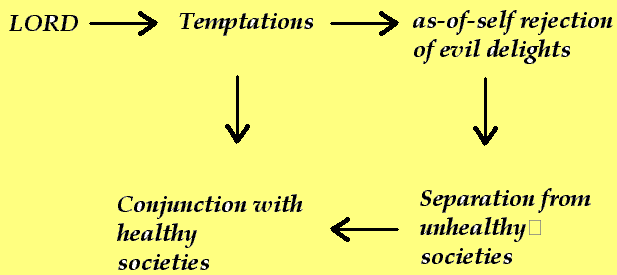
Note the expression "as-of-self" in the diagram just above (yellow), as it is one of the key concepts for moving from phase 2 personalism to phase 3 particularism. The car you're driving appears to move as-of-self, doesn't it. Many drivers talk to their cars in recognition of this appearance. Similarly, when we fight the battle of temptation, at whatever level, we're fighting as-of-self, but by ourself. The Lord alone has the power to fight and discipline the hells that are involved in temptations. And yet it is necessary to fight fighting as-of-self, without which there is no striving for good, no appropriation of goods or abilities from the Lord. This idea is crucial to keep at the center of our focus, so that we may avoid the deathly pitfalls of meritoriousness and belief in oneself as god.
So when we are facing a natural temptation, we cannot give up our delights without threat. So the Lord sees to it that the individual, whatever his or her religion, experiences believable threat along with the temptation, to help the individual along and to make it less hard to give up the forbidden delights. I use this phrase "forbidden delights" which has somewhat an arcane ring to it, to emphasize what's at stake: our soul. If you were taught that the devil is after you, and you believed it, you were not far from scientific actuality. If you look at the above diagram (in yellow), bottom right and left, you will see marked there the reality empirically observed by Swedenborg, that our thoughts and feelings cannot proceed on their own, but need influx from the vertical community in order to proceed. Without the direct and correspondential participation of others in the spiritual world in our thinking and feeling, the mental process stops as surely as being injected with a heavy dose of curare, and stops dead in its track, like a sinking anchor when it hits the bottom of the ocean.
During a temptation, the Lord stands still, ready to spring into helpful action, like an attentive nursemaid at the bedside of a woman in labor. In one moment He hooks us up with the evil societies He has brought up from hell into the spiritual world so that they may be in communication with our mind. We now have thoughts and emotions that correspond to their lusts and falsities. At this point in the temptation we are tottering. We are considering what it would be like to give in to the temptation. As we are thinking this, they are in the delight of their life, which is to oppose Good and Truth. They experience good and truth as searing threatening distasteful things from which they turn away, and the experience they have of turning away is delightful to them.
When they are brought up by the Lord from the hells in which they keep themselves hidden, they are suddenly in their greatest delight. This infernal delight is what we are also experiencing, simultaneously with them. This contiguity is so overpowering that we accept it as our own delight. In celestial temptations we are clearly aware of their presence as we are brought down into spiritual world and are made to face the spirits so we can see them as the source of the delight we're experiencing as-if from ourselves. And yet, despite this clear perception, the delight is so overpowering that we're willing to turn away from the Lord so that we may give ourselves over to that forbidden delight. But only for a brief moment, because the Lord then lines up the other forces.
There is a face off in our mind at the precise point in the spiritual world where the opposing spiritual soldiers are lined up against each other. Now we are aware of two opposing voices or emotions or justifications: the good vs. the evil, the true vs. the false. Actually, the evil allied with falsity vs. the good allied with truth. The Lord has matched them perfectly in terms of what we need in our mind in order to turn away from the evil and the false, and turn toward the good and the true.
It's a pure free will choice of love in total freedom.
The outcome is everything. The Lord cannot undo your choice, despite His Omnipotence. His infinite love and wisdom will not allow Him to interfere with your choice in a temptation. Why? Because if He did, you would be immeasurably worse off. Remember that He ceaselessly fights to save you from a worse hell than you have to be in. The cruelty of hellish existence and its horrendous inanities that appear bottomless, varies enormously, and so those who keep themselves in hell forever, are cared for by the Lord, lest they sink into bottomless cruelty and suffering. Honoring our choices in temptation is one of the Lord's protective policies.
Step 3:
If we choose right, we choose good, and then we can look in the face of evil
delights and they run from us, back into the hell they came from. The delights are
no longer irresistible. The Lord then jacks up the temptations, making them ever
more interior, bringing us to trial, therefore to the opportunity of deliverance and
salvation. At last we can look at our former delights which we found nearly
irresistible, and we can turn away from them, in disgust. We are then ready for the
next level of temptations.
| Life in the external
rational is a life of temptations in the sense that the Divine allows the external
rational to be in communication or consociation with those who inhabit mind's hell in
virtual reality. The Divine psychotherapy which goes on with each of us, and which is
called regeneration,
creates a spiritual balance between the forces of heaven streaming into the interior
rational, above us, and the forces of hell streaming into the external rational, below us.
Conscience above, temptations below. We choose according to the virtual power we pick up.
We navigate and rise upward by appropriating or loving the spiritual wisdom of conscience
in our interior rational memory. We navigate and sink downward by appropriating or loving
the spiritual insanity or delusion within temptations. This spiritual balance keeps us in
freedom so that we can choose what we love. What we love is the only thing that remains
permanently. Whatever we choose not in love, by coercion, does not remain, but dissipates.
Every time you resist temptations, you gain in virtual power. You ascend by the mechanism of consociating with inhabitants of higher regions in communal mind. Conscience is a virtual elevator. You soar upward when you resist temptations. Your will is being purified, healed. Soon the things you loved that gave you delight, lose their attractiveness. Eventually you hold them in aversion. You are healed of it. That temptation will no longer present itself. Yet there are others to succeed, for without temptations, says Swedenborg, no one can be regenerated. Thus it is that throughout life on earth we accumulate our choices in freedom. When we pass on, our choices have cumulatively created our virtual empire, and how we've chosen is how we'll live to eternity. The afterlife is a continuation of the direction we've taken in this life. A change of direction is not feasible since the weight of accumulated choices carries us onward, irresistibly, and seemingly as-of-self. Our own virtual power, accumulated through the choices, carries us forward, in whichever direction we are already traveling. Right living is therefore a matter of right choices. These choices occur moment by moment. We are to micro-manage ourselves so as to witness the battle of good and evil in our mind, moment by moment. Focus your attention on your eyes, for instance. Where do they habitually look? What do they automatically inspect, examine, linger on? This self-witnessing will reveal to you what your natural loves are. The external mind is composed of the corporeal/sensuous/external rational complex below us. Your loves in the external mind are located in negative virtual zones of communal mind. These are the loves we share with those who inhabit the hells of mind. They are already fully committed to those loves, but we, not yet. We can reject them by loving what's above us even more. This love above us, in conscience, is more virtuous, more excellent, more virtually powerful, more desirable. Original here, along with quotations from the Writings relating to Temptations. |
TCR 664Fourth Memorable Relation:- Once I looked toward the right in the spiritual world, and observed some of the elect conversing together. I approached them and said, "I saw you at a distance, and there was round about you a sphere of heavenly light, whereby I knew that you belonged to those who in the Word are called `the elect;' therefore I drew near that I might bear what heavenly subject you were talking about." They replied, "Why do you call us the elect?" I answered, "Because in the world, where I am in the body they have no other idea than that `the elect' in the Word mean those who are elected and predestined to heaven by God either before or after they are born, and that to such alone faith is given as a token of their election, and that the rest are held as reprobates, and are left to themselves, to go to hell whichever way they please. And yet I know that no election takes place before birth, nor after birth, but that all are elected and predestined to heaven, because all are called; also that after their death the Lord elects those who have lived well and believed aright; and this takes place after they have been examined. That this is so it has been granted me to learn by much observation. And because I saw that your heads were encircled by a sphere of heavenly light, I had a perception that you belonged to the elect who are preparing for heaven." To this they replied, "You are telling things never before heard. Who does not know that there is no man born who is not called to heaven, and that from them after death those are elected who have believed in the Lord and have lived according to His commandments; and that to acknowledge any other election is to accuse the Lord Himself not only of being impotent to save, but also of injustice?"
TCR 665I would be delighted to know your reactions. PleaseAfter this there was heard a voice out of heaven from the angels who were immediately above us, saying, "Come up hither, and we will question one of you (who is yet in the body in the natural world) what is there known about Conscience." And we went up; and when we had entered, some wise men came to meet us, and asked me, "What is known in your world about conscience?" I replied, "If you please, let us descend and call together both from the laity and clergy, a number of those who are esteemed wise; and we will stand directly beneath you and will question them; and thus with your own ears you will hear what they will answer." This was done; and one of the elect took a trumpet and sounded it toward the south, north, east, and west; and then after a brief hour so many were present as almost to fill the space of a square furlong. But the angels above arranged them all in four assemblies, one consisting of statesmen, another of scholars, a third of physicians, and a fourth of clergy men. When thus arranged, we said to them, "Pardon us for calling you together; we have done so because the angels who are directly above us are eager to know what you thought, while in the world in which you formerly were, about conscience, and thus what you still think about it, since you still retain your former ideas on such subjects; for it has been reported to the angels that in your world a knowledge of conscience is among the lost knowledges."
[2] After this we began, and turning first to the assembly composed of statesmen, we asked them to tell us from their hearts, if they were willing, what they had thought, and there fore what they still thought, about conscience. To this they replied one after another; and the sum of their replies was that they knew only that conscience is secum scire (a knowing within one's self), thus conscire (a being conscious) of what one has intended, thought, done and said. But we said, "We do not ask about the etymology of the word conscience, but about conscience." And they answered, "What is conscience but pain arising from anxiety about the loss of honor or wealth, and the loss of reputation on this account? But this pain is dispelled by feasts and cups of generous wine, as also by conversation about the sports of Venus and her bay."
[3] To this we replied, "You are jesting; tell us, if you please, whether any of you have felt any anxiety arising from any other source." They answered, "What other source? Is not the whole world like a stage on which every man acts his part, as the player does on his stage? We cajole and circumvent people, each by his own lust, some by jests, some by flattery, some by cunning, some by pretended friendship, some by feigned sincerity, and some by various political arts and allurements. From this we feel no mental pain, but on the contrary, cheerfulness and gladness, which we quietly but fully exhale from an expanded breast. We have heard indeed from some of our class, that an anxiety and a sense of constriction, as it were, of the heart and breast has sometimes come over them causing a sort of contraction of the mind; but when they asked the apothecaries about it, they were informed that their trouble came from a hypochondriacal humor arising from undigested substances in the stomach, or from a disordered state of the spleen; and we have heard that some of these were restored to their former cheerfulness by medicines."
[4] After hearing this, we turned to the assembly composed of scholars, among whom there were also some skilful naturalists, and addressing them, we said, "You who have studied the sciences, and therefore are supposed to be oracles of wisdom: tell us, if you please what conscience is." They answered, "What kind of a question for consideration is that? We have heard, indeed, that with some there is a sadness, gloom, and anxiety, which infest not only the gastric regions of the body, but also the abodes of the mind; for we believe that the two brains are those abodes, and because they consist of containing fibers, that there is some acrid humor, which irritates, gnaws and corrodes the fibers, and thus compresses the sphere of the mind's thoughts, so that it cannot flow forth into any of the enjoyments arising from variety. This causes a man to fix his attention upon one thing only, and this destroys the tension and elasticity of these fibers, so that they become numb and rigid. All this gives rise to an irregular motion of the animal spirits, which by physicians is called ataxy, and also a defective performance of their functions, which is called lipothymia. In a word, the mind is then situated as if it were beset by hostile forces, nor can it turn itself in any direction any more than a wheel fastened with nails, or a ship stuck fast in quicksands. Such oppression of mind and consequently of the chest, afflicts those whose ruling love suffers loss; for if this love is assaulted, the fibers of the brain contract, and this contraction prevents the mind from going out freely and partaking of the various forms of enjoyment. Hallucinations of various kinds, madness, and delirium, attack such persons during these crises, each according to his temperament, and some are affected with a brain sickness in religious matters, which they call remorse of conscience."
[5] After this we turned to the third assembly, which was composed of physicians, among whom were also some surgeons and apothecaries. And we said to them, "Perhaps you know what conscience is. Is it a grievous pain that seizes both the head and the parenchyma of the heart, and from these the subjacent regions, the epigastric and hypogastric? Or is it something else?" They replied, "Conscience is nothing but such a pain; we understand its origin better than others; for there are related diseases that affect the organic parts of the body and of the head, and consequently the mind, since this has its seat in the organs of the brain like a spider in the midst of the threads of its web, by means of which it runs out and about in a like manner. These diseases we call organic, and such of them as return at intervals we call chronic. But the pain which has been described to us by the sick as a pain of conscience, is nothing but hypochondria, which primarily affects the spleen, and secondarily the pancreas and mesentery, depriving them of their normal functions; hence arise stomachic diseases, from which comes deterioration of juices; for there takes place a compression about the orifice of the stomach, which is called cardialgia; from these diseases arise humors impregnated with black, yellow, or green bile, by which the smallest blood-vessels, which are called the capillaries, are obstructed; and this is the cause of cachexy, atrophy, and symphysia, also bastard pneumonia arising from sluggish pituitous matter, and ichorous and corroding lymph throughout the entire mass of the blood. Like consequences arise when pus makes its way into the blood and its serum from the breaking of pustules, boils, and swellings in the body. This blood, as it ascends through the carotids to the head, frets, corrodes and eats into the medullary and cortical substances, and the meninges of the brain, and thus excites the pains that are called pains of conscience."
[6] Hearing this we said to them, "You talk the language of Hippocrates and Galen; these things are Greek to us; we do not understand them. We did not ask you about these diseases, but about conscience, which pertains only to the mind." They said, "The diseases of the mind and those of the head are the same, and the latter ascend from the body; for there is a connection like the two stories of one house, between which is a stairway by which one can ascend or descend. We know therefore that the state of the mind depends inseparably on the state of the body; but we have cured these heavinesses of the head or headaches (which we take it are what you mean by troubles of conscience), some by plasters and blisters, some by infusions and emulsions, and some by stimulants and anodynes."
[7] When therefore we had heard more of this kind, we turned away from them and toward the clergy, saying, "You know what conscience is; tell us therefore and instruct those present." They replied, "What conscience is we know and we do not know. We have believed it to be the contrition that precedes election, that is, the moment when man is gifted with faith, through which he obtains a new heart and a new spirit, and is regenerated. But we have perceived that this contrition had pens to but few; only with some is there a fear and consequent anxiety about hell-fire, while scarcely any one is troubled about his sins and the consequent just anger of God. But we confessors have cured such by the gospel that Christ took away damnation by the passion of the cross and thus extinguished hell-fire and opened heaven to those who are blessed with the faith on which is inscribed the imputation of the merit of the Son of God. Moreover, there are conscientious persons of different religions, both true and fanatical, who make to themselves scruples about matters of salvation, both in things essential and in things formal, and even in what is indifferent. Therefore, as we have said before, we know that there is such a thing as conscience, but what and of what nature true conscience is, which must by all means be spiritual, we know not."
TCR 666
All these declarations made by the four assemblies were heard by the angels who were above us, and they said to each other, "We see that there is no one in Christendom who knows what conscience is; we will therefore send down from us one who will instruct them." And immediately there stood in their midst an angel in white clothing, around whose head appeared a bright band in which there were little stars. This angel addressing the four assemblies said, "We have heard in heaven that you have presented succession your opinions about conscience, and that you have all regarded it as some mental pain which infests the head with heaviness, and from that the body, or infests the body and from that the head. But conscience viewed in itself is not a pain, but a spiritual desire to act in accordance with whatever pertains to religion and faith. Hence it is that those who feel delight in conscience are in the tranquillity of peace and interior blessedness when they are acting in accordance with their conscience, and in a kind of perturbation when they are acting contrary to it. But the mental pain which you have believed to be conscience, is not conscience but temptation, which is a conflict of the spirit with the flesh; and this conflict, when it is spiritual, has its origin in conscience; but if it is natural merely, it has its origin in those diseases which the physicians have just recounted."
[2] "But what conscience is may be illustrated by examples; A priest who has a spiritual desire to teach truths in order that his flock may be saved, has conscience; but he who has any other end in view, does not have conscience. A judge who regards justice exclusively, and executes it with judgment, has conscience; but a judge who looks primarily to reward, friendship, or favor, has not conscience. Again, a man who has in his possession the property of another, the other not knowing it, and who is thus able without fear of the law or loss of honor and reputation, to keep it as his own, and yet, because it is not his, restores it to the other, has conscience, since he does what is just for the sake of what is just. So again, one who can obtain an office but who knows that another who is also seeking it would be more useful to society, and yields the place to him for the sake of the good of society, has a good conscience. So in other things.
[3] All who have conscience say whatever they say from the heart, and do whatever they do from the heart; for not having a divided mind they speak and act according to what they understand and believe to be true and good. From all this it follows that a more perfect con- science may exist with those who have more of the truths of faith than others, and who have a clearer perception than others, than is possible with those who are less enlightened and whose perception is obscure. A true conscience is the seat of man's spiritual life itself, for there his faith in conjoined with charity; therefore when such act from conscience they act from their spiritual life, but when they act contrary to conscience they act contrary to that life. Moreover, does not every one know from common speech what conscience is? When it is said of any one: `He has conscience, ' does not that also mean that he is a just man? But on the other hand, when it is said of any one, `He has no conscience' does it not mean that he is also unjust?"
[4] When the angel had said this he was immediately taken up into heaven; and the four assemblies came together as one; but when they had conversed together some time about the remarks of the angel, behold, they were again divided into four assemblies, but different from the former. One contained those who comprehended the words of the angels and assented to them; a second those who did not comprehend but still favored them; a third those who did not wish to comprehend them, saying, "What have we to do with conscience?" and a fourth those who laughed at what was said, saying, "What is conscience but a breath of wind?" And I saw the four bodies separating from one another, the two former passing to the right and the two latter to the left, these going downward, but the others upward. (end of Memorable Relation)
e-mail me now.
|








